Science & TechnologyS


Magic Hat

Caterpillar Fungus Making Tibetan Herders Rich

Harvesting of a parasitic fungus that grows high on the Tibetan Plateau in China is infusing hordes of cash into rural communities, scientists say.
Caterpillar Fungi Tibet
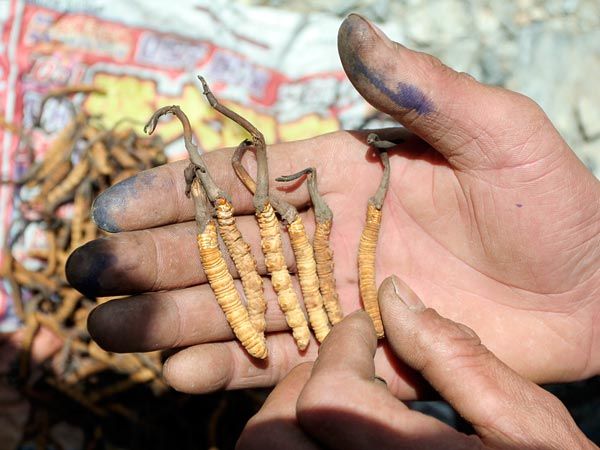
© ReutersA local resident holds caterpillar fungi in western China's Qinghai Province in May 2007.
The fungus, Ophiocordyceps sinensis, takes over the bodies of caterpillar larvae then shoots up like finger-size blades of grass out of the dead insects' heads.

Known as yartsa gunbu - or "summer grass winter worm" - by Chinese consumers, the nutty-tasting fungus is highly valued for its purported medicinal benefits, for instance, as a treatment for cancer and aging and as a libido booster. Far away in the booming cities of Beijing and Shanghai, demand for the fungus has soared.

"Medically, it seems to deliver," according to Daniel Winkler, a fungus researcher and head of Eco-Montane Consulting in Seattle, Washington.

"Even the whole thing that it's an aphrodisiac - yes, it might really help."

Some Chinese grind up the fungus and sell it as a powder, and others use it whole as a garnish - and therefore a display of wealth.

Question

Rare Green Flashes Captured From the Moon

Green Flashes
© ESO/G.HüdepohlGreen flashes from the setting Moon.
Green flashes from the Sun at sunset are a rare phenomenon, but even rarer are green flashes from a setting Moon. With the unique atmospheric conditions at Cerro Paranal in Chile, a photographer from ESO's Very Large Telescope managed to what are likely the best images ever taken of the Moon's green flash. ESO Photo Ambassador Gerhard Hüdepohl took a series of images of the setting full Moon crossing the horizon, taken on a clear early morning from the Paranal Residencia.

What happens that makes the green flashes appear?

The Earth's atmosphere bends, or refracts, light, like a giant prism. The effect is greater in the lower denser layers of the atmosphere, so rays of light from the Sun or Moon are curved slightly downwards. Shorter wavelengths of light are bent more than longer wavelengths, so that the green light from the Sun or Moon appears to be coming from a slightly higher position than the orange and red light, from the point of view of an observer. When the conditions are just right, with an additional mirage effect due to the temperature gradient in the atmosphere, the elusive green flash is briefly visible at the upper edge of the solar or lunar disc when it is close to the horizon.

Meteor

Cosmic collision: Nasa monitors unusually bright asteroid after 11,000mph impact

An unexpectedly bright asteroid that sported short-lived plumes had collided with a smaller body, scientists have said.

The aftermath of the impact on Scheila was first spotted by the University of Arrizona's Catalina Sky Survey on December 11 last year.

It revealed Scheila to be twice as bright as expected and immersed in a faint comet-like glow.

Image
© NASACollision: Faint dust plumes bookend asteroid Scheila in this composite taken by Nasa's Swift satellite on December 15 last year when it was 232million miles from Earth
Looking through the survey's archived images, astronomers inferred the outburst began between November 11 and December 3.

Data from Nasa's Swift satellite and Hubble Space Telescope then showed these changes likely occurred after Scheila was struck by a much smaller asteroid.

'Collisions between asteroids create rock fragments, from fine dust to huge boulders, that impact planets and their moons,' said lead Swift researcher Dennis Bodewits, from the University of Maryland.

'Yet this is the first time we've been able to catch one just weeks after the smash-up, long before the evidence fades away.'

Asteroids are rocky fragments thought to be debris from the formation and evolution of the solar system approximately 4.6billion years ago.

Comment: The article says: "Ejecta kicked up by Deep Impact contained lots of ice, and the absence of ice in Scheila's interior shows that it's entirely unlike comets." But perhaps it isn't entirely true, and comets are not the "dirty snowballs" we are led to believe by NASA scientists. Read Planet-X, Comets and Earth Changes by J.M. McCanney to learn more.


Attention

US: Geologists Solve Mystery of the Colorado Plateau

Image
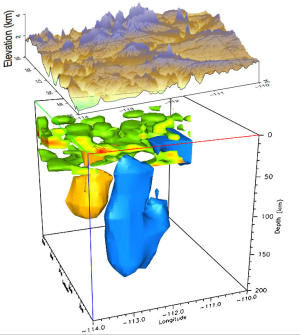
© Levander Lab/Rice University)A convective "drip" of lithosphere (blue) below the Colorado Plateau is due to delamination caused by rising, partially molten material from the asthenosphere (gold), as plotted by Rice University researchers and their colleagues and described in a new paper in the journal Nature.
A team of scientists led by Rice University has figured out why the Colorado Plateau -- a 130,000-square-mile region that straddles Colorado, Utah, Arizona and New Mexico -- is rising even while parts of its lower crust appear to be falling. The massive, tectonically stable region of the western United States has long puzzled geologists.

A paper published April 27 in the journal Nature shows how magmatic material from the depths slowly rises to invade the lithosphere -- Earth's crust and strong uppermost mantle. This movement forces layers to peel away and sink, said lead author Alan Levander, professor and the Carey Croneis Chair in Geology at Rice University.

The invading asthenosphere is two-faced. Deep in the upper mantle, between about 60 and 185 miles down, it's usually slightly less dense and much less viscous than the overlying mantle lithosphere of the tectonic plates; the plates there can move over its malleable surface.

But when the asthenosphere finds a means to, it can invade the lithosphere and erode it from the bottom up. The partially molten material expands and cools as it flows upward. It infiltrates the stronger lithosphere, where it solidifies and makes the brittle crust and uppermost mantle heavy enough to break away and sink. The buoyant asthenosphere then fills the space left above, where it expands and thus lifts the plateau.

Palette

Modern girls are born to plump for pink 'thanks to berry-gathering female ancestors'

Girls really do prefer pink - and not just because it is pretty.

Scientists have shown that females are drawn to pinks and reds and men to blues and greens - and they believe the explanation lies our hunter-gatherer past.

As the gatherers of the operation, women's brains became fine-tuned to the purples and reds of ripe fruits and berries.

Colour Pink Berries Ancient
Pink for a girl and blue for a boy: Scientists have shown a distinct gender preference for certain colours - and tired to explain why
The men, meanwhile, developed a preference for the clear blue skies that signalled good weather for hunting.

The theory comes from Chinese scientists who asked more than 350 students to study 11 colours for three minutes and then rank them in order of preference.

The students also underwent personality tests.

Saturn

Six Planets Now Aligned in the Dawn Sky

If you get up any morning for the next few weeks, you'll be treated to the sight of all the planets except Saturn arrayed along the ecliptic, the path of the sun through the sky.

six,planet
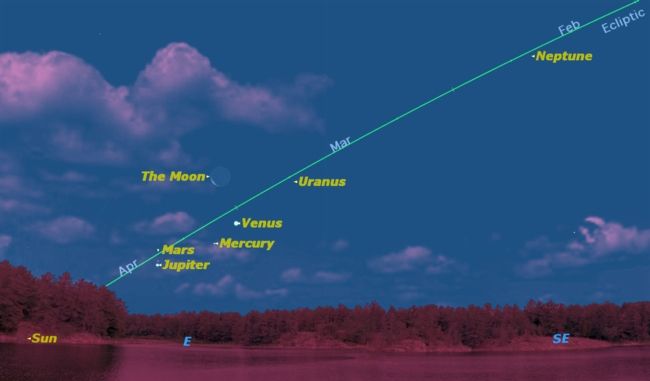
© Starry Night SoftwareSix planets and the waning crescent moon arrayed in the dawn sky on Saturday April 30, as seen from Los Angeles, California.
For the last two months, almost all the planets have been hiding behind the sun, but this week they all emerge and are arrayed in a grand line above the rising sun. Mercury, Venus, Mars, and Jupiter are visible, and you can add Uranus and Neptune to your count if you have binoculars or a small telescope.

This sky map of the six planets shows how they should appear at dawn to observers with clear weather and an unobstructed view.

People

Electrical oscillations critical for storing spatial memories in brain: study

Image
© University California/San DiegoRed dots signal the location of electrical impulses generated within this grid cell, which are needed for the brain to store information about the rat's physical environment.
Electrical oscillations found to be critical for storing spatial memories in brain

Biologists at UC San Diego have discovered that electrical oscillations in the brain, long thought to play a role in organizing cognitive functions such as memory, are critically important for the brain to store the information that allows us to navigate through our physical environment.

The scientists report in the April 29 issue of the journal Science that neurons called "grid cells" that create maps of the external environment in one portion of our brain require precisely timed electrical oscillations in order to function properly from another part of the brain that serves as a kind of neural pacemaker.

Meteor

SOTT Focus: A Pig in a Poke and the scars of a Wayward Comet


Comment: With all of the data we've gathered here on SOTT over the past several years showing an increase in fireball and meteor sightings, we believe that studying impact events and understanding the fallout from such events is a pursuit of supreme importance for all of humanity. While it may not be the most comforting thought to know that we live at the center of a cosmic turkey shoot, having knowledge of what may befall us at any time is better than having none at all. Knowledge, once applied, can ultimately protect, but having knowledge first is key. And mainstream geologists - who've instead chosen to bury their heads in the sand - have done little in terms of helping humanity understand or prepare for such disasters.

We recently featured the article A Different Kind of Catastrophe - Something Wicked This Way Comes by Dennis Cox where he lays out the evidence for impacts that don't conform to the usual crater formations. The following is part of an exchange we had with Dennis on this topic of mutual interest, and the problem of malfeasance in the Earth sciences towards catastrophic events. The interested reader may want to follow up on the suggestion offered at the bottom.

Cat Bag
© UnknownA pig in a poke or a cat in a bag? Mainstream science offers the latter when it comes to understanding catastrophic earth-changing events.

A couple of years ago, as a hobby, and pastime, I set out to see if I could work out a better way of identifying potential sites to go meteorite hunting. I had learned to do battle damage assessment from aerial reconnaissance photos a long time ago in the Army and the blast damage, and ground effects from an explosive event, are pretty much the same, no matter what the source of the explosion might be. It's only a question of scale, and explosive force. Visually, there is very little difference in the appearance of a bomb crater, and an impact crater of the same size. So the military style forensic technique of reading the patterns of movement in the emplacement of blast effected materials on the ground applies well in the search for potential impact related geology. The quality of the image data now commonly available to anyone with a good PC, an internet connection, and a copy of Google Earth, is excellent. In the past five years, the publicly available image data has really come into its own. And today's 21st century satellite imagery allows us to study the surface of the Earth at a level of detail our fathers could never have imagined.

Almost a century ago, using aerial photography, a geologist named Harlan Bretz noticed evidence for the mega-floods that sculpted the Grande Coulee, and the 'Channeled Scablands' of eastern Washington. What he had found, were the patterns of fluid flow, like the ripples you see in the sedimentary deposits of a stream bed, but these 'ripples' are hundreds of feet high. He saw them as empirical evidence of a major catastrophic flood event, on a scale that the standard theorists of his day thought was inconceivable.

Better Earth

Prehistoric Warming Mysteries

forest lake in summer
© Axel-D

A new research paper published in the journal Nature Geoscience has drawn attention to the possibility that the Earth may be able to recover quicker than anticipated from rising carbon dioxide emissions.

This new theory is based on data gathered from studying the end of the Palaeocene-Eocene Thermal Maximum, which took place some 56 million years ago, and constitutes an approximately 170,000 year long period of global warming that, sadly, has much in common with Earth's present-day conditions.

According to the research, the Earth increased its ability to pull carbon from the air, leading to a recovery that was quicker than models would have anticipated. That being said, the recovery is still measured in the order of tens of thousands of years.

"We found that more than half of the added carbon dioxide was pulled from the atmosphere within 30,000 to 40,000 years, which is one-third of the time span previously thought," said Gabriel Bowen, the associate professor of earth and atmospheric sciences who led the study and who also is a member of the Purdue Climate Change Research Center. "We still don't know exactly where this carbon went, but the evidence suggests it was a much more dynamic response than traditional models represent."

Toys

Titanic's Unknown Child Given New, Final Identity

Image
© Carol GoodwinA photograph of the baby Sidney Leslie Goodwin, who is now believed to be the Titanic's unknown child.
Five days after the passenger ship the Titanic sank, the crew of the rescue ship Mackay-Bennett pulled the body of a fair-haired, roughly 2-year-old boy out of the Atlantic Ocean on April 21, 1912. Along with many other victims, his body went to a cemetery in Halifax, Nova Scotia, where the crew of the Mackay-Bennett had a headstone dedicated to the "unknown child" placed over his grave.

When it sank, the Titanic took the lives of 1,497 of the 2,209 people aboard with it. Some bodies were recovered, but names remained elusive, while others are still missing. But researchers believe that they have finally resolved the identity of the unknown child -- concluding that he was 19-month-old Sidney Leslie Goodwin from England.

Though the unknown child was incorrectly identified twice before, researchers believe they have now conclusively determined the child was Goodwin. After his recovery, he was initially believed to be a 2-year-old Swedish boy, Gösta Leonard Pålsson, who was seen being washed overboard as the ship sank. This boy's mother, Alma Pålsson, was recovered with the tickets for all four of her children in her pocket, and buried in a grave behind the unknown child.

The effort to verify the child's identity using genetics began a little over a decade ago, when Ryan Parr, an adjunct professor at Lakehead University in Ontario who has worked with DNA extracted from ancient human remains, watched some videos about the Titanic.

"I thought 'Wow, I wonder if anyone is interested or still cares about the unidentified victims of the Titanic,'" Parr said.