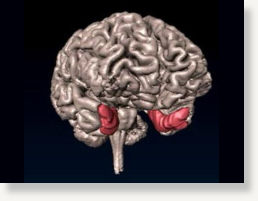
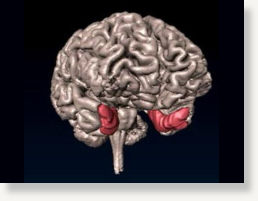
© Brain Observatory, UC San DiegoThe human brain
The UC San Diego Brain Observatory would like your brain, please. Especially if you can provide a detailed life history--or, best-case scenario, have already had your biography written--and are just a little strange in the head.
Can't feel fear? Can't form memories? Can't smell? These are traits of the people the Observatory already has on its rosters (they have 20 brains and 7 still-living donors), but director Jacopo Annese of UCSD is looking to recruit 1,000 more prospective donors this year. Apparently one brain he'd love to get his custom-made brain-slicing machinery on is Donald Trump's: The guy's had an unusual life,
he explains to Bloomberg News, and with more than 15 books and a reality show to his name, he is nothing if not well-documented.
The Observatory is the outfit that made news in 2009 when it added the brain of H.M., a famous amnesiac who could remember only the last 20 seconds, to its collection. (
The slicing process, which took two days and was streamed live, was watched by 400,000 people.) Established to study how ephemeral characteristics like personality, memory, and emotion are reflected in the physical structure of the brain, the Observatory records vast tracts of data about donors, from MRI images to cognitive tests to questionnaires, and, once the brains themselves are freed up, slices them into thousands of thin sheets and reconstructs them into computer models for study.











Comment: Also, consider another candidate for a 'noon-day star' of 29th of May,1630. One of the corollaries of the Nemesis (Planet X, brown dwarf) theory is that the dark companion might well become visible as a second sun in the sky when it was closest to the sun.
From Independence Day by Laura Knight-Jadczyk: Of course, the mentioned article was written over 8 years ago, and prior to the recent research by Martin Lunn and historian Lila Rakoczy. But it's SOTT editors current assessment that the hypothesis of the companion sun being a "noon-day sun" remains worthy of consideration.