Science & TechnologyS


Info

Comet Elenin: Preview of a Coming Attraction

Comet Elenin
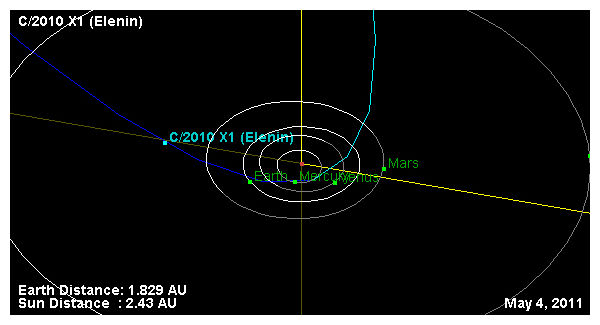
© NASA/JPL-CaltechTrajectory of comet Elenin.

You may have heard the news: Comet Elenin is coming to the inner-solar system this fall. Comet Elenin (also known by its astronomical name C/2010 X1), was first detected on Dec. 10, 2010 by Leonid Elenin, an observer in Lyubertsy, Russia, who made the discovery "remotely" using the ISON-NM observatory near Mayhill, New Mexico. At the time of the discovery, the comet was about 647 million kilometers (401 million miles) from Earth. Over the past four-and-a-half months, the comet has - as comets do - closed the distance to Earth's vicinity as it makes its way closer to perihelion (its closest point to the sun). As of May 4, Elenin's distance is about 274 million kilometers (170 million miles).

"That is what happens with these long-period comets that come in from way outside our planetary system," said Don Yeomans of NASA's Near-Earth Object Program Office at NASA's Jet Propulsion Laboratory in Pasadena, Calif. "They make these long, majestic, speedy arcs through our solar system, and sometimes they put on a great show. But not Elenin. Right now that comet looks kind of wimpy."

How does a NASA scientist define cometary wimpiness?

"We're talking about how a comet looks as it safely flies past us," said Yeomans. "Some cometary visitors arriving from beyond the planetary region - like Hale-Bopp in 1997 -- have really lit up the night sky where you can see them easily with the naked eye as they safely transit the inner-solar system. But Elenin is trending toward the other end of the spectrum. You'll probably need a good pair of binoculars, clear skies, and a dark, secluded location to see it even on its brightest night."

Question

Earth Fossils on the Moon -- Could They Unlock the Mystery of How Life Began?

The Moon
© JAXA

Research by a team of scientists at the University of London reinforced a theory that evidence of life on the early Earth might be found in rocks on the moon that were ejected during the Late Heavy Bombard period -- about four billion years ago when the Earth was subjected to a rain of asteroids and comets. Given that material from early Mars has been found in meteorites on Earth, it certainly seems reasonable that tens of thousands of tons of terrestrial meteorites may have arrived there during the Late Heavy Bombardment.
Research by a team under Ian Crawford and Emily Baldwin of the Birkbeck College School of Earth Sciences at the University of London in 2008 used sophisticated technology to simulate the pressures any such terrestrial meteorites might have experienced during their arrival on the lunar surface. In many cases, the pressures could be low enough to permit the survival of biological markers, making the lunar surface a productive place to look for evidence of early terrestrial life.

Any such markers are unlikely to remain on Earth, where they would have been erased long ago by more than three billion years of volcanic activity, later meteor impacts, or simple erosion by wind and rain.

However, meteorites arriving on Earth are decelerated by passing through our atmosphere. As a result, while the surface of the meteorite may melt, the interior is often preserved intact.
Could a meteorite from Earth survive a high-velocity impact on the lunar surface? Crawford and Baldwin used finite element analysis to simulate the behavior of two different types of meteors impacting the lunar surface.

Einstein

Gravity Probe B Confirms Two of Einstein's Space-Time Theories

Schiff Equation
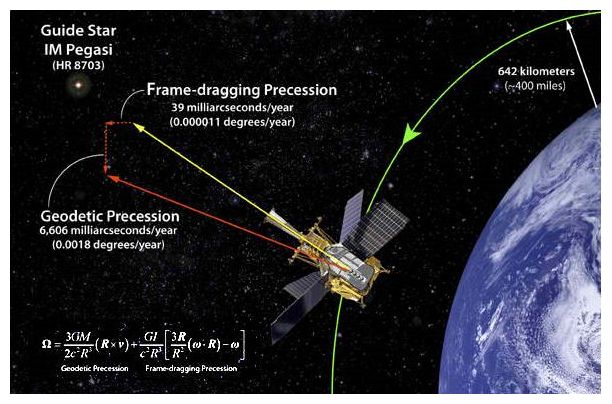
© Stanford UniversityEinstein's predicted geodetic and frame-dragging effects, and the Schiff Equation for calculating them.

Researchers have confirmed two predictions of Albert Einstein's general theory of relativity, concluding one of NASA's longest-running projects. The Gravity Probe B experiment used four ultra-precise gyroscopes housed in an Earth-orbiting satellite to measure two aspects of Einstein's theory about gravity. The first is the geodetic effect, or the warping of space and time around a gravitational body. The second is frame-dragging, which is the amount a spinning object pulls space and time with it as it rotates.

Gravity Probe-B determined both effects with unprecedented precision by pointing at a single star, IM Pegasi, while in a polar orbit around Earth. If gravity did not affect space and time, GP-B's gyroscopes would point in the same direction forever while in orbit. But in confirmation of Einstein's theories, the gyroscopes experienced measurable, minute changes in the direction of their spin, while Earth's gravity pulled at them.

The project as been in the works for 52 years.

The findings are online in the journal Physical Review Letters.

Telescope

Electrical Link Lights Bright Spot in Saturn's Atmosphere

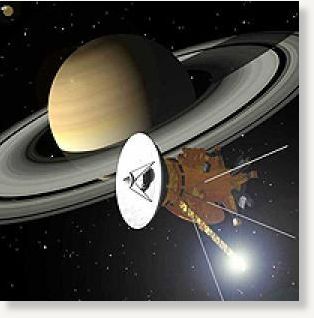
Cassini spacecraft approaching Saturn.
© NASACassini spacecraft approaching Saturn
Scientists studying Saturn have detected a glowing patch of ultraviolet light that marks the presence of an electrical circuit connecting the planet with its moon Enceladus, they report today in the journal Nature.

Long theorized, but not previously seen, the newly discovered bright patch indicates that electrically charged particles travel between Saturn and Enceladus, interacting with the planet's magnetic field lines. This makes a glowing patch near the planet's north pole, caused by a similar phenomenon to the northern and southern lights ( or aurora ) on Earth.

Sun

Solar Dynamics Observatory see mountains on the Moon

There was no eclipse on Earth, today, but there was one in Earth orbit. More than 22,000 miles above the planet's surface, NASA's Solar Dynamics Observatory watched the Moon pass almost directly in front of the sun:

Image
© NASA/SDO
Look at the full-sized image and trace your finger around the Moon's limb. Thanks to the high resolution of SDO's 16 megapixel cameras, you can actually count jagged mountains backlit by the sun's atmosphere.

Beyond the novelty of observing a such an event from space, these images have practical value to the SDO science team. Karel Schrijver of Lockheed-Martin's Solar and Astrophysics Lab explains: "The very sharp edge of the lunar limb allows us to measure the in-orbit characteristics of the telescope--e.g., light diffraction on optics and filter support grids. Once these are characterized, we can use that information to correct our data for instrumental effects and sharpen up the images to even more detail."

Magic Wand

Researchers discover mechanism that could convert certain cells into insulin-making cells

Findings of UCLA study hold promise for fight against diabetes.

Simply put, people develop diabetes because they don't have enough pancreatic beta cells to produce the insulin necessary to regulate their blood sugar levels.

But what if other cells in the body could be coaxed into becoming pancreatic beta cells? Could we potentially cure diabetes?

Researchers from UCLA's Larry L. Hillblom Islet Research Center have taken an important step in that direction. They report in the April issue of the journal Developmental Cell that they may have discovered the underlying mechanism that could convert other cell types into pancreatic beta cells.

While the current standard of treatment for diabetes - insulin therapy - helps patients maintain sugar levels, it isn't perfect, and many patients remain at high risk of developing a variety of medical complications. Replenishing lost beta cells could serve as a more permanent solution, both for those who have lost such cells due to an immune assault (Type 1 diabetes) and those who acquire diabetes later in life due to insulin resistance (Type 2).

"Our work shows that beta cells and related endocrine cells can easily be converted into each other," said study co-author Dr. Anil Bhushan, an associate professor of medicine in the endocrinology division at the David Geffen School of Medicine at UCLA and in the UCLA Department of Molecular, Cell and Developmental Biology.

Evil Rays

Report cites "liquefaction" as key to much of Japanese earthquake damage


The report this story is based on is available online here.

The massive subduction zone earthquake in Japan caused a significant level of soil "liquefaction" that has surprised researchers with its widespread severity, a new analysis shows.

The findings also raise questions about whether existing building codes and engineering technologies are adequately accounting for this phenomenon in other vulnerable locations, which in the U.S. include Portland, Ore., parts of the Willamette Valley and other areas of Oregon, Washington and California.

A preliminary report about some of the damage in Japan has just been concluded by the Geotechnical Extreme Events Reconnaissance, or GEER advance team, in work supported by the National Science Foundation.

The broad geographic extent of the liquefaction over hundreds of miles was daunting to experienced engineers who are accustomed to seeing disaster sites, including the recent earthquakes in Chile and New Zealand.

"We've seen localized examples of soil liquefaction as extreme as this before, but the distance and extent of damage in Japan were unusually severe," said Scott Ashford, a professor of geotechnical engineering at Oregon State University and a member of this research team.

Einstein

Girl Scout Team Patents Prosthetic Hand Device, Helping a Toddler Write For the First Time

Danielle
© Girl ScoutsDanielle and the BOB-1 via Girl Scouts.

Proving that the FIRST program is much more than games of robotic awesomeness, a team of Girl Scouts in Iowa engineered a prosthetic device that allowed a Georgia toddler to write for the first time. The device won an inaugural X Prize Global Innovation Award and the team has applied for a patent.

The Flying Monkeys robotics team from Ames, Iowa, developed a prosthetic tool for a 3-year-old girl who was born without fingers on her dominant hand. The device, called the BOB-1, allowed young Danielle to hold a pencil and draw for the first time, according to the Girl Scouts. The team hopes the invention could help others with hand abnormalities or injuries hold and stabilize a wide range of items.

The Flying Monkeys, who are all between 11 and 13 years old, built the BOB-1 as part of the FIRST Lego League, a robotics competition for middle school students. One of the team members has a limb deficiency that inspired their work.

The Girl Scouts visited a prosthetics manufacturer and an occupational therapist to learn about existing prosthetics, and they learned they're expensive and cumbersome, so they wanted to build something that was simple to put on and use. The BOB-1 involves a plastic platform attached to a user's arm, with a perpendicular piece that can grip a pencil or another utensil.

Info

Eye of the Storm: Incredible 'New' Image Shows Jupiter's Great Red Spot in Unprecedented Detail

This amazing image shows Jupiter's Great Red Spot in unprecedented detail.

Collated from data gathered over 30 years ago, the recently completed image has undergone digital enhancement.

Now it is possible to clearly see the Great Red Spot, a hurricane twice the size of Earth that has been raging for longer than telescopes have been able to view it.

Red Spot
© NASA / JPLJupiter's Great Red Spot: The hurricane is twice the size of Earth and has been raging for longer than telescopes have been able to view it. This digitally enhanced image was collated from data sent back by Voyager 1 in 1979.
The image data was taken by Voyager 1 during a fly-by in 1979.

Nasa launched Voyager 1 in 1977 and, 34 years later, it is currently making its way towards the outer edges of our solar system.

Info

The Winners of Mass Extinction: With Predators Gone, Prey Thrives

Marine Ecosystem
© Art by Robert NichollsThis is an artist's rendering of a shallow marine ecosystem during the early Carboniferous Period (359-318 million years ago). Crinoids include the camerates Dizygocrinus (under attack, bottom center, left) and the spiny Dorycrinus (bottom center, right), and the cladids Decadocrinus (bottom left) and Abrotocrinus (bottom right). Fishes include the cochliodont Deltoptychius (bottom center), the petalodont Janassa (left of center, ventral view), the chondrenchelyiform Chondrenchelys (far left), and the actinopterygian Amphicentrum (upper right).

In modern ecology, the removal or addition of a predator to an ecosystem can produce dramatic changes in the population of prey species. For the first time, scientists have observed the same dynamics in the fossil record, thanks to a mass extinction that decimated ocean life 360 million years ago.

What was bad for fish was good for the fish's food, according to a paper published today in Proceedings of the National Academy of Sciences. Researchers from the University of Chicago, West Virginia University, and The Ohio State University find that the mass extinction known as the Hangenberg event produced a "natural experiment" in the fossil record with results that mirror modern observations about predator-prey relationships.

"This is the first time that specific, long-term predator-prey interactions have been seen in the fossil record," said Lauren Sallan, graduate student in the Department of Organismal Biology and Anatomy at the University of Chicago and lead author. "It tells us a lot about the recovery from mass extinctions, especially mass extinctions that involved a loss of predators."

Paleontologists know the Devonian Period, which spanned from 416 to 359 million years ago, as the Age of Fishes, a time of astonishing diversity for marine vertebrate species. That thriving world was devastated by the Hangenberg event, a mass extinction of unknown origin that set the stage for modern biodiversity.

But some species survived the carnage of the Hangenberg event. The next 15 million years in the fossil record are dominated by crinoids, species similar to modern sea lilies and related to starfish. So abundant and diverse were these marine animals that the period is known as the Age of the Crinoids; entire limestone deposits from the era are made up of crinoid fossils.