Science & TechnologyS


Info

Divers Attempt to Communicate With Wild Dolphins, Using A Two-Way Translation Device

Dolphins
© Wikimedia CommonsAtlantic Spotted Dolphins. So long, and thanks for all the fish.
Dolphins can understand more than 100 words, decipher human instructions and even use iPads to learn basic communication skills. But that's kind of unfair on the part of us humans, don't you think? Shouldn't dolphins be able to ask for more smelt without learning our sign language or using our gadgets?

A researcher in Florida aims to meet the mammals in the middle, creating a new language that both humans and dolphins can understand.

Denise Herzing, founder of the Wild Dolphin Project in Jupiter, Fla., and Thad Starner, an artificial intelligence researcher at Georgia Tech, developed a project called Cetacean Hearing and Telemetry (CHAT). Researchers will test a prototype device this summer, reports New Scientist.

It involves a small computer encased in a waterproof shell and two hydrophones capable of detecting the full frequency of dolphin sounds, which can be up to 10 times higher than the highest pitch a person can hear. A diver will strap the computer to his or her chest, using a handheld device to select which sound to make in reply.

Info

Alien Superfluids That Can Climb Upwards Detected at Core of Supernova Neutron Star

Cassiopeia A
© The Daily GalaxyThis image presents a beautiful composite of X-rays from Chandra (red, green, and blue) and optical data from Hubble (gold) of Cassiopeia A, the remains of a massive star that exploded in a supernova.
Evidence for a bizarre state of matter has been found in the dense core of the star left behind, a so-called neutron star, based on cooling observed over a decade of Chandra observations. NASA's Chandra X-ray Observatory discovered the first direct evidence for a superfluid, a bizarre, friction-free state of matter, at the core of Cassiopeia A. Superfluids created in laboratories on Earth exhibit remarkable properties, such as the ability to climb upward and escape airtight containers. The finding has important implications for understanding nuclear interactions in matter at the highest known densities.

Neutron stars contain the densest known matter that is directly observable. One teaspoon of neutron star material weighs six billion tons. The pressure in the star's core is so high that most of the charged particles, electrons and protons, merge, resulting in a star composed mostly of uncharged particles called neutrons.

Two independent research teams studied the supernova remnant Cassiopeia A, or Cas A for short, the remains of a massive star 11,000 light years away that would have appeared to explode about 330 years ago as observed from Earth. Chandra data found a rapid decline in the temperature of the ultra-dense neutron star that remained after the supernova, showing that it had cooled by about four percent over a 10-year period.

Info

A Cometary Case for Titan's Atmosphere

Titan's Atmosphere
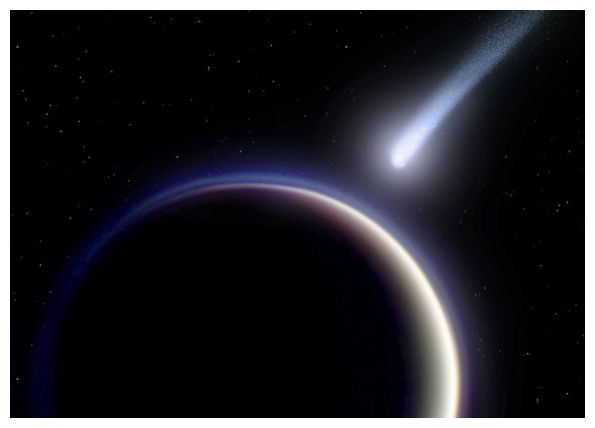
© NASA / JPL / SSI and Caltech/UCLA.Ancient comets may have created Titan's nitrogen-rich atmosphere. This image is a combination of a color-composite of Titan made from raw Cassini data taken on October 12, 2010 and a recolored infrared image of the comet Siding Spring, taken by NASA’s WISE observatory on January 10, 2010. The background stars were also taken by the Cassini orbiter.

Titan is a fascinating world to planetary scientists. Although it's a moon of Saturn it boasts an opaque atmosphere ten times thicker than Earth's and a hydrologic cycle similar to our own - except with frigid liquid methane as the key component instead of water. Titan has even been called a living model of early Earth, even insofar as containing large amounts of nitrogen in its atmosphere much like our own. Scientists have wondered at the source of Titan's nitrogen-rich atmosphere, and now a team at the University of Tokyo has offered up an intriguing answer: it may have come from comets.

Traditional models have assumed that Titan's atmosphere was created by volcanic activity or the effect of solar UV radiation. But these rely on Titan having been much warmer in the past than it is now...a scenario that Cassini mission scientists don't think is the case.

New research suggests that comet impacts during a period called the Late Heavy Bombardment - a time nearly 4 billion years ago when collisions by large bodies such as comets and asteroids were occurring regularly among worlds in our solar system - may have generated Titan's nitrogen atmosphere. By firing lasers into ammonia-and-water-ice material similar to what would have been found on primordial Titan, researchers saw that nitrogen was a typical result. Over the millennia these impacts could have created enough nitrogen to cover the moon in a dense haze, forming the thick atmosphere we see today.

Bizarro Earth

Millions Face High Risk of Deadly Andes Quake

Andes Mountains
© NASAMore than 7,000 kilometers (4,400 miles) long and more than 500 kilometers (300 miles) wide in places, the Andes Mountains encompass a wide range of climates and habitats, from snow-capped mountain peaks to rainforests to high deserts. This picture, acquired by NASA’s Landsat 7 satellite, shows a dramatic change in landscape about 250 kilometers southeast of la Paz, the capital of Bolivia.

Millions of people living near the Andes Mountains face a significantly higher risk of a giant earthquake than previously thought, and such a temblor could be more than 10 times stronger than anything the region has expected in the past.

Scientists investigated the Subandean margin along the eastern flank of the Andes Mountains, an area that includes Bolivia. A recent hazard assessment estimated a maximum earthquake there of magnitude 7.5.

Now, however, researchers unexpectedly find that a giant quake of up to magnitude 8.9 is possible, threatening more than 2 million people living in the area, where the infrastructure is not designed for a temblor that big.

"If the entire fault below the Subandes were to rupture, you can get a lot of damage," researcher Benjamin Brooks, a geodesist at the University of Hawaii in Honolulu, told OurAmazingPlanet. "It could be like a combination of the 2010 earthquake in Chile, which was very powerful, with the 2010 earthquake in Haiti, which hit a place with inadequate building standards."

The scientists used global positioning satellite data to map movement of the Earth's surface in the Subandean margin. They discovered that west-to-east surface movements measure 2 to 10 millimeters less per year over a stretch up to about 60 miles long (100 kilometers) than in the area's surroundings.

Saturn

Super-Civilizations Might Live Off Black Holes

Image
© NASA
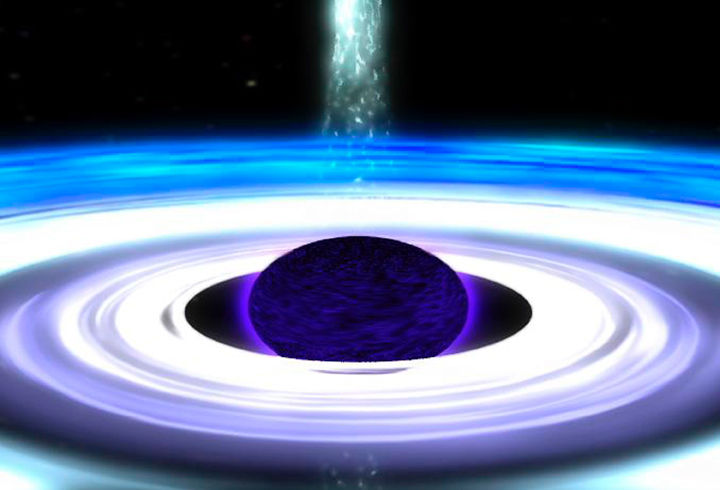
The sad unplugging of the Allen Telescope Array due to lack of funding brings a screeching halt, at least temporarily, to the most ambitious search for "hello" radio transmissions from E.T.

But perhaps it's time to simply think far outside of the box regarding our preconceptions of how to find extraterrestrial civilizations, says Clement Vidal of the Evolution, Complexity and Cognition group at the Vrije Universiteit Brussel. And, the most advanced aliens may be the easiest to find.

Info

Heidelberg Man Links Humans, Neanderthals

Image
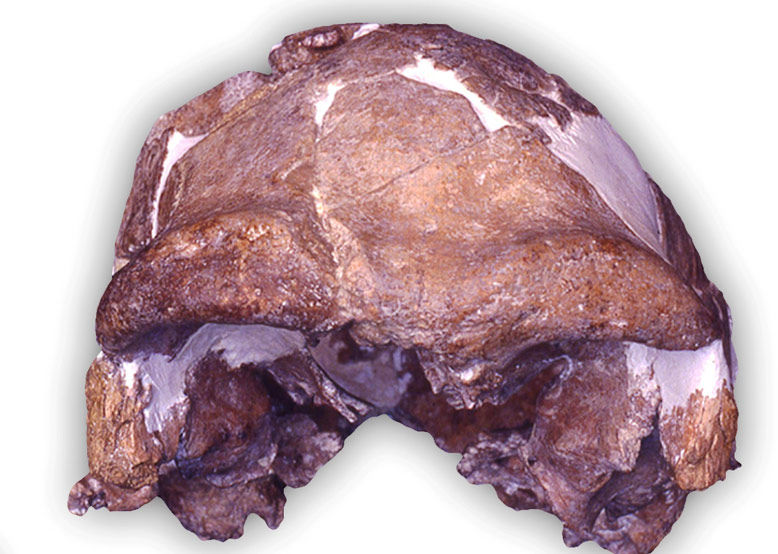
© Silvana CondemiWhile many eyes are on Heidelberg Man as being the likely common ancestor to Neanderthals and our species, the jury is still out as to where that pivotal evolution took place.
The last common ancestor of humans and Neanderthals was a tall, well-traveled species called Heidelberg Man, according to a new PLoS One study.

The determination is based on the remains of a single Heidelberg Man (Homo heidelbergensis) known as "Ceprano," named after the town near Rome, Italy, where his fossil -- a partial cranium -- was found.

Magnify

Repugnant plant not really a plant at all, but still mysterious

Image
"Starfish stinkhorn", Aseroe rubra
Shocking, vile, outrageous, repellent, bizarre or just plain gross - take your pick of any number of adjectives for this thing. The scientific name may be translated as "disgusting" and "red."

Of course, it is not a plant at all, but a fungus. This week's mystery may not be a plant, but it is still mysterious! (At one time, all organisms on earth were presumed to be either plant or animal, but considerable scientific research has modified this scheme to include other groups. Although they are not true plants, the study of fungi remains a component of botany.)

Our fungus is one of the fascinating members of the stinkhorn group, which are related to familiar mushrooms and puffballs. All of the stinkhorns are characterized by producing a strong odor at the time their spores are shed, and this one is no exception.

Einstein

I control therefore I am: chimps self-aware, says study

Image
arge

File photo of three female chimpanzees at the Taronga Zoo in Sydney

The findings, reported in the Proceedings of the Royal Society B, challenge assumptions about the boundary between human and non-human, and shed light on the evolutionary origins of consciousness, the researchers said.

Earlier research had demonstrated the capacity of several species of primates, as well as dolphins, to recognize themselves in a mirror, suggesting a fairly sophisticated sense of self.

The most common experiment consisted of marking an animal with paint in a place -- such as the face -- that it could only perceive while looking at its reflection.

If the ape sought to touch or wipe off the mark while facing a mirror, it showed that the animal recognised itself.

Beaker

HBOC201: The synthetic blood that saved Australian woman's life

Image
© Craig BorrowA last-ditch effort to save Mrs Coakley's life led to 10 units of the haemoglobin-based oxygen carrier, called HBOC-201 to be flown in from the US

An Australian woman's life has been saved using a radical synthetic blood substitute made from cow plasma.

In a world first, doctors at The Alfred Hospital in Melbourne brought 33-year-old Tamara Coakley back from the brink after a car crash left her with severe blood loss and close to heart failure.

Her spinal cord was almost severed, her lungs collapsed, her skull was fractured, several ribs were broken, as were her cheekbone and an elbow, and her spleen was ruptured.

She was barely alive when she arrived at hospital.

"I had one litre of blood left in my body," she said.

In a last-ditch effort to save Ms Coakley's life, 10 units of the haemoglobin-based oxygen carrier HBOC201 were flown in from the US.

The synthetic contains a molecule derived from cow plasma and restored her levels of haemoglobin, which carries oxygen to the tissues.

Question

Oregon Woman Has Foreign Accent After Dental Surgery

Dental Tools
© RedOrbit
A 56-year-old Oregon woman awoke from sedation after dental implant surgery speaking in a British accent, in what some say may be a case of 'foreign accent syndrome' -- a rare, but very real, speech disorder.

Appearing Thursday on NBC's Today show, Karen Butler of Toledo, OR, described the accent as an odd mixture of Irish, Scottish and northern British, with perhaps a dash of Australian and South African.

"And I can't make it be something that it isn't. You can pretend to have a southern drawl and talk like John Wayne; I can't," she said.

"Whatever pops out of my mouth is what pops out."

"At first we assumed it was because of all of the swelling," Butler said during an interview with ABC news, referring to her initial symptoms following her surgery 18 months ago.

"But within a week the swelling went down and the accent stayed," she said.

Butler may have something known as foreign accent syndrome, a condition so uncommon that only 60 cases have been documented worldwide.

The disorder is often preceded by a minor stroke, with the new accent thought to derive from a minor injury to a tiny part of the brain responsible for language pattern and tone.