Science & TechnologyS


Dollar

Direct Air Capture Is Pricey Fix for Climate Change

Capturing carbon dioxide in the Earth's atmosphere makes little sense compared to dealing with greenhouse gas sources such as coal and natural gas power plants, according to a new report. But direct air capture might prove more cost-effective down the road.

Scrubbing CO2 from the smokestack of a coal power plant costs about $80 per metric ton, whereas removing a metric ton of CO2 from the atmosphere might cost an estimated $600 under optimistic scenarios. That's because the CO2 emissions from power plants have 300 times greater concentration than the CO2 in the atmosphere.

Chalkboard

Doppler effect found even at molecular level - 169 years after its discovery

doppler effect rotational
Whether they know it or not, anyone who's ever gotten a speeding ticket after zooming by a radar gun has experienced the Doppler effect - a measurable shift in the frequency of radiation based on the motion of an object, which in this case is your car doing 45 miles an hour in a 30-mph zone.

But for the first time, scientists have experimentally shown a different version of the Doppler effect at a much, much smaller level - the rotation of an individual molecule. Prior to this such an effect had been theorized, but it took a complex experiment with a synchrotron to prove it's for real.

"Some of us thought of this some time ago, but it's very difficult to show experimentally," said T. Darrah Thomas, a professor emeritus of chemistry at Oregon State University and part of an international research team that today announced its findings in Physical Review Letters, a professional journal.

Most illustrations of the Doppler effect are called "translational," meaning the change in frequency of light or sound when one object moves away from the other in a straight line, like a car passing a radar gun. The basic concept has been understood since an Austrian physicist named Christian Doppler first proposed it in 1842.

But a similar effect can be observed when something rotates as well, scientists say.

Igloo

EPA Whistleblower Criticizes Global Warming in Peer-Reviewed Study

Claims of Catastrophic Warming Are Overwhelmingly Contradicted By Real-World Data

The scientific hypotheses underlying global warming alarmism are overwhelmingly contradicted by real-world data, and for that reason economic studies on the alleged benefits of controlling greenhouse gas emissions are baseless. That's the finding of a new peer-reviewed report by a former EPA whistleblower.

Dr. Alan Carlin, now retired, was a career environmental economist at EPA when CEI (Competitive Enterprise Institute) broke the story of his negative report on the agency's proposal to regulate greenhouse gases in June, 2009. Dr. Carlin's supervisor had ordered him to keep quiet about the report and to stop working on global warming issues. EPA's attempt to silence Dr. Carlin became a highly-publicized embarrassment to the agency, given Administrator Lisa Jackson's supposed commitment to transparency.

Dr. Carlin's new study, A Multidisciplinary, Science-Based Approach to the Economics of Climate Change, is published in the International Journal of Environmental Research and Public Health. It finds that fossil fuel use has little impact on atmospheric CO2 levels. Moreover, the claim that atmospheric CO2 has a strong positive feedback effect on temperature is contradicted on several grounds, ranging from low atmospheric sensitivity to volcanic eruptions, to the lack of ocean heating and the absence of a predicted tropical "hot spot."

Sun

UBC lab seeks process to convert greenhouse gas emissions to fuel

Image
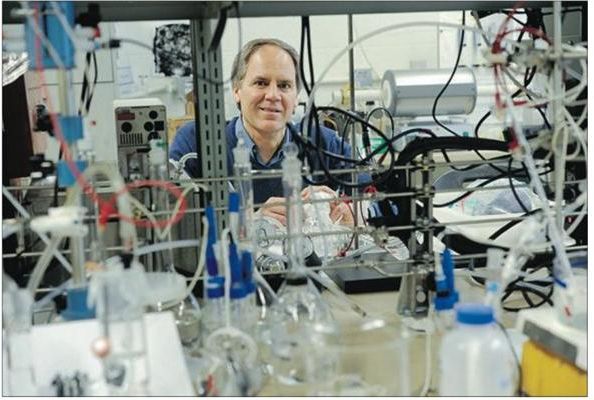
© Jason Payne, PNG, Vancouver SunDavid Wilkinson of UBC's Clean Energy Research Centre is working to lower CO2 emissions by converting the gas into methane, methanol and other chemicals for combustion or electric cells.
Catalyst could use solar radiation to create carbon-neutral source.

University of B.C. scientists are working to harness the sun's energy to power a process that converts the planet-threatening greenhouse gas carbon dioxide into a useful fuel.

David Wilkinson, executive director of the Clean Energy Research Centre at UBC, says concentrated CO2 emissions from power plants combined with water can be converted to methane, methanol, formic acid and other fuels suitable for combustion or electric cells using known chemical processes.

Question

Huge Gamma-ray Flares Mystify World's Astronomers

Crab Nebula
© The Daily Galaxy
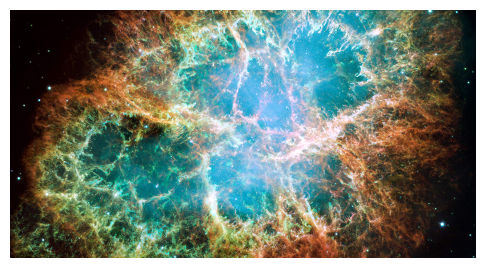
The Crab Nebula has stunned astronomers by emitting an unprecedented blast of gamma rays, the highest-energy light in the Universe, from a small area of the famous nebula. The cause of the 12 April gamma-ray flare, which lasted for some six days, hitting levels 30 times higher than normal and varying at times from hour to hour, described at the Third Fermi Symposium in Rome, is a complete and total mystery. The Crab's recent outburst is more than five times more intense than any yet observed.

Nasa's Fermi space observatory is designed to measure only gamma rays, that emanate from the Universe's most extreme environments and violent processes. Since its launch nearly three years ago, Fermi has spotted three such outbursts, with the first two reported earlier this year at the American Astronomical Society meeting.

The Crab Nebula is composed mainly of the remnant of a supernova, which was seen on Earth to explode in the year 1054. At the core of the brilliantly coloured gas cloud is a pulsar - a rapidly spinning neutron star that emits radio waves which sweep past the Earth 30 times per second. But so far none of the nebula's known components can explain the signal Fermi sees, said Roger Blandford, director of the Kavli Institute for Particle Astrophysics and Cosmology, US.

Info

The Human Body, Searchable in 3-D

3D Anatomical Views
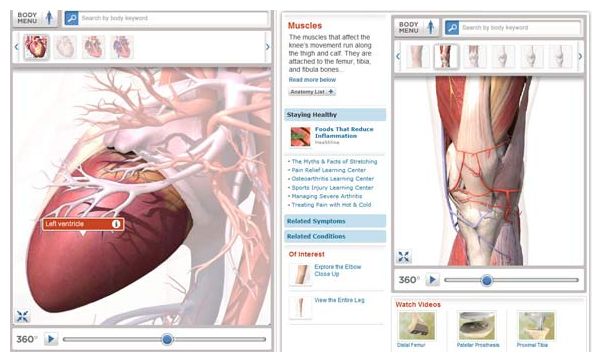
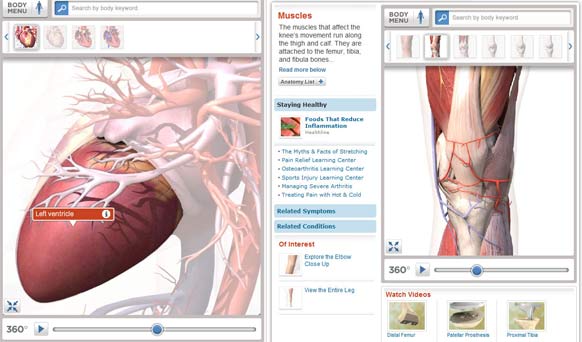
© Healthline and GE Healthyimagine Anatomical views: BodyMaps, a 3-D visual search tool, allows a user to search and navigate the human body. Shown at left is the left ventricle of the heart. Pop-up text gives definitions, descriptions, and common conditions. At right, the “deep muscle” view of the knee shows layers of the body from the skin and muscles down to the arteries, vessels, and bones.

The first online 3-D interactive search tool of the human body was released today. It allows a user to view and navigate the human anatomy, male or female, down to the finest detail - from the muscles and deep muscles to the nerves, arteries, vessels, and bones. This new tool, called BodyMaps, was developed by Healthline Networks, a company that provides medical information to consumers online, and GE Healthyimagination, a Web-based platform that shares and promotes projects that focus on consumer health, such as apps or healthy how-to videos.

BodyMaps is a consumer tool developed to educate the user on health conditions or medical ailments. At the center of the BodyMaps page is a 3-D image of the body; at left is textual information about the body section being shown. As a user mouses over the text, the section of the body in the image is highlighted, and vice versa if a user mouses over the image. At the bottom is a scrubber that lets the user rotate the body 360 degrees. The page also features videos, tips on staying healthy, information on symptoms and conditions, and a definition of the section in view.

The user can select a body region to explore by clicking the text or image, or by using the search tool. Selecting shoulders generated a crisp, high-definition 3-D image of the shoulder section, starting at the skin level, with the option to click through to see the muscles, nerves and vessels, and bone. Choosing the deltoid muscle, a definition popped up and the remaining muscles were shaded out. An option to read more provided a lengthy definition and description of the muscle, including common injuries and their causes and symptoms.

Question

Destroyer of Galaxies Discovered: Hyper Cosmic Storms

Galaxy with Molecular Flow
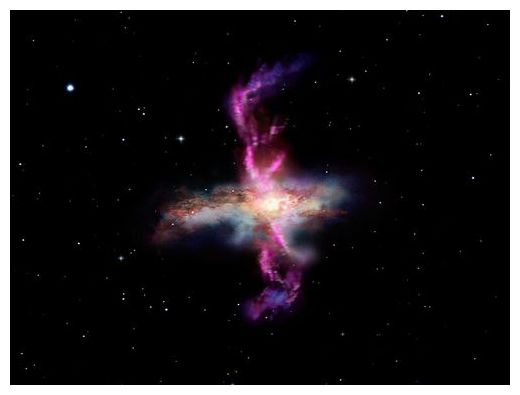
© ESA/AOES MedialabAn artist’s impression showing a galaxy with a molecular outflow. Herschel has discovered that such outflows can travel at 1000 km/s, which could deplete the galaxy of the gas needed for further star formation within one million to 100 million years.
The European Space Agency's Herschel infrared space observatory has detected raging winds of molecular gas streaming away from galaxies. Suspected for years, these outflows may have the power to strip galaxies of gas and halt star formation in its tracks.

The winds that Herschel has detected are extraordinary, some blowing at a speed of more than 1000 km/s, or about 10,000 times faster than the wind in a terrestrial hurricane.

This is the first time that such molecular gas outflows have been unequivocally observed in a sample of galaxies. This is an important discovery because stars form from molecular gas, and these outflows are robbing the galaxy of the raw material it needs to make new stars. If the outflows are powerful enough, they could even halt star formation altogether.

"With Herschel, we now have the chance to really study what these outflows mean for galactic evolution," says Eckhard Sturm from the Max-Planck-Institut für extraterrestrische Physik in Germany, the lead author of this work. Dr. Sturm and colleagues used Herschel's Photoconductor Array Camera and Spectrometer to study 50 galaxies.

Info

Neanderthals Died Out Earlier Than Thought: Study

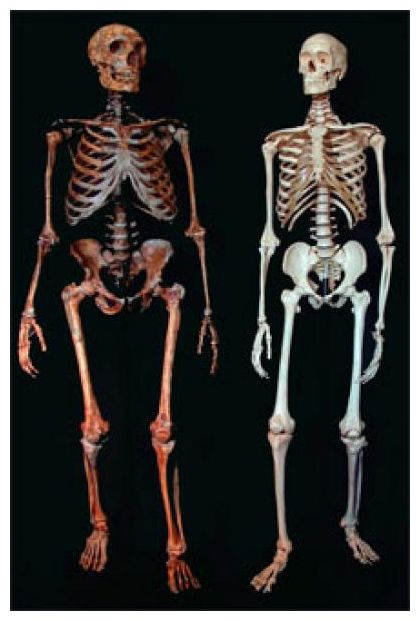
Neanderthal versus Modern Humans
© Ian TattersallComparison of Neanderthal and modern human skeletons. Photo: K. Mowbray, Reconstruction: G. Sawyer and B. Maley,
Neanderthals may have died out 10,000 years earlier than is commonly believed, suggests new dating of the remains of a Neanderthal infant.

The finding, published today in the Proceedings of the National Academy of Sciences, may revise the present Neanderthal timeline. It's commonly believed that Neanderthals from what is now Russia died out around 30,000 years ago. The latest discovery could push back the Neanderthal extinction, at least for this region, to 39,700 years ago, which was the age of the infant's fossil.

Since modern humans are believed to have arrived in the northern Caucasus region just a few hundred years beforehand, that means our species may not have had much, if any, time to interact with Neanderthals.

Info

North America Was Populated by no More Than 70 People 14,000 Years Ago, Claims Stunning New DNA Research

The next time you're having a disagreement with a work colleague or annoying neighbour, bear this in mind: Chances are you're related.

A new study of DNA patterns throughout the world suggests that North America was originally populated by no more than 70 people.

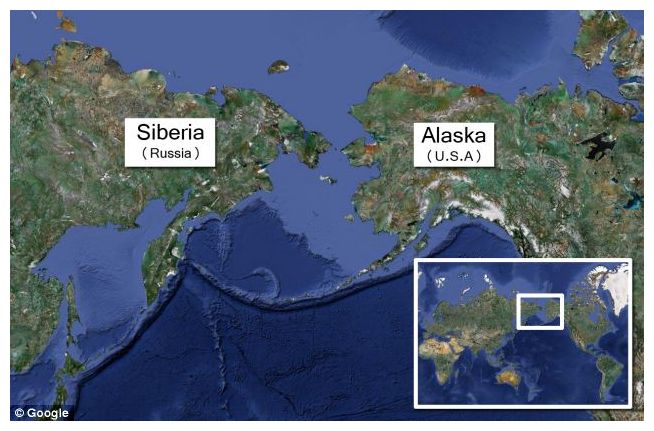
Most experts agree that, around 14,000 years ago, a group of humans crossed the land bridge that connected what is now Siberia in Russia with Alaska.

Google Map
© GoogleCrossing over: Most experts agree that, at some point between 12,000 and 14,000 years ago, people from Asia moved over to North America. A new study of genetics puts the number of New World travellers at 70.
But new research has shown just how small that group was, venturing into a vast continent from Asia during the last Ice Age.

Up to now DNA analyses of the intrepid and original 'founding fathers' looked at a particular gene, using estimates and academic assumptions on constant population sizes over time.

Meteor

New Mineral Discovered: One of Earliest Minerals Formed in Solar System

New Mineral Meteorite
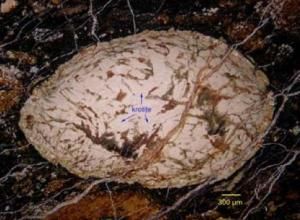
© Chi MaThe "Cracked Egg" grain, in which krotite was discovered, is contained in the NWA 1934 Meteorite.

In the May-June issue of the journal American Mineralogist, a team of scientists announced the discovery of the new mineral krotite, one of the earliest minerals formed in our solar system. It is the main component of an unusual inclusion embedded in a meteorite (NWA 1934), found in northwest Africa. These objects, known as refractory inclusions, are thought to be the first planetary materials formed in our solar system, dating back to before the formation of Earth and the other planets.

This particular grain is known affectionately as "Cracked Egg" for its distinctive appearance. Dr. Harold C. Connolly, Jr. and student Stuart A. Sweeney Smith at the City University of New York (CUNY) and the American Museum of Natural History (AMNH) first recognized the grain to be of a very special type, known as a calcium-aluminum-rich refractory inclusion. ("Refractory" refers to the fact that these grains contain minerals that are stable at very high temperature, which attests to their likely formation as very primitive, high-temperature condensates from the solar nebula.)

Cracked Egg refractory inclusion was sent to Dr. Chi Ma at California Institute of Technology (Caltech) for very detailed nano-mineralogy investigation. Dr. Ma then sent it to Dr. Anthony Kampf, Curator of Mineral Sciences at the Natural History Museum of Los Angeles County (NHM), for X- ray diffraction study. Kampf's findings, confirmed by Ma, showed the main component of the grain was a low-pressure calcium aluminum oxide (CaAl2O4) never before found in nature. Kampf's determination of the atomic arrangement in the mineral showed it to be the same as that of a human-made component of some types of refractory (high-temperature) concrete.