
Science & TechnologyS


Hourglass

'Oldest living thing on earth' discovered

Sea grass
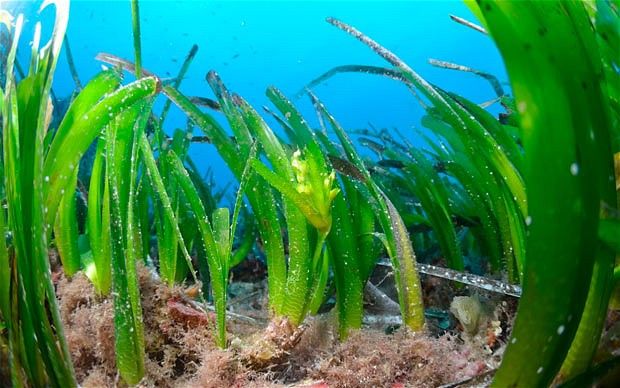
© Getty ImagesScientists say a patch of ancient seagrass in the Mediterranean is up to 200,000 years old
Ancient patches of a giant seagrass in the Mediterranean Sea are now considered the oldest living organism on Earth after scientists dated them as up to 200,000 years old.

Scientists say a patch of ancient seagrass in the Mediterranean is up to 200,000 years and could be the oldest known living thing on Earth. Australian researchers, who genetically sampled the seagrass covering 40 sites from Spain to Cyprus, say it is one of the world's most resilient organisms - but it has now begun to decline due to global warming.

Comment: Bad science. Where is the evidence for global warming? For example see: Forget Global Warming - It's Cycle 25 We Need to Worry About where we read:
The supposed 'consensus' on man-made global warming is facing an inconvenient challenge after the release of new temperature data showing the planet has not warmed for the past 15 years.

The figures suggest that we could even be heading for a mini ice age to rival the 70-year temperature drop that saw frost fairs held on the Thames in the 17th Century.

Based on readings from more than 30,000 measuring stations, the data was issued last week without fanfare by the Met Office and the University of East Anglia Climatic Research Unit. It confirms that the rising trend in world temperatures ended in 1997.
For a species that is "between 12,000 and 200,000 years old" it seems to have survived many shifts in climate just fine. What won't survive the next shift in climate are studies linked to 'man made global warming'.


Roses

British Scientists Show Vegetables Can 'Talk'

Image
© flickr.com/ nocivegliaBritish Scientists Show Vegetables Can 'Talk'
A research team at the University of Exeter visualized on television the ability of plants to communicate, the university reported on its website.

Injured plants are capable of releasing a gas that triggers responses in plants around them. But the team at Exeter, led by Professor Nick Smirnov, was the first to catch the process on film by infusing a plant with a firefly gene and using a special camera.

Saturn

Signs of Ancient Ocean on Mars Spotted by European Spacecraft

The Mars Express spacecraft's MARSIS
© ESA, C. CarreauThe Mars Express spacecraft's MARSIS collects data on the subsurface of Mars.

A European spacecraft orbiting Mars has found more revealing evidence that an ocean may have covered parts of the Red Planet billions of years ago.

The European Space Agency's Mars Express spacecraft detected sediments on Mars' northern plains that are reminiscent of an ocean floor, in a region that has also previously been identified as the site of ancient Martian shorelines, the researchers said.

"We interpret these as sedimentary deposits, maybe ice-rich," study leader Jérémie Mouginot, of the Institut de Planétologie et d'Astrophysique de Grenoble (IPAG) in France and the University of California, Irvine, said in a statement. "It is a strong new indication that there was once an ocean here."

As part of its mission, Mars Express uses a radar instrument, called MARSIS, to probe beneath the Martian surface and search for liquid and solid water in the upper portions of the planet's crust.

The researchers analyzed more than two years of MARSIS data and found that the northern plains of Mars are covered in low-density material that suggests the region may have been an ancient Martian ocean.

Bulb

Belgian Battery Can Power 1,400 Homes

Chemicals giant Solvay hailed Monday the successful entry into service in Flanders of what it said was the largest fuel cell of its type in the world.

A super-battery that produces enough electricity to power nearly 1,400 homes, the Proton Exchange Membrane (PEM) fuel cell has been producing clean electricity at a "steady rate" for weeks at a SolVin plant part-owned by Germany's BASF in Antwerp, northern Dutch-speaking Belgium.

SolVin is a market leader in vinyl, or PVC production.

The fuel cell converts the chemical energy from hydrogen into clean electricity through an electrochemical reaction with oxygen, and "has generated over 500 MWh in about 800 hours of operation," Solvay said in a news release.

Telescope

Newfound Alien Planet is Best Candidate Yet to Support Life, Scientists Say

planet GJ 667Cc
© Carnegie Institution for ScienceAn artist's conception of the alien planet GJ 667Cc, which is located in the habitable zone of its parent star.
A potentially habitable alien planet - one that scientists say is the best candidate yet to harbor water, and possibly even life, on its surface - has been found around a nearby star.

The planet is located in the habitable zone of its host star, which is a narrow circumstellar region where temperatures are neither too hot nor too cold for liquid water to exist on the planet's surface.

"It's the Holy Grail of exoplanet research to find a planet around a star orbiting at the right distance so it's not too close where it would lose all its water and boil away, and not too far where it would all freeze," Steven Vogt, an astronomer at the University of California, Santa Cruz, told SPACE.com. "It's right smack in the habitable zone - there's no question or discussion about it. It's not on the edge, it's right in there."

Cell Phone

US: Website Can Find Your Exact Location Using Your Phone Number

Mobile Phone Tracking
© AP Photo / Seth Wenig

Is it possible to pinpoint your location with nothing more than a cellphone number? Absolutely.

Your smartphone always knows where you are. And thanks to the Life360.com service, powered by technology from a company called Loc-Aid, a parent can locate a child by her phone number or even an elderly parent who has wandered away from home.

Indeed, network location services can save lives, protect children, and enable business services -- and they're available to anyone.

Thanks to a free online demo at Loc-Aid.com, you can type in the cellphone number of anyone in the U.S. and find their precise location in just a few seconds.

Agreements with wireless carriers like T-Mobile and Sprint let Loc-Aid triangulate position using cellular towers and the GPS signal on your phone. In urban areas, the results are more precise than rural areas where there are fewer cell towers.

Locaid adds security measures to keep the site safe: You have to type in your own birthday (to prevent minors from using the service) and the person you are trying to locate must agree to the location search by replying to a text message.

Magnify

'Lost World' Reached: 20 million Year Old Antarctic Lake 'Drilled'

Antarctica
© n/a
After 30 years spent drilling through a four-kilometer-thick ice crust, researchers have finally broken through to a unique subglacial lake. Scientists are set to reveal its 20-million-year-old secrets, and imitate a quest to discover ET life.

The Vostok project breathes an air of mystery and operates at the frontiers of human knowledge. The lake is one of the major discoveries in modern geography; drilling operations at such depths are unprecedented; never before has a geological project required such subtle technologies.

The main inspiration for the project - the Russian scientist who posited the lake's existence - died just six months before the moment of contact with the lake's surface. Now, the whole world is looking to Lake Vostok for crucial data which might help to predict climate change.

"Yesterday [on Sunday] our scientists at the Vostok polar station in the Antarctic completed drilling at depths of 3,768 meters and reached the surface of the subglacial lake," RIA Novosti reported, quoting an unnamed Russian scientist.

Meanwhile, Itar-Tass news agency says the scientists still have a few meters to go.

Eye 1

Scientists Use Brain Waves to Eavesdrop on the Mind

brain
© unknown
Scientists may one day be able to read the minds of people who have lost the ability to speak, new research suggests.

In their report, published in the Jan. 31 online edition of the journal PLoS Biology, University of California, Berkeley researchers describe how they have found a way to analyze a person's brain waves in order to reconstruct words the person hears in normal conversation.

This ability to decode electrical activity in an area of the auditory system called the superior temporal gyrus may one day enable neuroscientists to hear the imagined speech of stroke or other patients who can't speak, or to eavesdrop on the constant, internal monologues that run through people's minds, the researchers explained in a journal news release.

"This is huge for patients who have damage to their speech mechanisms because of a stroke or Lou Gehrig's disease [amyotrophic lateral sclerosis] and can't speak," Robert Knight, a professor of psychology and neuroscience, said in the news release. "If you could eventually reconstruct imagined conversations from brain activity, thousands of people could benefit."

Monkey Wrench

The Great Escape: Gene-altered Crops Grow Wild

Image
© Environmental Health NewsFeral flowers: Escaped gene-altered canola has some experts concerned that herbicide-resistant “super weeds” could result.
Throughout North Dakota, little yellow flowers dot thousands of miles of roadsides. These canola plants, found along most major trucking routes, look harmless. But they are fueling a controversy: They prove that large numbers of genetically modified plants have escaped from farm fields and are now growing wild.

About 80 percent of canola growing along roadsides in North Dakota contains genes that have been modified to make the plants resistant to common weed-killers, according to a team of University of Arkansas researchers.

The discovery of escaped gene-altered canola has some experts concerned that it could lead to herbicide-resistant "super weeds" that farmers would have difficulty controlling. Also, the plants could be moving onto the fields of organic farmers. In Australia, one farmer who lost his organic certification has sued his neighbor, saying genetically modified canola contaminated his organic crops.

Magnify

Missing Scientists Mystery Deepens in Frozen Antarctica

Image
© NASANASA photo of Lake Vostok in Antarctica.

The world holds its breath, hoping for the best after six days of radio silence from Antarctica -- where a team of Russian scientists is racing the clock and the oncoming winter to dig to an alien lake far beneath the ice.

The team from Russia's Arctic and Antarctic Research Institute (AARI) have been drilling for weeks in an effort to reach isolated Lake Vostok, a vast, dark body of water hidden 13,000 ft. below the surface of the icy continent. Lake Vostok hasn't been exposed to air in more than 20 million years.

The team's last contact with colleagues in the unfrozen world was six long days ago, and scientists from around the globe are unsure of the fate of the mission -- and the scientists themselves -- as Antarctica's killing winter draws near.

"When you're outside, it's extremely cold -- minus 30, minus 40," microbiologist Dr. David A. Pearce told FoxNews.com. "If you left your eyes open the fluid in them would start to freeze. Your nostrils would start to freeze. The moisture in your mouth would start to freeze," he said.