Science & TechnologyS


Info

Magma May Give Signs of Super-Volcano Eruptions

Santorini Volcano
© NASA/GSFC/MITI/ERSDAC/JAROS, and U.S./Japan ASTER Science Team Santorini Volcano in the Aegean Sea, seen in this NASA satellite image, was the site of one of the largest eruptions in the last 10,000 years. The explosion of the volcano removed so much magma from below the Earth that the volcano collapsed, producing a large crater, or caldera.
Crystals from a giant eruption linked to the legend of Atlantis may reveal ways to predict future super-volcano eruption, researchers say.

Each of the world's roughly one dozen super-volcanoes is capable of spewing out thousands of times more magma and ash than any eruption ever recorded in human history.

For instance, when Mount Toba on the Indonesian island of Sumatra erupted some 74,000 years ago, a staggering 700 cubic miles (2,800 cubic kilometers) of magma and a thick layer of ash were released over South Asia. In comparison, the explosion of the Indonesian island of Krakatoa in 1883, one of the largest eruptions in recorded history, released about 3 cubic miles (12 cubic km) of material.

"These are catastrophic eruptions," said researcher Tim Druitt, a volcanologist at the University of Blaise Pascal in France, who with his colleagues examined crystals from the Greek island of Santorini to try to learn about the behavior of the magma reservoir beneath a powerful volcano.

Camcorder

Surveillance Video Becomes a Tool for Studying Customers

surveillance footage
© Prism Skylabs Software from Prism Skylabs processes surveillance footage.
The huge success of online shopping and advertising - led by giants like Amazon and Google - is in no small part thanks to software that logs when you visit Web pages and what you click on. Startup Prism Skylabs offers brick-and-mortar businesses the equivalent - counting, logging, and tracking people in a store, coffee shop, or gym with software that works with video from security cameras.

"There's a lot of wonderful information locked up in video, and 40 million security cameras in the U.S. collecting it, but it's data that's not been available," says Steve Russell, cofounder and CEO of Prism, based in San Francisco. "We want to free up that information."

Prism's software can count people that come into a business, measure the length of the line at checkout, and produce static or animated visualizations showing how people moved around a store. It is designed so that it cannot identify or track individuals. One national wireless carrier is already using Prism's technology to generate heat maps of where visitors go in their showrooms, to compare the level of interest in different devices - valuable data to them and to the device makers.

Laptop

Facebook's Oregon Data Center Uses As Much Power As Entire County

Facebook servers
© FacebookThe interior of Facebook data center in Prineville, Oregon.
Facebook has invested $210 million to build the first phase of its new data center in Prineville, Oregon, which has a capacity of 28 megawatts of power, the company and local economic development officials revealed this week. The disclosures, released in an economic impact study and a community economic forum, were the first public confirmations of the cost and power usage of the Facebook project.

The new data, which shed light on the cost of operating Facebook's massive server infrastructure, emerges as the company is said to be prepping papers for an initial public offering, which would include additional details about the company's operations. The Oregon disclosures are part of Facebook's effort to reinforce the benefits of its data center to the local economy, amid a dispute over property taxes and questions from some Prineville residents about the impact of data centers on the small community in central Oregon.

For Prineville, Facebook is a big business operation - a fact reflected in the power required to operate the first phase of the data center. The 28 megawatts of utility power for the 300,000 square foot first phase isn't extraordinary for a data center of that size. But it stands out in Crook County, where all the homes and business other than Facebook use 30 megawatts of power.

Radar

First Chimeric Monkeys Born

Roku and Hex-chimera monkeys
© Oregon Health and Science UniversityRoku and Hex are two of the three chimera monkeys that contain genetic information from six monkey embryos.
By inserting genes from six different monkey embryos, US researchers have created the first chimera primates.

Three chimera monkeys were born in a lab at the Oregon National Primate Research Center recently. To create these chimera primates, scientists inserted a combination of genes from several monkey embryos into a new embryo, accomplishing a feat that had been previously only demonstrated in less complex species.

Previously, knockout mice have become powerful tools for scientists studying genetic diseases including Parkinson's and obesity, but the techniques were not applicable to primates. Knockout mice are created by fusing together mouse embryonic stem cells in a lab dish and then culturing those cells into a mouse embryo. But with the more complicated primate embryo, the cultured stem cells do not integrate so easily.

"So far, scientists studied human and monkey embryonic stem cells in vitro, in a Petri dish, and thought that since they came initially from embryos, they retain the ability to develop into mature and functional tissues and organs, just like normal stem cells in developing embryos," said study author Shoukhrat Mitalipov of the Oregon National Primate Research Centre at Oregon Health and Science University.

Question

NASA Probe Discovers 'Alien' Matter From Beyond Our Solar System

iBex Spacecraft
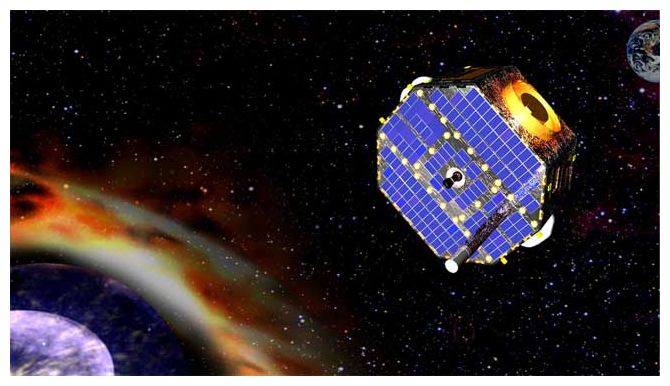
© NASA/GSFCArtist's impression of NASA's IBEX spacecraft exploring the edge of our solar system.
For the very first time, a NASA spacecraft has detected matter from outside our solar system - material that came from elsewhere in the galaxy, researchers announced today (Jan. 31).

This so-called interstellar material was spotted by NASA's Interstellar Boundary Explorer (IBEX), a spacecraft that is studying the edge of the solar system from its orbit about 200,000 miles (322,000 kilometers) above Earth.

"This alien interstellar material is really the stuff that stars and planets and people are made of - it's really important to be measuring it," David McComas, IBEX principal investigator and assistant vice president of the Space Science and Engineering Division at Southwest Research Institute in San Antonio, said in a news briefing today from NASA Headquarters in Washington, D.C.

An international team of scientists presented new findings from IBEX, which included the first detection of alien particles of hydrogen, oxygen and neon, in addition to the confirmation of previously detected helium.

These atoms are remnants of older stars that have ended their lives in violent explosions, called supernovas, which dispersed the elements throughout the galaxy. As interstellar wind blows these charged and neutral particles through the Milky Way, the IBEX probe is able to create a census of the elements that are present.

Newspaper

US: Nuclear reactor loses power, venting steam

Image
© AP Photo/Robert RayMonday, Jan. 30, 2012 after losing power, steam was being vented to reduce pressure, according to officials from Exelon Nuclear and federal regulators.
Chicago - A nuclear reactor at a northern Illinois plant shut down Monday after losing power, and steam was being vented to reduce pressure, according to officials from Exelon Nuclear and federal regulators.

Unit 2 at Byron Generating Station, about 95 miles northwest of Chicago, shut down at 10:18 a.m., after losing power, Exelon officials said. Diesel generators began supplying power to the plant, and operators began releasing steam to cool the reactor from the part of the plant where turbines are producing electricity, not from within the nuclear reactor itself, officials said.

The steam contains low levels of tritium, a radioactive form of hydrogen, but federal and plant officials insisted the levels were safe for workers and the public.

The U.S. Nuclear Regulatory Commission declared the incident an "unusual event," the lowest of four levels of emergency. Commission officials also said the release of tritium was expected.

Comment: According to Wikipedia: "..Tritium has several different experimentally determined values of its half-life, the National Institute of Standards and Technology lists 4,500±8 days (approximately 12.32 years)."


Bacon

Patent For A Pig - The Big Business of Genetics

Patent For A Pig: The Big Business of Genetics: The American biotechnology firm, Monsanto, has applied for a patent for pig breeding in 160 countries. The patent is for specific parts of the genetic material of pigs which Monsantos genetic researchers have decoded. If this patent is granted, pig breeding would be possible with the approval of the company.


Farmers and breeders are naturally alarmed because these genes have long existed in the great majority of their pigs. Using DNA tests they can prove that there is no new invention in the patent applications but that, instead, granting this patent would be to allow a part of nature to fall into the hands of a single company. Monsantos influence on the patent offices is huge. If the patent is approved, money will have to be paid to Monsanto for e
very pig in the world carrying this genetic marker.

This has long been the case for certain feedstuffs, such as genetically modified maize. Many farmers in the US have already become dependent on the company. It is not merely a question of money, however, but also a question of the risk posed to consumers. In America, as in Europe, cases of infertility in animals fed with genetically modified maize are becoming increasingly common. No-one yet knows what effects such products are having on humans.

Info

Students Discover Millisecond Pulsar, Help in the Search for Gravitational Waves

Gravity Waves
© NRAOUsing an array of millisecond pulsars, astronomers can detect tiny changes in the pulse arrival times in order to detect the influence of gravitational waves.

A special project to search for pulsars has bagged the first student discovery of a millisecond pulsar - a super-fast spinning star, and this one rotates about 324 times per second. The Pulsar Search Collaboratory (PSC) has students analyzing real data from the National Radio Astronomy Observatory's (NRAO) Robert C. Byrd Green Bank Telescope (GBT) to find pulsars. Astronomers involved with the project said the discovery could help detect elusive ripples in spacetime known as gravitational waves.

"Gravitational waves are ripples in the fabric of spacetime predicted by Einstein's theory of General Relativity," said Dr. Maura McLaughlin, from Western Virginia University. "We have very good proof for their existence but, despite Einstein's prediction back in the early 1900s, they have never been detected."

Four other pulsars have been discovered by high school students participating in this project.

"When you discover a pulsar, you feel like you're walking on air! It is the best experience you can ever have," said student co-discoverer Jessica Pal of Rowan County High School in Kentucky. "You get to meet astronomers and talk to them about your experience. I still can't believe I found a pulsar. It is wonderful to know that there is something out there in space that you discovered."

Info

Unusual Volcanic Episode Rapidly Triggered Little Ice Age, Researchers Find

Professor Gifford Miller
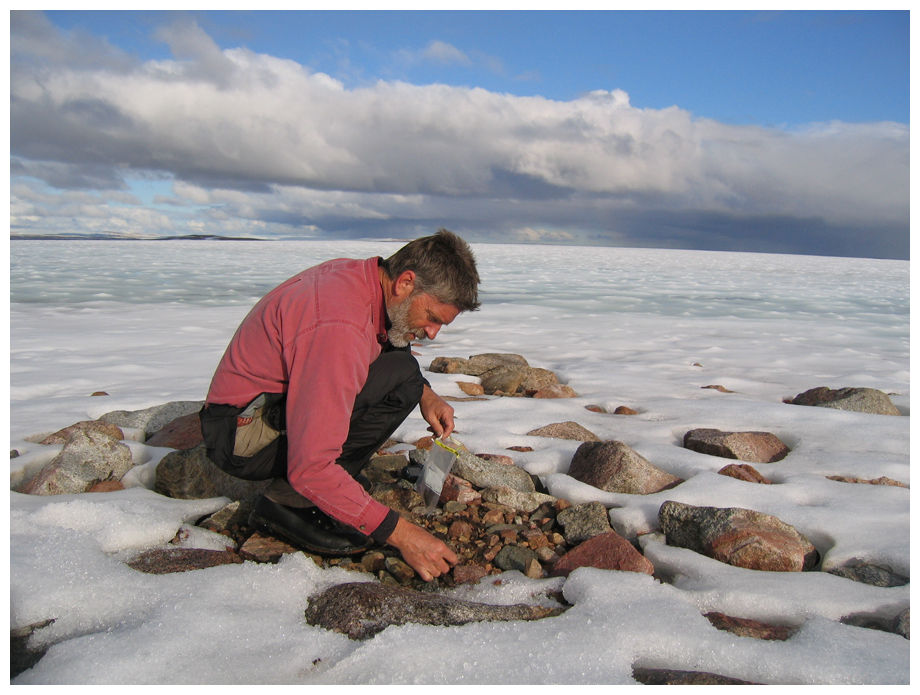
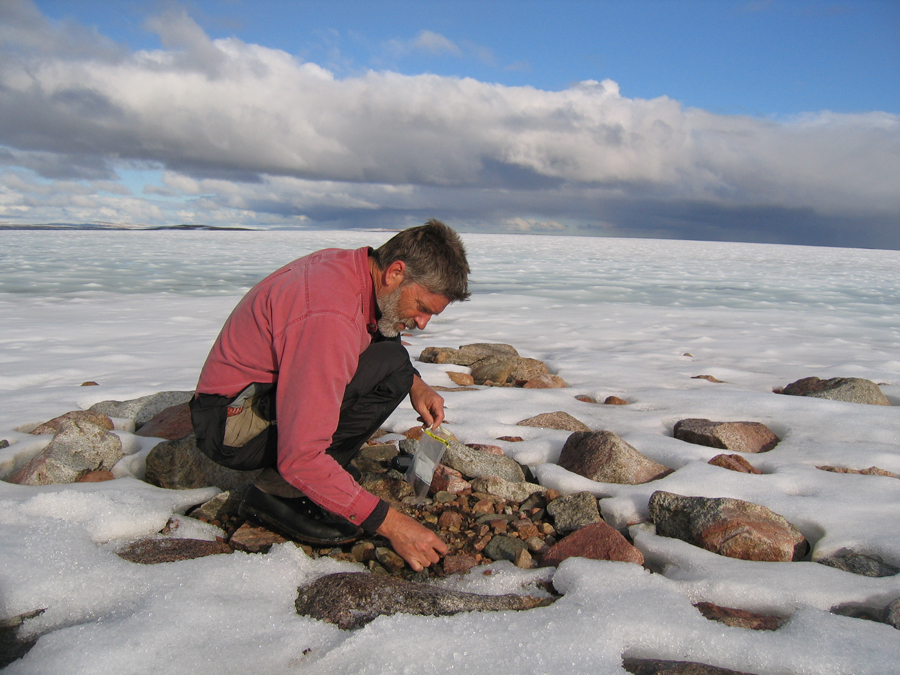
© Gifford Miller, University of ColoradoUniversity of Colorado, Boulder Professor Gifford Miller collects dead plant samples from beneath a Baffin Island ice cap. Miller led a new study, to be published in in Geophysical Research Letters, which indicates the Little Ice Age began roughly A.D. 1275 and was triggered by repeated, explosive volcanism that cooled the atmosphere.

Washington, DC - New evidence from northern ice sheets suggests that volcanic eruptions triggered the multiple-century cool spell known as the Little Ice Age, and pinpoints the start of the climate shift to the final decades of the 13th century. Researchers have long known that the Little Ice Age began sometime after the Middle Ages and lasted into the late 19th century. But, estimates of its onset have ranged from the 13th to the 16th century.

According to the new study, the Little Ice Age began abruptly between 1275 and 1300 A.D., triggered by repeated, explosive volcanism and sustained by a self- perpetuating sea ice-ocean feedback in the North Atlantic Ocean, according to Gifford Miller, a geological sciences professor at the University of Colorado, Boulder (CU-Boulder), who led the study. The primary evidence comes from radiocarbon dates from dead vegetation emerging from rapidly melting icecaps on Baffin Island, combined with ice and sediment core data from the poles and Iceland, and from sea-ice climate model simulations, said Miller.

He and his colleagues will publish their findings on 31 January in Geophysical Research Letters, a publication of the American Geophysical Union (AGU).

During the cool spell, advancing glaciers in mountain valleys in northern Europe destroyed towns. Famous paintings from the period depict people ice-skating on the Thames River in London and canals in the Netherlands, places that were ice-free before and after the Little Ice Age. There is evidence also that the Little Ice Age affected places far from Europe, including South America and China.

While scientific estimates regarding the onset of the Little Ice Age extend from the 13th century to the 16th century, there has been little consensus, said Miller. "The dominant way scientists have defined the little Ice Age is by the expansion of big valley glaciers in the Alps and in Norway," said Miller. "But the time in which European glaciers advanced far enough to demolish villages would have been long after the onset of the cold period," said Miller, a Fellow at his university's Institute of Arctic and Alpine Research.

Info

Our Planet's Killer Electrons Shoot Toward Space, Not Earth

Magnetic Storm
© NASASolar wind presses against Earth's magnetic field, giving it a bow shock much like that of a boat in the water. During heavy solar ejections, the pressure can shove the magnetosphere into the Van Allen radiation belts, releasing dangerously charged electrons into space.

As the sun heads toward its 2013 maximum, the corresponding increase in space weather may temporarily strip the radiation belts around Earth of their charged electrons. But a new study of data recorded by 11 independent spacecraft reveals that the deadly particles are blown into space rather than cast into our planet's atmosphere, as some scientists have suggested.

Streams of highly charged electrons zip through the Van Allen radiation belts circling Earth. When particles from the sun collide with the planet's magnetic field, which shields Earth from the worst effects, the resulting geomagnetic storms can decrease the number of dangerous electrons.

Where those particles go is something physicists have long puzzled over - and since they could wreak havoc on sensitive telecommunication satellites and pose a risk to astronauts in space, it's an important question, researchers say.

At the heart of the geomagnetic storm mystery are strange dips, known as dropouts, in the number of charged particles in the radiation belts. These lapses can happen multiple times per year, but when the sun is going through an active period - as it is now - the number can increase to several times per month, scientists involved in the new study explained.