Science & TechnologyS


Telescope

Two New Moons Found Orbiting Jupiter

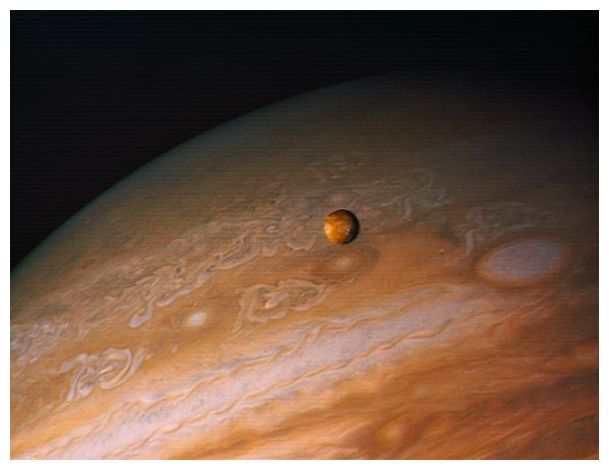
Io
© NASAThe Galilean moon Io orbits Jupiter in a picture from the Voyager 1 spacecraft.
Tiny satellites add to planet's "backward" swarm, astronomers say.

Two new moons have been found orbiting Jupiter, bringing the Jovian family count up to 66 natural satellites, astronomers revealed this week.

Currently known as S/2011 J1 and S/2011 J2, the new moons were first identified in images acquired with the Magellan-Baade Telescope at the Las Campanas Observatory in Chile on September 27, 2011.

The objects are among the smallest moons yet discovered in the solar system, each measuring only about a kilometer (0.62 mile) wide.

Unlike Jupiter's four large Galilean moons, which are visible from Earth with even small backyard telescopes, both new moons are dim and very distant from the planet, taking about 580 and 726 days to complete their orbits.

Scientists had previously discovered new Jovian satellites in 2010, and astronomers think there may be more - lots more.

"The satellites are part of the outer retrograde swarm of objects around Jupiter," said Scott Sheppard, of the Department of Terrestrial Magnetism at the Carnegie Institute for Science in Washington, D.C., who reported the discovery.

Retrograde satellites are moons that orbit "backward" - in the opposite direction of a planet's axial rotation. Including the two new moons, the Jupiter swarm features 52 known retrograde satellites, which are all relatively tiny.

"It is likely there are about a hundred satellites of this size" in the swarm, Sheppard said.

Satellite

NASA probe sends back its first video of the moon's 'dark side'

Nasa's twin Grail probes arrived at the moon in early January - and one has just sent back its first video from the 'dark' side of the moon, the one we don't see from Earth.

The video shows a flight from the north pole to the south pole of the moon.

'It's very rugged and covered with impact craters from asteroids that hit the moon's surface,' says Maria Zuber, Nasa's principal investigator on Grail.


In the video, the north pole of the Moon is visible at the top of the screen as the spacecraft flies toward the lunar south pole.

Info

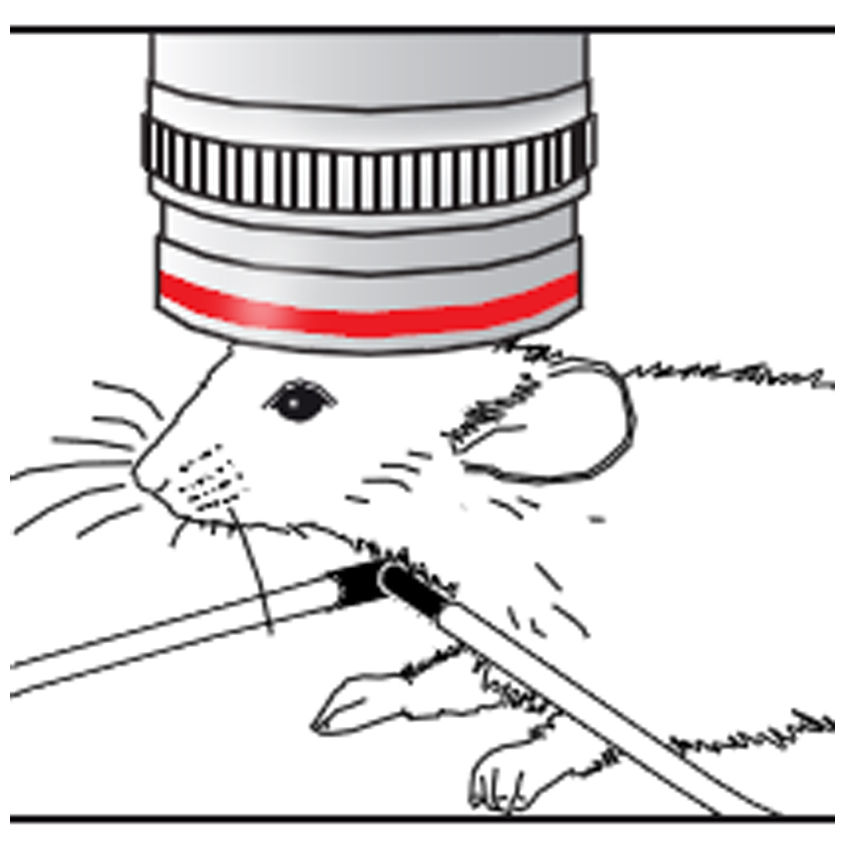
Window Installed Into a Live Brain

Window to The Brain
© Max Planck Institute for Biophysical Chemistry, GoettingenAn illustration of a "window" built into a mouse's brain. The mouse survived the procedure.

What if we had a glass window into the brain that lets us look inside? For the first time ever, a team of physicists, chemists and biologists has done just that. Led by a microscopy pioneer, they peered into a living mouse's brain using powerful technology.

"You can look into the brain and see a true neuron in action," said physicist Stefan Hell, who leads the Max Planck Institute of Biophysical Chemistry's Department of NanoBiophotonics. His team's achievement is described in the latest issue of the journal Science.

Hell is well-known in the field for inventing a super-resolution "stimulated emission depletion" or STED microscope in the 1990s that can distinguish among features in living samples on a scale so small that general wisdom said it would be impossible.

With that microscope, Hell and his colleagues at Max Planck can discern features down to 70 nanometers in the living brain -- four times beyond what had been the physical limit.

An electron microscope can show powerful levels of detail, but only on dead cells mounted and prepared just so. Recently Hell's team took a live mouse that had been genetically modified so its neurons produce a fluorescent agent. They placed the mouse under anesthesia, opened its skull, and replaced part of the bone with a glass window.

Christmas Tree

Northern forests may be losing their ability to trap carbon

Northern forest no longer trap carbon
© Linnea Hanson/U.S. Forest Service.Young aspen grove.

The northern forests of western Canada are likely absorbing less carbon dioxide because of climate change, and the decline may be making a bad situation worse, researchers from Quebec and China have concluded.

If the situation remains as it is, the forests may actually put more carbon dioxide back into the air than they absorb, the researchers said. While researchers have seen this happen in tropical rainforests, the new result suggests that this problem could be much more widespread.

The scientists at the University of Quebec's Montreal campus and from several Chinese institutions, reporting in this week's Proceedings of the National Academy of Sciences, have been able to put numbers to the fears that the ability of northern forests to absorb carbon -- to act as carbon sinks -- was decreasing.

The researchers studied 96 permanent old-growth forests out of 20,000 candidates, concentrating on aspens, which are more sensitive to changes in precipitation.

Info

San Andreas Fault May Look Like a Propeller, Scientists Find

San Andreas Fault
© Fuis, et al. The suggested propeller-like shape of the San Andreas Fault below the Earth’s surface.
Last October more than 8.6 million Californians practiced the "Drop, Cover and Hold On" drill in the Great California ShakeOut. The exercise was designed to help residents prepare for the next "big one," a potential magnitude-7.8 earthquake along the southern San Andreas Fault.

All of the Great ShakeOut scenarios are based on everything scientists think they know about the San Andreas Fault - a so-called strike-slip boundary between the North American and Pacific plates that, geologists assumed, is very near vertical.

But what if it's not vertical? A team recently took a new look at the San Andreas Fault and found that its geometry isn't that simple.

"It looks like the San Andreas continues down into the mantle with a propeller shape," said Gary Fuis, a geophysicist with the U.S. Geological Survey in Menlo Park, Calif. "If it's not vertical, it makes a big difference in who feels the shaking."

Pistol

Engineers Invent Bullet That Guides Itself to Target


Engineers at Sandia National Laboratories have invented a bullet that guides itself to the target.

Sandia has wide expertise at miniature technology, and the bullet works like a tiny guided missile.

The patented design doesn't shoot straight. Instead of a spiral rotation, the bullet twists and turns to guide itself towards a laser directed point. It can make up to thirty corrections per second while in the air.

Jim Jones, distinguished member of technical staff, and his team of engineers at Sandia Labs think the .50-caliber bullets would work well with military machine guns so soldiers could hit their mark faster and with precision.

Blackbox

Book Review: The Science Delusion by Rupert Sheldrake

Image
© Laurie and Charles/Getty ImagesDogs: do they really know when you're coming home?
The unlucky fact that our current form of mechanistic materialism rests on muddled, outdated notions of matter isn't often mentioned today. It's a mess that can be ignored for everyday scientific purposes, but for our wider thinking it is getting very destructive. We can't approach important mind-body topics such as consciousness or the origins of life while we still treat matter in 17th-century style as if it were dead, inert stuff, incapable of producing life. And we certainly can't go on pretending to believe that our own experience - the source of all our thought - is just an illusion, which it would have to be if that dead, alien stuff were indeed the only reality.

We need a new mind-body paradigm, a map that acknowledges the many kinds of things there are in the world and the continuity of evolution. We must somehow find different, more realistic ways of understanding human beings - and indeed other animals - as the active wholes that they are, rather than pretending to see them as meaningless consignments of chemicals.

Rupert Sheldrake, who has long called for this development, spells out this need forcibly in his new book. He shows how materialism has gradually hardened into a kind of anti-Christian faith, an ideology rather than a scientific principle, claiming authority to dictate theories and to veto inquiries on topics that don't suit it, such as unorthodox medicine, let alone religion. He shows how completely alien this static materialism is to modern physics, where matter is dynamic. And, to mark the strange dilemmas that this perverse fashion poses for us, he ends each chapter with some very intriguing "Questions for Materialists", questions such as "Have you been programmed to believe in materialism?", "If there are no purposes in nature, how can you have purposes yourself?", "How do you explain the placebo response?" and so on.

Bulb

Best of the Web: It's Time For Science to Move On from Materialism

Image
© David SillitoeSome scientists are challenging conventional interpretations and proposing top-down, holistic explanations.
The rigid 19th-century orthodoxy should be challenged to allow broader interpretations, as Rupert Sheldrake argues

Werner Heisenberg, one of the founding fathers of quantum physics, once observed that history could be divided into periods according to what people of the time made of matter. In his book Physics and Philosophy, published in the early 60s, he argued that at the beginning of the 20th century we entered a new period. It was then that quantum physics threw off the materialism that dominated the natural sciences of the 19th century.

Of materialism, he wrote:
"[This] frame was so narrow and rigid that it was difficult to find a place in it for many concepts of our language that had always belonged to its very substance, for instance, the concept of mind, of the human soul or of life. Mind could be introduced into the general picture only as a kind of mirror of the material world."
Today we live in the 21st century, and it seems that we are still stuck with this narrow and rigid view of the things. As Rupert Sheldrake puts it in his new book, published this week, The Science Delusion: "The belief system that governs conventional scientific thinking is an act of faith, grounded in a 19th-century ideology."

Comment: For more information on the corruption of science read:

Dark Ages and Inquisitions, Ancient and Modern - Or Why Things are Such a Mess On Our Planet and Humanity is on the Verge of Extinction


Snowflake

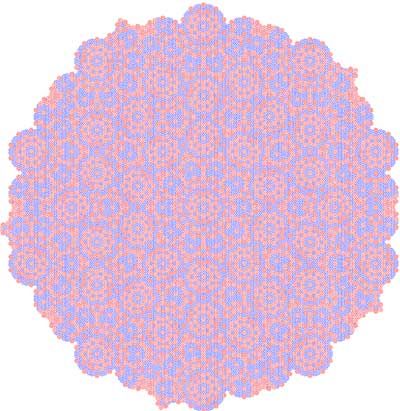
Ancient Islamic Architects Created Perfect Quasicrystals

Quasi-periodic pattern
© n/aQuasi-periodic pattern at the Gunbad-I Kabud tomb tower in Maragh
A researcher in the US reports to have found the first examples of perfect quasicrystal patterns in Islamic architecture. Her upcoming paper also describes how the designers were creating these geometric patterns from as early as the 12th century CE using nothing but rudimentary tools. It was not until the 1970s that academics began to develop mathematics that could explain these striking patterns seen in nature.

Quasicrystals are patterns that fill all of a space but do not have the translational symmetry that is characteristic of true crystals. In two dimensions this means that sliding an exact copy of the pattern over itself will never produce an exact match, though rotating the copy will often produce a match. They were first described mathematically by the British academic Roger Penrose in the guise of the famous Penrose tiles. About 10 years later Danny Schechtman of Israel's Technion University showed that the positions of atoms in a metallic alloy had a quasicrystalline structure. Since then, hundreds of different quasicrystals have been discovered in nature.

Mesmerizing patterns

Various people from both scientific and design fields have noted the similarity between quasicrystal structures and certain forms of Islamic decorative art. These mesmerizing geometric patterns, often located in places of worship, comprise repetitive patterns that reveal different features depending on whether you look at small sections or larger regions of the design.

Telescope

"Alien" Particles Found Invading Our Solar System

Alien matter
© ESA/NASAA Hubble Space Telescope picture of the Crab Nebula, a cloud of dust and gas left over from a supernova.
NASA probe detects matter from interstellar space.

For the first time, a NASA spacecraft has directly observed "alien" particles that came from beyond our solar system, astronomers announced today.

The discovery not only gives us a glimpse of what exists in the so-called interstellar medium - the matter between stars - but also offers clues to the anatomy of our local galactic neighborhood.

Orbiting Earth some 200,000 miles (322,000 kilometers) away, the Interstellar Boundary Explorer (IBEX) spacecraft was able to snag samples of hydrogen, oxygen, and neon that came from interstellar space.

"It's exciting to be able to have these first observations of alien matter - stuff that didn't come from our sun or the planets, but came from the outside of our solar system, from other parts of the galaxy," David McComas, team leader for the IBEX program, said during a NASA news conference Tuesday.

"We think these are really important measurements, because these elements are the fundamental building blocks of stars, planets, and people."