Science & TechnologyS


Beaker

Most Lethal Known Species of Prion Protein Identified

Image
© pandasthumb.org
Scientists from the Florida campus of The Scripps Research Institute have identified a single prion protein that causes neuronal death similar to that seen in "mad cow" disease, but is at least 10 times more lethal than larger prion species.

This toxic single molecule or "monomer" challenges the prevailing concept that neuronal damage is linked to the toxicity of prion protein aggregates called "oligomers."

The study was published this week in an advance, online edition of the journal Proceedings of the National Academy of Sciences.

"By identifying a single molecule as the most toxic species of prion proteins, we've opened a new chapter in understanding how prion-induced neurodegeneration occurs," said Scripps Florida Professor Corinne Lasmézas, who led the new study. "We didn't think we would find neuronal death from this toxic monomer so close to what normally happens in the disease state. Now we have a powerful tool to explore the mechanisms of neurodegeneration."

Info

Milky Way Humming with Microwave Mystery

Galatic Haze
© ESA/Planck CollaborationAll-sky image shows the distribution of the Galactic Haze seen by ESA's Planck mission at microwave frequencies superimposed over the high-energy sky as seen by NASA's Fermi Gamma-ray Space Telescope.

A European space observatory has discovered something peculiar about our galaxy: it's humming in microwaves and, for the moment, the source of the radiation is a complete mystery. Also, the Milky Way is home to previously unknown "islands" of cold carbon monoxide gas, helping astronomers uncover the distribution of star-forming regions.

The Planck space observatory was launched in 2009 to analyze small fluctuations in the ubiquitous cosmic microwave background (CMB) -- complementing data gathered by NASA's Wilkinson Microwave Anisotropy Probe. To understand the structure of the CMB is to open a window on the conditions immediately after the Big Bang. This extremely faint radiation is the ancient "echo" of the creation of the Universe over 14 billion years ago.

However, Planck's toolkit isn't restricted to measuring ancient microwaves from the dawn of time, it is also building an all-sky map of our own galaxy. To remove the microwave radiation being emitted from the Milky Way, a very accurate survey of microwave sources within our cosmic backyard needs to be carried out.

And it is this survey that's turning up some surprises.

On Monday, at an international conference in Bologna, Italy, Planck scientists have presented the intermediate results from the mission ahead of its first cosmological dataset expected to be released in 2013.

Magnify

Jungle Fungus Eats Plastic, Beats Cancer

Image
© Yale UniversityPestalotiopsis microspora
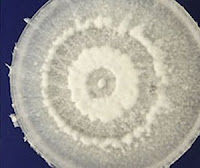
Researchers have found the first endophytic fungus that eats plastic, and can use it as its sole food source even in an oxygen-free environment.[1]

Pestalotiopsis microspora presents a massive bioremediation opportunity for landfills, where buried and surface plastics can be degraded naturally.

More likely, though, the enzyme responsible for degrading polyurethane (PUR) will be tweaked, patented and commercialized. There will be no mad escape into urban centers where the mold will eat all our plastics, like medical scientist Kit Pedler envisioned in his sci-fi classic, Mutant 59: The Plastic Eaters.

One hopes, anyway.

Info

'Woolly Mammoth' Video a Hoax, Original Footage Proves

Mammoth?
© The Sun/Michael Cohen/Barcroft MediaScreen grab of video showing alleged woolly mammoth crossing a river in Siberia.

Last week, a new video surfaced claiming to show a live woolly mammoth - an animal scientists think has been extinct for at least four millennia - crossing a river in Russia. The suspiciously blurry footage was allegedly "caught by a government-employed engineer last summer in the Chukotka Autonomous Okrug region of Siberia," according to a story in The Sun newspaper.

The video became an Internet sensation, making headlines around the world. Some Bigfoot believers and Loch Ness Monster lovers murmured their tentative approval, hoping it proved that large unknown (or assumed extinct) animals still exist in Earth's remote wilds.

While most people didn't believe that the animal in the video was really a woolly mammoth as claimed, viewers were sharply divided about what exactly it was.

Some suspected the video is an outright hoax - a computer-generated mammoth digitally inserted into a real river scene. Many others, however, were convinced that the animal was real: not a mammoth, but instead a bear with a large fish hanging from its mouth. That would explain its relatively small size, the shape of the "trunk" on its head, and the color. Experts cast doubts on the video's authenticity; Derek Serra, a Hollywood video effects artist, concluded that it "appears to have been intentionally blurred."

Frog

The Frog of War

Image
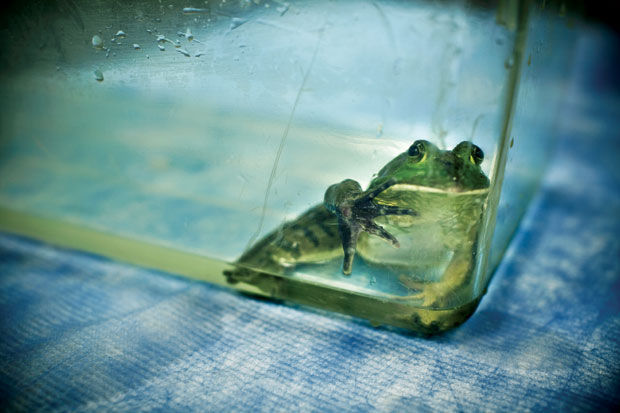
© Annie TrittThe frog depicted here isn't Xenopus laevis, but another species studied in Hayes' lab.
When biologist Tyrone Hayes discovered that a top-selling herbicide messes with sex hormones, its manufacturer went into battle mode. Thus began one of the weirdest feuds in the history of science.

Darnell lives deep in the basement of a life sciences building at the University of California-Berkeley, in a plastic tub on a row of stainless steel shelves. He is an African clawed frog, Xenopus laevis, sometimes called the lab rat of amphibians. Like most of his species, he's hardy and long-lived, an adept swimmer, a poor crawler, and a voracious eater. He's a good breeder, too, having produced both children and grandchildren. There is, however, one unusual thing about Darnell.

He's female.

Comment: In addition to the information provided by Biologist Tyrone Hayes, read the following articles for More Stark Evidence of the Hazards of Atrazine:


Magic Wand

Zebra Stripes Evolved to Keep Flies Away: Study

Image
© Unknown
Zebras got their stripes to avoid tiny, but harmful, predators: bloodsucking horseflies.

That's the conclusion from a new study from researchers from Hungary and Sweden who tested how zebra stripes might influence the attraction tabanids or horseflies have to their victims.

The scientists used boards painted with either black and white strips like zebras or single colors of black, brown, gray or white like regular horses in an effort to find which color lured more horseflies.

The researchers nabbed the blood suckers with oil and glue and found that zebra stripes attracted fewer horseflies.

The stripes repel the insects reflecting light in a polarizing fashion, making a zebra coat look undesirable to the pesky -- and harmful -- critters.

Bulb

Best of the Web: Rupert Sheldrake: the 'heretic' at odds with scientific dogma

Rupert Sheldrake has researched telepathy in dogs, crystals and Chinese medicine in his quest to explore phenomena that science finds hard to explain
Rupert Sheldrake
© Karen Robinson for the ObserverRupert Sheldrake in Hampstead, north London.

It is not often, in liberal north London, that you come face to face with a heretic, but Rupert Sheldrake has worn that mantle, pretty cheerfully, for 30 years now. Sitting in his book-lined study, overlooking Hampstead Heath, he appears a highly unlikely candidate for apostasy; he seems more like the Cambridge biochemistry don he once was, one of the brightest Darwinians of his generation, winner of the university botany prize, researcher at the Royal Society, Harvard scholar and fellow of Clare College.

All that, though, was before he was cast out into the wilderness. Sheldrake's untouchable status was conferred one morning in 1981 when, a couple of months after the publication of his first book, A New Science of Life, he woke up to read an editorial in the journal Nature, which announced to all right-thinking men and women that his was a "book for burning" and that Sheldrake was to be "condemned in exactly the language that the pope used to condemn Galileo, and for the same reason. It is heresy".

For a pariah, Sheldrake is particularly affable. But still, looking back at that moment, he still betrays a certain sense of shock. "It was," he says, "exactly like a papal excommunication. From that moment on, I became a very dangerous person to know for scientists." That opinion has hardened over the years, as Sheldrake has continued to operate at the margins of his discipline, looking for phenomena that "conventional, materialist science" cannot explain and arguing for a more open-minded approach to scientific inquiry.

Info

Is Venus' Rotation Slowing Down?

New measurements from ESA's Venus Express spacecraft shows that Venus' rotation rate is about 6.5 minutes slower than previous measurements taken 16 years ago by the Magellan spacecraft. Using infrared instruments to peer through the planet's dense atmosphere, Venus Express found surface features weren't where the scientists expected them to be.

"When the two maps did not align, I first thought there was a mistake in my calculations as Magellan measured the value very accurately, but we have checked every possible error we could think of," said Nils Müller, a planetary scientist at the DLR German Aerospace Centre, lead author of a research paper investigating the rotation.

Venus Express
© ESAVenus Express in orbit since 2006 around our nearest planetary neighbor.
Using the VIRTIS infrared instrument, scientists discovered that some surface features were displaced by up to 20 km from where they should be given the accepted rotation rate as measured by the Magellan orbiter in the early 1990s.

Over its four-year mission, Magellan determined the length of the day on Venus as being equal to 243.0185 Earth days. But the data from Venus Express indicate the length of the Venus day is on average 6.5 minutes longer.

Info

E-Cat 'Cold Fusion' Machine: Claims of Fraud Heating Up

Atom
© Life's Little Mysteries
If Italian inventor Andrea Rossi's cold fusion machine, called the E-Cat, really works, then the world's energy problems are all but solved. Rossi claims that a small amount of input energy drives a fusion reaction between hydrogen and nickel atoms inside his machine, producing an outpouring of surplus heat that can be used to generate electricity. And instead of the nasty radioactive byproducts given off by nuclear fission reactors - think Fukushima or Chernobyl - the E-Cat spits out just a teaspoon of copper.

In the past year, at least 15 reputable scientists have watched live demonstrations of Rossi's E-Cat (short for Energy Catalyzer) and have declared it to be a success. Government documents reveal that NASA scientists have discussed the E-Cat extensively in meetings, and in December, Rossi even visited a senator in Massachusetts to explore the possibility of opening an energy plant in the state. The E-Cat is fast becoming an international star. But most scientists couldn't raise their eyebrows any higher, and now, an Australian engineer has provided an alternative explanation for where all the E-Cat's excess heat is coming from, and how Rossi is possibly scamming the world.

Cold fusion - the term for stable atoms fusing together at room temperature - is ruled out by the laws of physics. Those laws say it takes a huge amount of energy to push atoms close enough together for them to fuse, and so nuclear fusion can happen only in scorching hot places like the sun. But two decades ago, a pair of scientists, puzzled by the results of an experiment, thought they were observing nuclear fusion at room temperature. Ever since, fringe scientists have been trying to harness the physics-defying effect they called cold fusion. They've kept at it despite the fact that the original experiment turned out to be flawed.

The E-Cat has gone further into mainstream acceptance than any attempted cold fusion machine before it. Though Rossi doesn't let anyone look under the E-Cat's hood, claiming the technology isn't patent-protected, he invites scientists and investors to staged demonstrations. After a demo last April, for example, a pair of Swedish physicists vouched for Rossi's work, reporting that the E-Cat produced too much excess heat to have been originating from a chemical process, and that "the only alternative explanation is that there is some kind of a nuclear process that gives rise to the measured energy production." According to their report, 400 watts was put into the machine, and this appeared to catalyze a mysterious reaction, and in the process, generate 12,400 watts of energy that slowly poured out of the machine over the next two hours.

And therein lies the alleged scam.

Sherlock

What are superbugs doing in Antarctica?

Image
© Agence France-PresseScientists have found drug-resistant E. coli bacteria off the Antarctic coast, near a Chilean research station's sewage outflows.
A multidrug-resistant strain of E. coli, potentially even more dangerous than the superbug MRSA, has been discovered living in Antarctic seawater.

Escherichia coli bacteria, better-known as E. coli, are common in the lower intestines of humans. That means they go everywhere people go - even Antarctica.

Many strains of E. coli are harmless when ingested, but some are deadly - as seen during last year's major outbreak of foodborne E. coli in Europe, as well as smaller U.S. outbreaks in Ohio, Oregon, Tennessee and Virginia. And while antibiotics are rarely used to treat food poisoning, it's nonetheless troubling that many E. coli strains can now withstand such medicine when it is needed - a phenomenon known as antibiotic resistance.

Drug-busting microbes are mainly a problem in hospitals, whether it's MRSA, C. difficile or NDM-1 superbugs. But they're increasingly common in the broader environment, too, as illustrated by a recent study in the journal Applied and Environmental Microbiology.