Science & TechnologyS


Magnify

Physicists Discover Evidence of Rare Hypernucleus, A Component of Strange Matter

Physicists in Italy have discovered the first evidence of a rare nucleus that doesn't exist in nature and lives for just 10-10 seconds before decaying. It's a type of hypernucleus that, like all nuclei, contains an assortment of neutrons and protons. But unlike ordinary nuclei, hypernuclei also contain at least one hyperon, a particle that consists of three quarks, including at least one strange quark. Hypernuclei are thought to form the core of strange matter that may exist in distant parts of the universe, and could also allow physicists to probe the inside of the nucleus.

Image
© FINUDAA view of one of the three events found by FINUDA: a schematic frontal view of the apparatus is shown, and the two blue lines represent the two 'pi' mesons moving along opposite bent trajectories in the magnetic field of the apparatus.
The particular hypernucleus investigated here, called "hydrogen six Lambda" (6ΛH), was first predicted to exist in 1963. Now, in a study published in a recent issue of Physical Review Letters, physicists working in the FINUDA experiment at the Istituto Nazionale di Fisica Nucleare - Laboratori Nazionali di Frascati (INFN-LNF) in Frascati, Italy, have reported finding the first evidence for the particle. The FINUDA collaboration's analysis of millions of events has turned up three events for the rare hypernucleus.

Sun

The Electric Universe: Thunderbolts of the Gods

Challenge yourself, your peers, your teachers. Participate in a revolution in science and human evolution. Watch this film and in an hour know more than most NASA scientists about the fundamental force that forms and sustains the universe (summary below).

Visit: www.thunderboltsdvd.com - to purchase the DVD andor Thunderbolts Of The Gods 'monograph' (book), - to view higher resolution sequences from the film (with stereo sound), - to subscribe to a free newsletter that will keep you up to date on the latest discoveries in space and a revolutionary new interpretation of them. The Thunderbolts Project calls into question not only countless modern scientific assumptions, but also the billions of dollars of big-science government and corporate funding that continues to preserve and entrench questionable theories - elevating them to the status of doctrine - while systematically excluding legitimate alternatives that threaten the status-quo.

Alternatives that may represent the future of science. The Thunderbolts Project offers remarkably simple explanations for 'black holes', 'dark matter', the electric sun, comets that are NOT made of ice, planetary scarring and many other 'mysterious' phenomena. It proposes that much of the currently observable phenomena of deep space can be intelligently explained by already known principles of electricity. High school students get it immediately. A doctorate in higher math is not required. This extraordinary new theory also redefines ancient history, linking rock art images carved in basalt 5,000 years ago with identical images found only in Hubble photographs of deep space or in photographs of recently declassified high-energy plasma discharge experiments generated in a billion dollar lab. The Thunderbolts Project invites you to participate in this revolution, to test and even challenge its validity, or, if finding it rational and intriguing enough, to contribute to its expansion and further evolution. Thank you, The Thunderbolts Project.

Part One:


Saturn

Flashback Saturn's Rotation Observed to Slow Down, Instrumental Error Ruled Out

Image
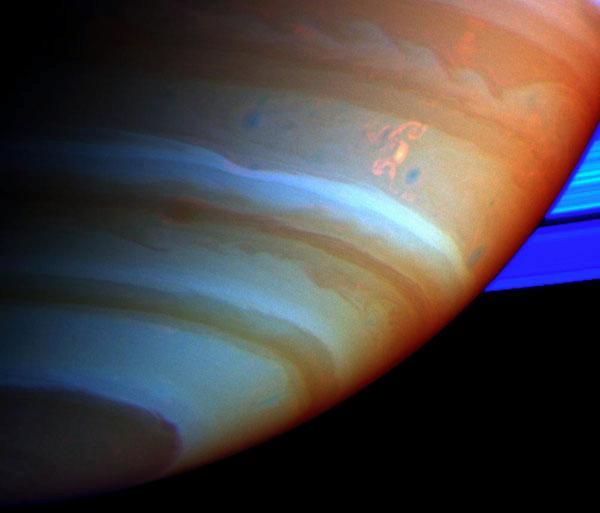
© NASA/JPL/SSIOne possible explanation is that the perihelion passage of a Twin Sun companion is exerting tremendous forces on the inner solar system.
A new estimate of how fast Saturn spins has been made using magnetic data from NASA's Cassini spacecraft - but it is not the answer scientists were expecting.

As a gas giant, Saturn's rotation has been historically difficult to measure. Its hazy atmospheric features shift with respect to each other and cannot be used to clock the spin rate of the planet's interior.

The most commonly cited figure for Saturn's rotation period - 10 hours, 39 minutes and 22.4 seconds - was derived in 1980 from Voyager observations of radio waves generated by solar radiation hitting the planet's atmosphere. Yet Cassini has returned a result almost 8 minutes longer, a difference that defies easy explanation.

"The knowledge of the rotation period is a very important ingredient when you try to model the interior of a planet like Saturn," says Giacomo Giampieri of NASA's Jet Propulsion Laboratory.

Blackbox

'Dropout' Electrons Get Pushed out of Van Allen Belt

Image
© NASAAurora as seen from the International Space Station as it crossed over the southern Indian Ocean on September 17, 2011.
Judging by the many flares erupting from the sun at the moment, it is well on track to reach its next peak in activity early next year. As this peak approaches, we can expect many more huge bursts of energy that erupt from the sun and send lots of energetic particles, and sometimes magnetic fields, our way. These in turn will lead to more of the fantastic light displays, which you might have seen (or at least heard about) lately, creeping down from the North Pole towards the equator.

These light shows are the visible sign that a geomagnetic storm is raging overhead. But there's another phenomenon that happens alongside the northern lights that you won't have noticed at all. Surrounding our planet, way up above the atmosphere, is a doughnut shaped ring of charged particles held in place by Earth's magnetic field. In fact, there are two of them. They're called the inner and outer Van Allen belts.

The Van Allen belts were found in 1958 and were the first major scientific discovery of the space age. During geomagnetic storms, electrons in the Van Allen belts have been known to vanish - only to return a few hours later. This strange phenomenon was first spotted in the 1960s, and has puzzled physicists ever since.

Magnify

Hunting Fossil Viruses in Human DNA

Fossil viruses
© Eye of Science/Photo ResearchersEvolved Fossil viruses are helping to shed light on the deep history of viruses like HIV, shown above with red triangular cores of RNA material.
The borna virus is at once obscure and grotesque. It can infect mammals and birds, but scientists know little about its effects on its victims. In some species it seems to be harmless, but it can drive horses into wild fits. The horses sometimes kill themselves by smashing in their skulls. In other cases, they starve themselves to death. Some scientists have even claimed that borna viruses alter human behavior, playing a role in schizophrenia and bipolar disorder, although others say there is no solid evidence of a link.

The virus now turns out to have an intimate bond with every person on Earth. In the latest issue of Nature, a team of Japanese and American scientists report that the human genome contains borna virus genes. The virus infected our monkey-like ancestors 40 million years ago, and its genes have been passed down ever since.

Magnify

Mammals Made By Viruses

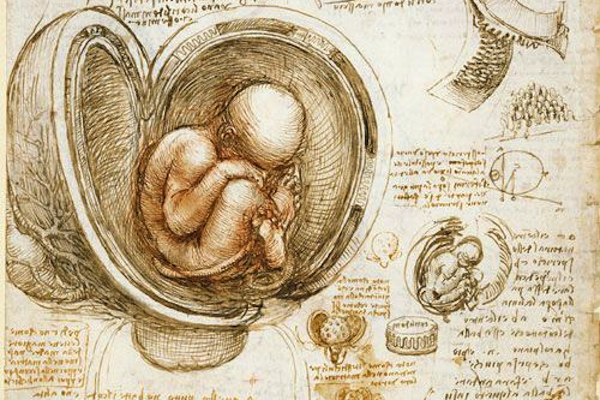
davinci fetus
If not for a virus, none of us would ever be born.

In 2000, a team of Boston scientists discovered a peculiar gene in the human genome. It encoded a protein made only by cells in the placenta. They called it syncytin.

The cells that made syncytin were located only where the placenta made contact with the uterus. They fuse together to create a single cellular layer, called the syncytiotrophoblast, which is essential to a fetus for drawing nutrients from its mother. The scientists discovered that in order to fuse together, the cells must first make syncytin.

What made syncytin peculiar was that it was not a human gene. It bore all the hallmarks of a gene from a virus.

Bizarro Earth

Lava Formations in Western U.S. Linked to Rip in Giant Slab of Earth

Image
© University of California, San DiegoA new model by Scripps researchers details a rupture inside the Farallon slab that caused a magma flow now known as Columbia River flood basalt in the Western U.S.
Like a stream of air shooting out of an airplane's broken window to relieve cabin pressure, scientists at Scripps Institution of Oceanography at UC San Diego say lava formations in eastern Oregon are the result of an outpouring of magma forced out of a breach in a massive slab of Earth. Their new mechanism explaining how such a large volume of magma was generated is published in the Feb. 16 issue of the journal Nature.

For years scientists who study the processes underlying the planet's shifting tectonic plates and how they shape the planet have debated the origins of sudden, massive eruptions of lava at the planet's surface. In several locations around the world, such "flood basalts" are marked by immense formations of volcanic rock. A famous example is India's Deccan flood basalt, a formation widely viewed as related to the demise of the dinosaurs 65 million years ago.

Such eruptions are thought to typically occur when the head of a mantle plume, a mushroom-shaped upwelling of hot rock rising from deep within Earth's interior, reaches the surface. Now Scripps postdoctoral researcher Lijun Liu and geophysics professor Dave Stegman have proposed an alternative origin for the volcanic activity of Oregon's Columbia River flood basalt.

Mars

Venus Could Be Shifting Gears: Planet's Rotation Appears to Have Slowed Down

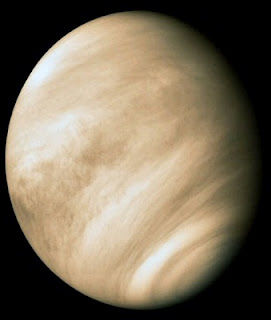
Venus shifting gears
© NASA
A spacecraft orbiting Venus has revealed that Earth's cloud-covered neighbour is rotating a little slower than previously measured.

Peering through the dense atmosphere in the infrared, the ESA's Venus Express spacecraft found surface features were not quite where they should be.

Using the VIRTIS instrument at infrared wavelengths to penetrate the thick cloud cover, scientists studied surface features and discovered that some were displaced by up to 20 km from where they should be given the accepted rotation rate as measured by NASA's Magellan orbiter in the early 1990s.

These detailed measurements from orbit are helping scientists determine whether Venus has a solid or liquid core, which will help our understanding of the planet's creation and how it evolved.

Magic Wand

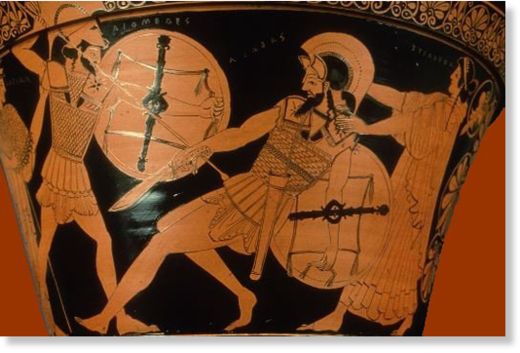
The birds in the Iliad strengthened warriors

Image
© Museum of Fine ArtsKrater painted by the Tyszkiewicz Painter, c 480BC
The birds in the Iliad help warriors and kings make difficult decisions and satisfy the basic human need for self-esteem and security. This is the conclusion of a new doctoral thesis from the University of Gothenburg, Sweden, that analyses 35 bird scenes in Homer's Iliad from around 700 B.C.

In the Iliad, gods use birds to disguise themselves and as transmitters of messages to humans. Similarly, humans use birds as signs and symbols that they interpret to acquire knowledge about the presence and identities of gods and their intentions for the future. Birds therefore have a very important function as intermediaries between humans and their gods.

'The birds are central in the event structure of the Iliad. They often appear in dangerous and important war situations and prior to risky journeys. Receiving a positive bird sign from the gods in those situations strengthened the warriors' fighting spirit and ability to fight, but it also evoked a sense of relief since it indicated that the god was with them,' says the author of the thesis Karin Johansson.

In her thesis, Johansson identifies the different bird species that are included in the Iliad and shows that they are carefully selected to fit into the particular situations and environments where they appear. The most common species are the peregrine falcon, the rock dove and the golden eagle, but also the so-called bearded vulture, with is very uncommon today.

Beaker

New power source discovered

electric sparks
© Unknown
Researchers at the Massachusetts Institute of Technology (MIT) and RMIT University have made a breakthrough in energy storage and power generation.

The power generated relative to the energy source size is three to four times greater than what is currently possible with the best lithium-ion batteries.

While on sabbatical from RMIT in 2009 and 2010, Associate Professor Dr Kourosh Kalantar-zadeh, from the School of Electrical and Computer Engineering, joined MIT Associate Professor Michael Strano's nanotechnology research group.

The team was working on measuring the acceleration of a chemical reaction along a nanotube when they discovered that the reaction generated power.

Now the two researchers are using their combined expertise in chemistry and nanomaterials to explore this phenomenon.

Their work titled "Nanodynamite: Fuel-coated nanotubes could provide bursts of power to the smallest systems" is in the December IEEE Spectrum Magazine, the publication of the IEEE, the world's largest professional technology association.