Science & TechnologyS


Evil Rays

US: Nevada first state to authorize driverless cars

Image
© Hanna-Barbera Productions
The Jetsons would feel right at home in Nevada -- which this month became the first state in the nation to formally approve legislation authorizing the use of autonomous vehicles on its roadways.

The once far-fetched idea is becoming more and more grounded every day as manufacturers work to develop technology that could permit a motorist to plug in a destination and let the vehicle drive there automatically. Indeed, Google has become a leader in autonomous technology, with several prototypes already logging over 160,000 miles in test runs.

While most experts contend the technology is still years away from widespread application, Nevada lawmakers apparently couldn't wait. Last summer, lawmakers there ordered state regulators to establish rules covering the use of autonomous vehicles.

The regulations have now been finalized -- and the Nevada Department of Motor Vehicles will now have to formalize licensing procedures for companies that want to test their vehicles in the state.

Telescope

Mars rocks indicate relatively recent quakes, volcanism, on Red Planet

Image
© HiRISEScientists have found evidence of relatively recent quakes on the surface of Mars by studying boulders that fell off cliffs, leaving tracks behind.
Images of a martian landscape offer evidence that the Red Planet's surface not only can shake like the surface of Earth, but has done so relatively recently. If marsquakes do indeed take place, said the scientists who analyzed the high-resolution images, our nearest planetary neighbor may still have active volcanism, which could help create conditions for liquid water.

With High Resolution Imaging Science Experiment (HiRISE) imagery, the research team examined boulders along a fault system known as Cerberus Fossae, which cuts across a very young (few million years old) lava surface on Mars.

By analyzing boulders that toppled from a martian cliff, some of which left trails in the coarse-grained soils, and comparing the patterns of dislodged rocks to such patterns caused by quakes on Earth, the scientists determined the rocks fell because of seismic activity. The martian patterns were not consistent with how boulders would scatter if they were deposited as ice melted, another means by which rocks are dispersed on Mars.

Info

Fossilized, 'Pompeii' Forest Discovered Under Ash

Ash Covered Forest
© Courtesy of Jun Wang / Painting: Ren YugaoAn artist's painting of a tropical forest before it was preserved in volcanic ash 300 million years ago in what is now Inner Mongolia.

About 300 million years ago, volcanic ash buried a tropical forest located in what is now Inner Mongolia, much like it did the ancient Roman city of Pompeii.

This preserved forest has given researchers the unusual opportunity to examine an ecosystem essentially frozen in place by a natural disaster, giving them a detailed look at ancient plant communities and a glimpse at the ancient climate.

This ancient, tropical forest created peat, or moist, acidic, decaying plant matter. Over geologic time, the peat deposits were subjected to high pressure and became coal, which is found in the area.

The volcano appears to have left a layer of ash that was originally 39 inches (100 centimeters) thick.

"This ash-fall buried and killed the plants, broke off twigs and leaves, toppled trees, and preserved the forest remains in place within the ash layer," the authors, led by Jun Wang of the Nanjing Institute of Geology and Palaeontology in China, wrote in an article published Monday (Feb. 20) in the journal Proceedings of the National Academy of Sciences.

Better Earth

A bill of rights for dolphins: They're so smart we must treat them as 'non human persons' say scientists

Image
© UnknownFlippin' heck: A coalition of scientists are calling for a bill of rights to protect dolphins like bottlenose Fungie who loves to entertain sightseers in boats in Dingle, Ireland
Dolphins are so intelligent that they should be thought of as 'non-human persons' and given their own bill of rights, it is claimed. A coalition of scientists, philosophers and animal welfare groups have come up with a declaration of dolphin rights which they hope will one day be enshrined in law. This would stop them being kept in zoos and waterparks, and being attacked by fishermen.

Whales would also be elevated above other animals by the list of rules, leading to whalers being classed as murderers, the American Association for the Advancement of Science's annual conference heard in Vancouver. Whale watching trips would be subject to regulations which would respect the creatures' privacy, and developers and oil companies would have to give huge consideration to the effect their projects would have on the animals' life and culture.

Philosopher Thomas White said: 'Scientific evidence is now strong enough to support the claim that dolphins are, like humans, self-aware, intelligent beings with emotions and personalities. 'Accordingly, dolphins should be regarded as "non-human persons" and valued as individuals. From an ethical perspective, the injury, deaths and captivity of dolphins are wrong.'

Telescope

NASA Spacecraft Reveals Recent Geological Activity on the Moon

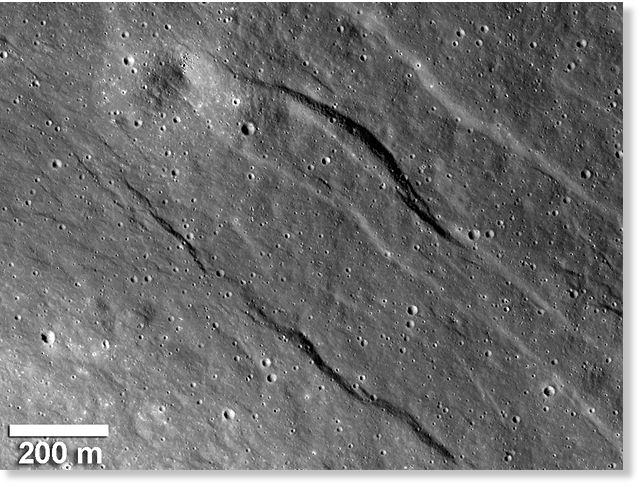
New images from NASA's Lunar Reconnaissance Orbiter (LRO) spacecraft show the moon's crust is being stretched, forming minute valleys in a few small areas on the lunar surface. Scientists propose this geologic activity occurred less than 50 million years ago, which is considered recent compared to the moon's age of more than 4.5 billion years.
Image
© NASA
A team of researchers analyzing high-resolution images obtained by the Lunar Reconnaissance Orbiter Camera (LROC) show small, narrow trenches typically much longer than they are wide. This indicates the lunar crust is being pulled apart at these locations. These linear valleys, known as graben, form when the moon's crust stretches, breaks and drops down along two bounding faults. A handful of these graben systems have been found across the lunar surface.

Sun

Supernova Countdown: Giant Star Could Explode Any Day Now

Image
© N. Smith / J.A. Morse (U. Colorado) et al. / NASAAbout 165 years ago, Eta Carinae mysteriously became the second brightest star in the sky. In 20 years, after ejecting more mass than our sun, it unexpectedly faded
When the sun finally dies some 5 billion years from now, the end will come quietly, the conclusion of a long, uneventful life. Our star will, in a sense, go flabby, swelling first, releasing its outer layers into space and finally shrinking into the stellar corpse known as a white dwarf.

Things will play out quite differently for a supermassive star like Eta Carinae, which lies 7,500 light-years from Earth. Weighing at least a hundred times as much as our sun, it will go out more like an adolescent suicide bomber, blazing through its nuclear fuel in a mere couple of million years and exploding as a supernova, a blast so violent that its flash will briefly outshine the entire Milky Way. The corpse this kind of cosmic detonation leaves behind is a black hole.

Info

Ancient Plants Resurrected from Siberian Permafrost

Resurrected Plant
© David Gilichinsky, PNASOne of the plants regenerated from Pleistocene Age fruit tissue.

Thirty thousand years after their burial on the Siberian tundra, immature fruits have been cultivated into small, weedy plants - the oldest successful regeneration of a living plant from ancient tissue.

The plants, Silene stenophylla, grew and produced lacy white flowers. When fertilized, the ancient plants fruited and produced viable seeds of their own.

"This is very exciting," said Jane Shen-Miller, a University of California, Los Angeles biologist who was not involved in the study. "These tissues are viable after, say, 30,000 years. That is very, very interesting."

Shen-Miller led an earlier project that germinated and grew a 1,300-year-old lotus seed from northern China. Another group of researchers germinated a 2,000-year-old palm date seed from Israel in 2005, the oldest germinating seed known to date.

Beaker

First test-tube hamburger ready this fall: researchers

Image
The world's first "test-tube" meat, a hamburger made from a cow's stem cells, will be produced this fall, Dutch scientist Mark Post told a major science conference on Sunday.

Post's aim is to invent an efficient way to produce skeletal muscle tissue in a laboratory that exactly mimics meat, and eventually replace the entire meat-animal industry.

The ingredients for his first burger are "still in a laboratory phase," he said, but by fall "we have committed ourselves to make a couple of thousand of small tissues, and then assemble them into a hamburger."

Telescope

X-Rays Illuminate the Interior of the Moon

Image
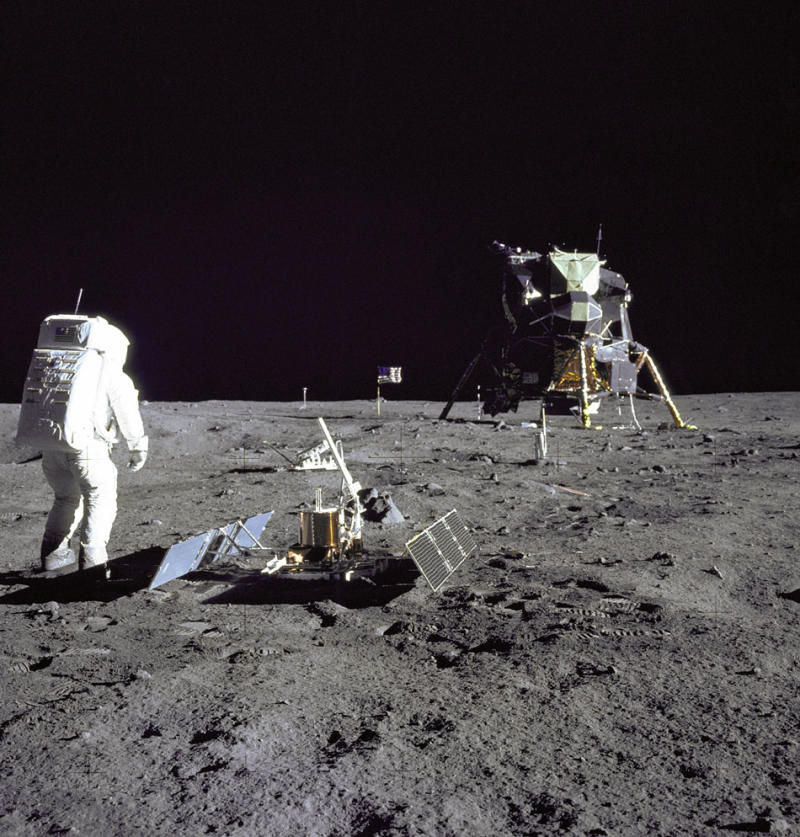
© NASABuzz Aldrin placing a seismometer on the moon during the Apollo 11 mission.
Unlike Earth, our Moon has no active volcanoes, and the traces of its past volcanic activity date from billions of years ago. This is surprising because recent Moonquake data suggest that there is plenty of liquid magma deep within the Moon and part of the rocks residing there are thought to be molten. Scientists have now identified a likely reason for this peaceful surface life: the hot, molten rock in the Moon's deep interior could be so dense that it is simply too heavy to rise to the surface like a bubble in water. For their experiments, the scientists produced microscopic copies of moon rock collected by the Apollo missions and melted them at the extremely high pressures and temperatures found inside the Moon. They then measured their densities with powerful X-ray beams.

The results are published in the journal Nature Geoscience on 19 February 2012.

The team was led by Mirjam van Kan Parker and Wim van Westrenen from VU University Amsterdam and composed of scientists from the Universities of Paris 6/CNRS, Lyon 1/CNRS, Edinburgh, and the European Synchrotron Radiation Facility (ESRF) in Grenoble.

Five decades after the Apollo missions, the formation and geological history of the Moon still hold many secrets. The astronauts not only returned 380 kg of Moon rocks to Earth but also placed many scientific instruments on the lunar surface. Last year, NASA scientists published a new model for the make-up of the interior of the Moon, using Moonquake data from these Apollo-era seismometers. Renee Weber and her colleagues claim that the deepest parts of the lunar mantle, bordering on the small metallic core, are partially molten, by up to 30 per cent. In Earth, such bodies of magma tend to move towards the surface leading to volcanic eruptions. If the deep interior of the Moon contains so much magma, why don't we see spectacular volcanic eruptions at its surface?

Telescope

Gamma-ray bursts' highest power side unveiled by Fermi telescope

Image
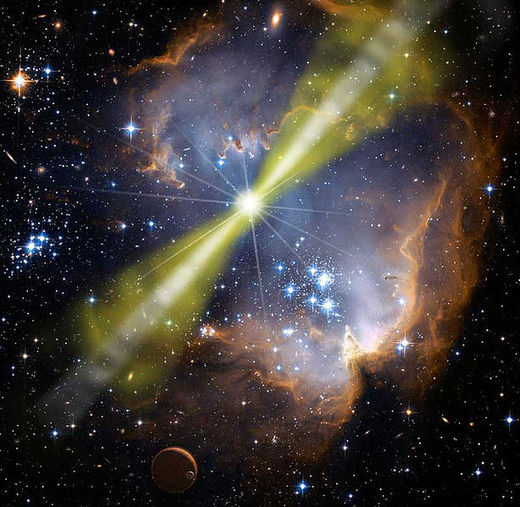
© NASAArtist's illustration of one model of the bright gamma-ray burst GRB 080319B.
Detectable for only a few seconds but possessing enormous energy, gamma-ray bursts are difficult to capture because their energy does not penetrate the Earth's atmosphere. Now, thanks to an orbiting telescope, astrophysicists are filling in the unknowns surrounding these bursts and uncovering new questions.

The Fermi Gamma-Ray Space Telescope, formerly called the Gamma-Ray Large Area Space Telescope, launched on June 11, 2008. As part of its mission, the telescope records any gamma-ray bursts within its viewing area.

"Fermi is lucky to measure the highest energy portion of the gamma-ray burst emission, which last for hundreds to thousands of seconds -- maybe 20 minutes," said Péter Mészáros, Eberly Chair Professor of Astronomy and Astrophysics and Physics, Penn State.

Most gamma-ray bursts occur when stars that are more than 25 times larger than our sun come to the end of their lives. When the internal nuclear reaction in these stars ends, the star collapses in on itself and forms a black hole. The outer envelope of the star is ejected forming a supernova.

"The black hole is rotating rapidly and as it is swallowing the matter from the star, the rotation ejects a jet of material through the supernova envelope," said Mészáros.

This jet causes the gamma-ray burst, which briefly becomes the brightest thing in the sky. However, unlike supernovas that radiate in all directions, gamma-ray bursts radiate in a very narrow area, and Fermi sees only jets ejecting in its direction. This, however, is the direction in which they send their highest energy photons. Any gamma-ray bursts on the other side of the black hole or even off at an angle are invisible to the telescope.