Science & TechnologyS


Sherlock

Inbreeding Mutation: Extraordinary story of Appalachia's 'Blue Family' whose bodies were discoloured after generations of inbreeding

In the Appalachian Mountains rests a medical oddity so unusual that it at first seems a massive hoax.

Dating back to the early 1800s, an isolated family in eastern Kentucky - who can trace their roots back to a French orphan - started producing children who were blue.

As a result of a coincidental meeting of recessive genes, intermarriage and inbreeding, members of the Fugate family were born with a rare condition that made them visibly discoloured.

Image
© UnknownFeeling blue: Due to inbreeding and inter-marriage, a rural family developed a rare skin discolouration
The mystery behind the astonishing picture of the Fugates, which has been baffling people for years, appears to have finally been solved.

It began when Martin Fugate, a French orphan, settled on the banks of eastern Kentucky's Troublesome Creek to claim a land grant in the early 19th century.

Bulb

Super Space Bugs Generate Electricity

Image
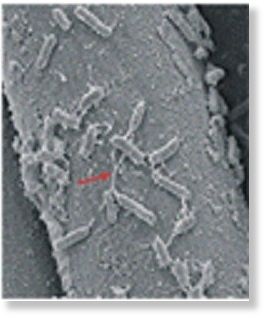
© Newcastle UniversityScientists have discovered that space bugs can generate electricity.
Scientists have discovered that space bugs can generate electricity.

Scientists from Newcastle University have discovered that space bugs - Bacillus stratosphericus and Bacillus altitudinis - bacteria normally found 30km above the earth have been identified as highly efficient generators of electricity.

Bacillus stratosphericus and Bacillus altitudinis are microbes commonly found in high concentrations in the stratosphere orbiting the earth but these microbes were spotted near the river Wear, which is located at Wear Estuary, Country Durham in the UK. Scientists believe that they were brought down to earth because of atmospheric cycling processes, according to a press release from the university.


Comment: And if so, we wonder about other microbes, bacteria or pathogens that can find their way from out of space to our back yard. Read New Light on the Black Death: The Viral and Cosmic Connection to learn more.


During the experiment, they had collected 75 different species of bacteria near river Wear. They tested these bacteria by using a Microbial Fuel Cell (MFC), a bio-electrochemical system that converts organic compounds directly into electricity by a process known as bio-catalytic oxidation. They discovered that the best species of bacteria like Bacillus stratosphericus and the Bacillus altitudinis were able to create an artificial biofilm that doubles the electrical output of the MFC from 105 milliwatts per cubic metre to 200 milliwatts per cubic metre.

Info

Space Elevator, Going Up

Space Elevator
© NASA

Ever ridden in one of those elevators where a softly feminine, robotic voice alerts you to what floor you're going to next? Yeah, me neither. But if I had, wouldn't it be cool if the voice said this instead: Going up. Next floor, outer space.

According to The Daily Yomiuri, Tokyo construction company, Obayashi Corporation, hopes to erect a space elevator by 2050. As a doff of the cap to our British readers, the space lift would ferry passengers and cargo along a carbon nanotube ribbon from a terrestrial terminal to a spaceport nearly a quarter of the way to the moon.

How is this possible? Well, on paper, here's what's on tap:

At the end of a 59,652-mile-long, carbon-nanotube cable, there would be a counterweight floating in space and anchoring the assembly connected to the ground terminal. Passengers would travel from terra firma to a spaceport research center equipped with residential facilities located 22,369 miles above the Earth's surface.

Telescope

Tellurium: Rare Element Discovered in Ancient Starlight

Tellurium
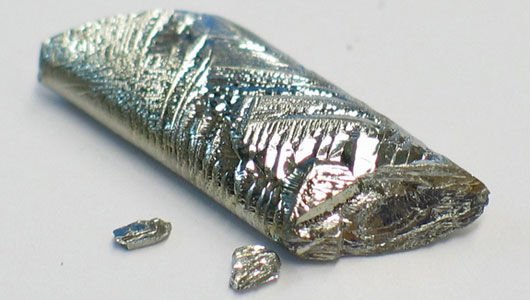
© MITSTAR STUFF: A photo of an ultra pure tellurium crystal. Astronomers have discovered the material in deep space by analyzing light from three ancient stars.
Tellurium has been a 'tough' element to detect because it absorbs light in the ultraviolet spectrum.

Light from three ancient stars at the edge of the Milky Way indicates that the stars contain tellurium, a brittle, superconducting element that is rare on Earth.

The cosmic discovery, which also spotted traces of other heavy elements, supports the theory that these elements were synthesized in the rapidly collapsing cores of rare supernovas (stellar explosions).

"You can make iron and nickel in any ordinary supernova, anywhere in the universe," said Anna Frebel, an astrophysicist at the Massachusetts Institute of Technologyand a member of the research team. "But these heavy elements seem to only be made in specialized supernovas."

According to the theory, heavy atoms form during rapid nuclear fusion at the heart of some supernovas. Called r-process, it sets in when a supernova core collapses, bombarding atomic nuclei with a fierce onslaught of neutrons. The result is the production of atoms heavier than iron, which then get hurled into space, enriching the cloud of gas and dust that eventually collapses to form another star.

Evil Rays

35 Years Later, The 'Wow!' Signal Still Tantalizes

The
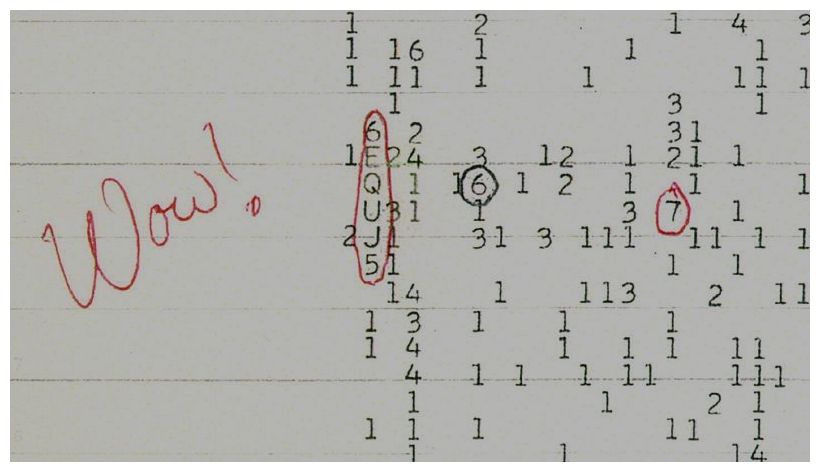
© Wikimedia CommonsThe "Wow!" signal.

Since the SETI program first began searching for possible alien radio signals a few decades ago, there have been many false alarms but also instances of fleeting signals of interest which disappeared again as quickly as they had appeared. If a potential signal doesn't repeat itself so it can be more carefully observed, then it is virtually impossible to determine whether it is of truly cosmic origin. One such signal in particular caught astronomers' interest on August 15, 1977. The famous "Wow!" signal was detected by the Big Ear Radio Observatory at Ohio State University; it was thirty times stronger than the background noise but lasted only 72 seconds and was never heard again despite repeated subsequent searches.

In a new book entitled The Elusive Wow, amateur astronomer Robert Gray chronicles the quest for the answer to this enduring puzzle.

When the signal was first seen in the data, it was so pronounced that SETI scientist Jerry Ehman circled it on the computer printouts in red ink and wrote "Wow!" next to it. It appeared to fit the criteria for an extraterrestrial radio signal, but because it wasn't heard again, the follow-up studies required to either confirm or deny this were not possible. So what was it about the signal that made it so interesting?

Beaker

How Did Human Brains Get to Be So Big?

Human brain
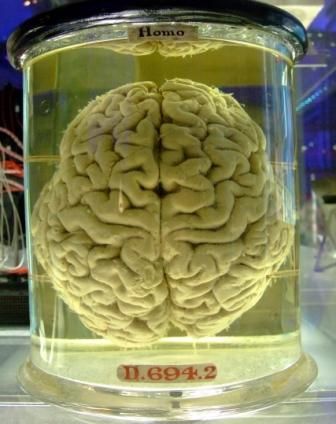
© Gaetan LeeHuman brain
New research points to an ancient energy tradeoff that meant more fuel for brains, and less fuel for muscles

Recently while visiting the National Museum of Natural History in Washington, D.C., I found myself pondering the noggins of some very, very, old apes.

Along one wall of the Hall of Human Origins - an exhibit on human evolution that opened in 2010 - were 76 fossil skulls from 15 species of early humans. Looking at these skulls, one thing was clear: millions of years of evolution have given us much bigger brains.

In the 8 to 6 million years since the ancestors of humans and chimps went their separate ways, the human brain more than tripled in size. If the earliest humans had brains the size of oranges, today's human brains are more akin to cantaloupes.

As for our closest primate relatives, the chimps? Their brains haven't budged.

Saturn

Researchers Say Galaxy May Swarm with "Nomad Planets"

Image
© Greg Stewart / SLAC National Accelerator LaboratoryThis image is an artistic rendition of a nomad object wandering the interstellar medium. The object is intentionally blurry to represent uncertainty about whether it has an atmosphere. A nomadic object may be an icy body akin to an object found in the outer solar system, a more rocky material akin to asteroid or even a gas giant similar in composition to the most massive solar system planets and exoplanets.
Our galaxy may be awash in homeless planets, wandering through space instead of orbiting a star.

In fact, there may be 100,000 times more "nomad planets" in the Milky Way than stars, according to a new study by researchers at the Kavli Institute for Particle Astrophysics and Cosmology (KIPAC), a joint institute of Stanford University and the SLAC National Accelerator Laboratory.

If observations confirm the estimate, this new class of celestial objects will affect current theories of planet formation and could change our understanding of the origin and abundance of life.

"If any of these nomad planets are big enough to have a thick atmosphere, they could have trapped enough heat for bacterial life to exist," said Louis Strigari, leader of the team that reported the result in a paper submitted to the Monthly Notices of the Royal Astronomical Society. Although nomad planets don't bask in the warmth of a star, they may generate heat through internal radioactive decay and tectonic activity.

Cookie

NASA Will Pay You to Eat Astronaut Food for 4 Months

NASA
You read that right. NASA wants volunteers for their four-month simulation to Mars. But instead of conducting tests on confinement and psychological stress, NASA just want to study your tastebuds.

According to Mashable,
The space agency is looking for applicants to eat astronaut food for four months during a simulated trip to the Red Planet. Participants will try instant foods, and ones with shelf-stable ingredients, and scientists will record their reactions. The goal of the experiment is to discover what foods people like to consume consistently.
Astronaut ice cream aside, limited supplies (such as flour, sugar and dried meat), and no chance of fresh food limits the space-based diet. This study will gauge if participants can avoid "menu fatigue," that is, becoming tired of eating the same foods. The study background states that if menu fatigue occurs, astronauts' "overall food intake declines, putting them at risk for nutritional deficiency, loss of bone and muscle mass, and reduced physical capabilities."

Info

Is Another Mass Extinction Event on the Way?

Dinosaur
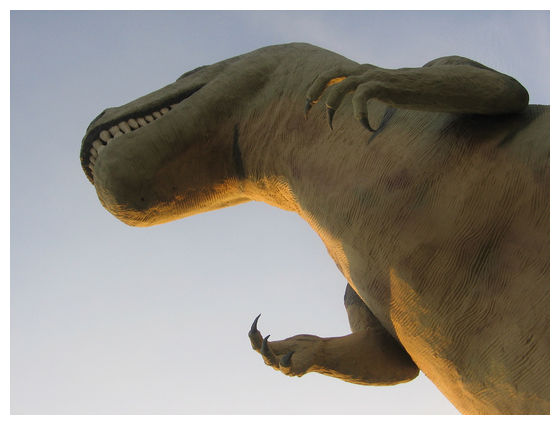
© Mr Kimberley / FlickrYou have to go back to the time of the dinosaurs to see where Earth is heading.

Why have mass extinctions of species occurred since the late Proterozoic (from 580 million years ago) and repeatedly through the Phanerozoic? Integral to these extinctions were abrupt changes in the physical and chemical properties of the atmosphere, ocean and land, inducing environmental changes at a pace to which many species could not adapt.

The best documented example to date is the 65 million years-old K-T boundary asteroid impact and extinction event. But several other mass extinctions were associated with volcanic eruptions and asteroid/comet impacts (see Figure 1).

Instantaneous effects of impacts (initial fireball flash as the asteroid or comet enters the atmosphere, crater explosion, seismic shock, tsunami waves, incandescent ejecta, dust plumes, greenhouse gas release from carbon-rich limestone and shale) occurred over periods ranging from seconds to weeks and months.

As shown in figure 1, Phanerozoic history (since about 540 million years ago) is marked with a number of mass extinction events. About 80% of genera were lost at the ~251 Ma Permian-Triassic boundary event. This was a consequence of both volcanic eruptions (known as the Siberian Norilsk traps) and an asteroid impact near Araguinha, Brazil (Araguinha: 40 km-diameter; 252.7+/-3.8 Ma).

Info

Blood Mystery Solved

Bryan Ballif
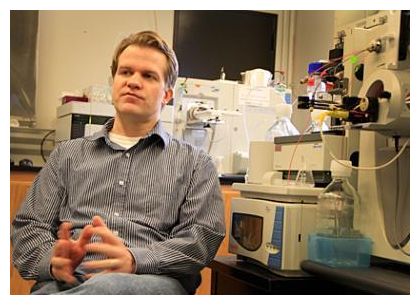
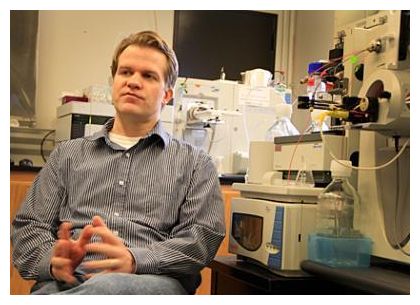
© Joshua Brown, University of Vermont, 2012With skilled handling of this mass spectrometer, University of Vermont biologist Bryan Ballif unraveled the mystery of two little-understood blood types. Now he and his international colleagues are looking for more.

You probably know your blood type: A, B, AB or O. You may even know if you're Rhesus positive or negative. But how about the Langereis blood type? Or the Junior blood type? Positive or negative? Most people have never even heard of these. Yet this knowledge could be "a matter of life and death," says University of Vermont biologist Bryan Ballif.

While blood transfusion problems due to Langereis and Junior blood types are rare worldwide, several ethnic populations are at risk, Ballif notes. "More than 50,000 Japanese are thought to be Junior negative and may encounter blood transfusion problems or mother-fetus incompatibility," he writes.

But the molecular basis of these two blood types has remained a mystery - until now.

In the February issue of Nature Genetics, Ballif and his colleagues report on their discovery of two proteins on red blood cells responsible for these lesser-known blood types.

Ballif identified the two molecules as specialized transport proteins named ABCB6 and ABCG2.

"Only 30 proteins have previously been identified as responsible for a basic blood type," Ballif notes, "but the count now reaches 32."

The last new blood group proteins to be discovered were nearly a decade ago, Ballif says, "so it's pretty remarkable to have two identified this year."