Science & TechnologyS


Info

The Woman in Red-Dress Effect

Woman in Red
© Adam PazdaWoman in red. In a survey, men graded the same woman to be more interested in sex when covered in a red as opposed to a white shirt.

Red dresses muddle men's minds, just ask The Matrix's Neo. In a scene from the 1999 sci-fi film, the hero is famously ambushed after becoming distracted by a woman on the street wearing a slinky red outfit. Now, a new study shows how such duds attain their sway. Men rate women wearing red clothing as being more interested in sex, hinting that humans may be conditioned to associate the color with fertility.

The pull of red is nothing new. Women have donned pinkish blush and bright lipstick for nearly 12,000 years. And, if you're lucky enough to get a Valentine's Day card, it will probably come decorated in tiny red hearts. It's an effect that likely stems from biology, says Adam Pazda, a psychologist at the University of Rochester in New York state and an author of the new study. When many primate females - from chimpanzees to types of baboons called mandrills - become fertile, their estrogen levels peak, opening up their blood vessels and turning their faces bright red. This flushed complexion seems to give males the signal that it's time to make their move.

The same could be true for humans, Pazda says. In a previous study, scientists showed that men seem to be more attracted to women clothed in red rather than in a blah color such as white. That's regardless of the cut, he adds. "It doesn't have to be a red dress or a sexy outfit," he says. "It can be a red T-shirt."
Info

Trans-Neptunian Object 2012 DR30 Discovered

M.P.E.C. 2012-D67, issued on 2012, February 26, announces the discovery of a new Trans-Neptunian Object (discovery magnitude 18.7) by R. H. McNaught with 0.5-m Uppsala Schmidt + CCD at Siding Spring on February 22, 2012. The new object has been designated 2012 DR30.

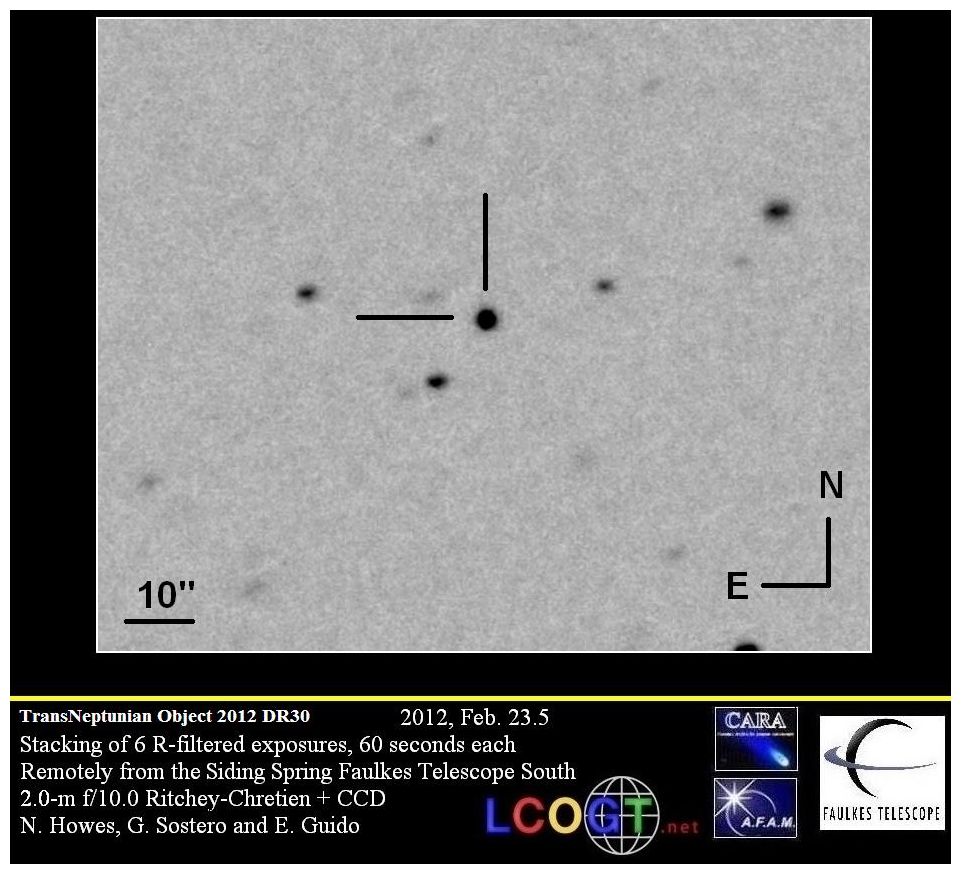
We performed some follow-up measurements of this object, while it was still on the neocp. Stacking of six R-filtered exposures, 60-sec each, obtained remotely, from the Siding Spring-Faulkes Telescope South on 2012, Feb. 23.5, through a 2.0-m f/10.0 Ritchey-Chretien + CCD, shows that the object has stellar aspect.

Our confirmation image

2012 DR30
© Remanzacco Observatory
M.P.E.C. 2012-D67 assigns the following preliminary orbital elements to 2012 DR30: H= 7.2; e= 0.91; a= 160.45; Peri.= 203.99; q= 14.43 AU; Incl.= 76.04

Info

Spinning Star's Vanishing Act Reveals Cosmic Mystery

Vanishing Pulsar
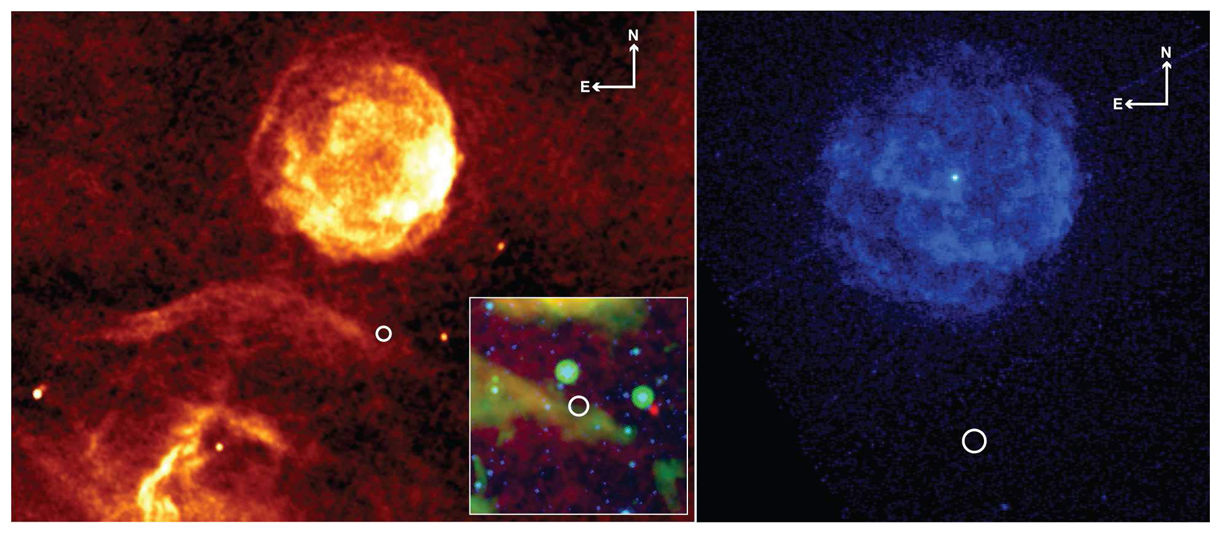
© Shami ChatterjeeWhile studying the globelike supernova remnant, astronomers discovered a new pulsar, PSR J1841-0500. After shining for at least a year, the pulsar, located inside the white circle, abruptly disappeared. The left image was provided by the Multi-Array Galactic Plane Imaging Survey, the right by CHANDRA.

Pulsars are fast-spinning stars that emit regular beams of light known for their clock like regularity. So, when one strangely turned off for a year and a half, astronomers were surprised to find that this abnormality could help them solve the longstanding mystery of what makes these flashing stars tick.

Despite more than forty years of study, astronomers still can't nail down what causes these rapidly rotating stars to pulse. But when one, called PSR J1841, turned off for 580 days, it gave astronomers a glimpse of how pulsars behave when they can't be seen.

In December 2008, Fernando Camilo, of Columbia University in New York, was using the Parkes telescope in Australia to search for a known object when he found a steadily flashing star in his field of view. He quickly identified it as a pulsar that was spinning once every 0.9 seconds - a fairly standard rotation.

"I wasn't too excited," Camilo admitted to SPACE.com.

His team continued to study the pulsar over the course of a year to help determine the characteristics of the new discovery, which orbits 22.8 light-years from the sun in the Scutum-Centaurus spiral arm of our Milky Way galaxy. Just as he was about to conclude his follow-up observations, the star disappeared.

"At first, I thought there was something wrong with my equipment," Camilo said.

But after several tests, it was obvious that the pulsar had vanished.

"I realized, it's really off now."

Comment: There are simple explanations for pulsars in the Electric Universe Theory. Electric Cosmology:
Pulsars are stars that have extremely short periods of variability in their production of EM radiation (both light and radio frequency emissions) . When they were first discovered it was thought that they rotated rapidly - like lighthouses. But when the observed rate of "rotation" got up to about once per second for certain pulsars, despite their having masses exceeding that of the sun, this official explanation became untenable. Instead, the concept of the "neutron star" was invented. It was proposed that only such a dense material could make up a star that could stand those rotation speeds.

But, one of the basic rules of nuclear chemistry is the 'zone of stability'. This is the observation that if we add neutrons to the nucleus of any atom, we need to add an almost proportional number of protons (and their accompanying electrons) to maintain a stable nucleus. In fact, it seems that when we consider all the natural elements (and the heavy man made elements as well), there is a requirement that in order to hold a group of neutrons together in a nucleus, a certain number of proton-electron pairs are required. The stable nuclei of the lighter elements contain approximately equal numbers of neutrons and protons, a neutron/proton ratio of 1. The heavier nuclei contain a few more neutrons than protons, but the limit seems to be 1.5 neutrons per proton. Nuclei that differ significantly from this ratio SPONTANEOUSLY UNDERGO RADIOACTIVE TRANSFORMATIONS that tend to bring their compositions into or closer to this ratio.

Flying in the face of this observed fact, mainstream astrophysicists continue to postulate the existence of stars made up of solid material consisting only of neutrons, "neutronium". This is yet one more example of Fairie Dust entities fantasized by astrophysicists to explain otherwise inexplicable observations. The 'neutron star' is simply yet another fantasy conjured up, this time, in order to avoid confronting the idea that pulsar discharges are electrical phenomena. A nucleus or charge free atom made up of only neutrons has never been synthesized in any laboratory nor can it ever be.

Some pulsars oscillate with periods in the millisecond range. Their radio pulse characteristics are: the 'duty cycle' is typically 5% (i.e., the pulsar flashes like a strobe light - the duration of each output pulse is much shorter than the length of time between pulses); some individual pulses are quite variable in intensity; the polarization of the pulse implies the origin has a strong magnetic field; magnetic fields require electrical currents. These characteristics are consistent with an electrical arc (lightning) interaction between two closely spaced binary stars. Relaxation oscillators with characteristics like this have been known and used by electrical engineers for many years.


Sheeple

Mystery virus kills thousands of lambs

lamb virus
© GettyThe worst affected counties are Norfolk, Suffolk, East Sussex and Kent, but the virus has spread all along the south coast to Cornwall

Thousands of lambs have been killed by a new virus that is threatening the survival of many British farms.

The Schmallenberg virus causes lambs to be born dead or with serious deformities such as fused limbs and twisted necks, which mean they cannot survive.

Scientists are urgently trying to find out how the disease, which also affects cattle, spreads and how to fight it, as the number of farms affected increases by the day.

So far, 74 farms across southern and eastern England have been hit by the virus, which arrived in this country in January.

A thousand farms in Europe have reported cases since the first signs of the virus were seen in the German town of Schmallenberg last summer.

The National Farmers Union has called it a potential "catastrophe" and warned farmers to be vigilant. "This is a ticking time bomb," said Alastair Mackintosh, of the NFU. "We don't yet know the extent of the disease. We only find out the damage when sheep and cows give birth, and by then it's too late."

Chalkboard

There's Math Hiding in the Music We Love

music math fractels
© Vlue / Shutterstock
After analyzing close to 2,000 compositions, researchers have uncovered a mathematical formula governing the rhythmic patterns in music. Researchers discovered that composers have their own individual rhythmic signature. "Mozart's notated rhythms were the least predictable, Beethoven's were the most, and Monteverdi and Joplin had nearly identical, overlapping rhythm distributions. But they each have their own distinctive rhythmic signature that you can capture," says Daniel Levitin, a neuroscientist at McGill University.

"One of the things that we've known about music for a couple of decades is that the distribution of pitches and loudness in music follow predictable mathematical patterns," says Daniel Levitin, a neuroscientist at McGill University and co-author of the study published in the Proceedings of the National Academy of Sciences.
"Rhythm is even more fundamental to our enjoyment of music: it's rhythm that infants respond to first, it's rhythm that makes you want to get out of your chair and move, and so it's not really a surprise to discover that rhythm, too, is governed by a similar mathematical formula."
Levitin and Vinod Menon, a neuroscientist at Stanford University, led the team that analyzed the scores of close to 2,000 musical compositions written by more than 40 composers over the last 400 years in a large variety of Western musical genres.

They found that all the musical compositions they studied shared the same "fractal" quality, where the part is a more limited repetition of the whole. That is the larger temporal structure of well-formed musical pieces is composed of repeating motifs of their own short-term temporal structure.

At the same time, researchers also discovered that each composer had his or her own highly individual rhythmic signature.

Info

European Neandertals on the Verge of Extinction Even Before the Arrival of Modern Humans

Neanderthal Teeth
© Centro de Evolución y Comportamiento Humanos (UCM-ISCIII)Teeth from a Neanderthal boy, northern Spain.

New findings from an international team of researchers show that most neandertals in Europe died off around 50,000 years ago. The previously held view of a Europe populated by a stable neandertal population for hundreds of thousands of years up until modern humans arrived must therefore be revised.

This new perspective on the neandertals comes from a study of ancient DNA published today in Molecular Biology and Evolution. The results indicate that most neandertals in Europe died off as early as 50,000 years ago. After that, a small group of neandertals recolonised central and western Europe, where they survived for another 10,000 years before modern humans entered the picture. The study is the result of an international project led by Swedish and Spanish researchers in Uppsala, Stockholm and Madrid.

"The fact that neandertals in Europe were nearly extinct, but then recovered, and that all this took place long before they came into contact with modern humans came as a complete surprise to us. This indicates that the neandertals may have been more sensitive to the dramatic climate changes that took place in the last Ice Age than was previously thought", says Love Dalén, associate professor at the Swedish Museum of Natural History in Stockholm.

Sun

NASA Captures Incredible Video Of Epic Solar Tornado With A Diameter As Big As The Earth Itself

The Solar Dynamics Observatory (SDO) is a NASA satellite mission which will observe the Sun for over five years. It was launched on February 11, 2010, and the observatory is part of the Living With a Star (LWS) program. The goal of the LWS program is to develop the scientific understanding necessary to effectively address those aspects of the connected Sun - Earth system that directly affect life and society. Ever since its launch, SDO has captured a bounty of astonishing images and video of our Sun, the most recent of which was taken over a 30-hour span between February 7-8, 2012.

The video shows a gargantuan tornado ripping along the surface of the Sun with gusts up to 300,000mph. Terry Kucera is a solar physicist with NASA's Goddard Space Flight Center, and in an interview with FOX News he said, "It's about 15,000 degrees Fahrenheit - relatively cool." Which is accurate when considering the Sun's corona is a whopping 2 million degrees. Solar tornadoes such as this one are known as "solar prominences", and the existence of these huge beasts have been known about since at least 1996 when the European Space Agency's SOHO spacecraft captured evidence of them near the Sun's north and south poles. Although they look very much like their tiny Earth-bound cousins, these solar tornadoes are structured in an entirely different way - through magnetism, not pressure and temperature fluctuations.

Competing magnetic forces which pull the charged magnetic particles on the sun back and forth, create the spinning mass of plasma that tracks along strands of magnetic field lines, NASA explained. The diameter of the funnel is estimated to be roughly the same diameter of Earth, and the long, ribbon shapes could span hundreds of thousands of miles (i.e. several Earths long). High resolution recordings such as this were not possible until the launch of SDO. The satellite has several cameras on board which are constantly capturing solar activity in various wavelengths and frequencies. "Each wavelength of light tells us something different," said Kucera.

Rocket

Romania Sends First Nanosatellite to Space

Image
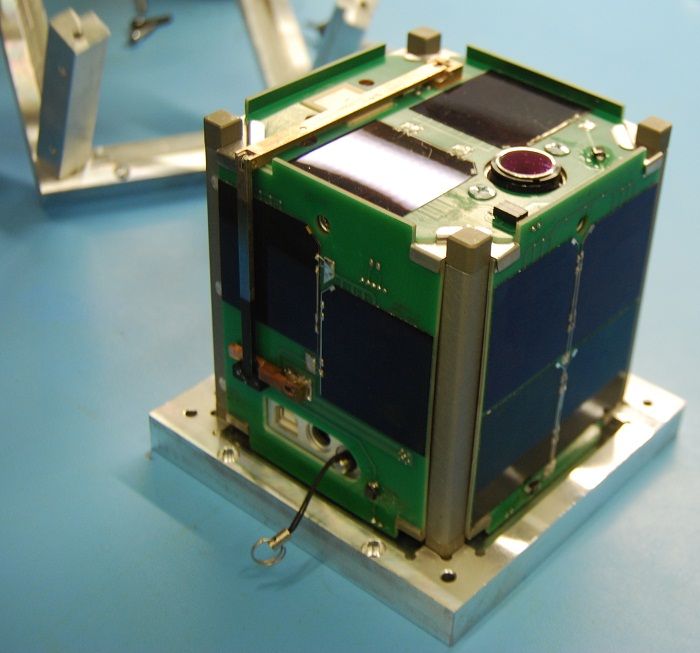
Romania launched its first satellite to space today (February 13) from a base in the French Guiana. The nanosatellite, called Goliat (in picture, left), was created by a research consortium led by the Romanian Space Agency, and was launched together with the inaugural flight of the European Space Agency's Vega rocket (in picture, below).

Romania's satellite Goliat, designed as a cube with 10 cm margins and weighting 1 kilogram, will capture high - resolution images, measure radiations, and micro-meteor influx. It includes a digital camera, a nuclear radiations detector, and a micro-meteor detector, as well as radio communication systems, a board computer, and a system to determine and control altitude.

The Romanian Space Agency aims to develop and launch nanosatellites for complex missions in observing the Earth. The project includes two stations in Romania - the Magurele station close to Bucharest and the ROSA station in Cluj. The project was coordinated by Marius - Ioan Piso from the Romanian Space Agency. The team which created this first nanosatellite also included teachers and students from the Bucharest University and the Polytechnics University.

Bulb

Replacing Electricity With Light: First Physical 'Metatronic' Circuit Created

Image
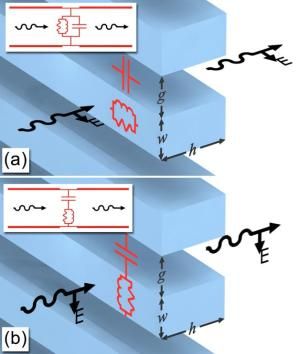
© University of PennsylvaniaFigure A. When the plane of the electric field is in line with the nanorods the circuit is wired in parallel. Figure B. When the plane of the electric field crosses both the nanorods and the gaps the circuit is wired in series.
The technological world of the 21st century owes a tremendous amount to advances in electrical engineering, specifically, the ability to finely control the flow of electrical charges using increasingly small and complicated circuits. And while those electrical advances continue to race ahead, researchers at the University of Pennsylvania are pushing circuitry forward in a different way, by replacing electricity with light.

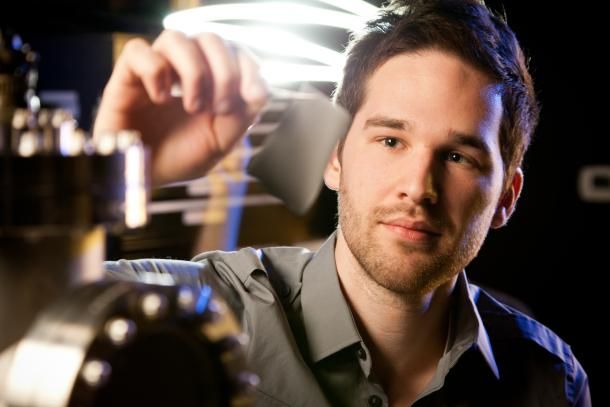
"Looking at the success of electronics over the last century, I have always wondered why we should be limited to electric current in making circuits," said Nader Engheta, professor in the electrical and systems engineering department of Penn's School of Engineering and Applied Science. "If we moved to shorter wavelengths in the electromagnetic spectrum -- like light -- we could make things smaller, faster and more efficient."

Different arrangements and combinations of electronic circuits have different functions, ranging from simple light switches to complex supercomputers. These circuits are in turn built of different arrangements of circuit elements, like resistors, inductors and capacitors, which manipulate the flow of electrons in a circuit in mathematically precise ways. And because both electric circuits and optics follow Maxwell's equations -- the fundamental formulas that describe the behavior of electromagnetic fields -- Engheta's dream of building circuits with light wasn't just the stuff of imagination. In 2005, he and his students published a theoretical paper outlining how optical circuit elements could work.

Cell Phone

'Power Felt' electricity-generating fabric to power iPhone with body heat?

Image
© Wake Forest’s Center for Nanotechnology and Molecular Material
Researchers from the Center for Nanotechnology and Molecular Materials at Wake Forest University have developed a cost-efficient fabric that can capture body heat and convert it into electricity. It may one day power your iPhone or laptop.

You're looking at a smartphone case's material of the future, which will allow for self-charging cell phones with the literal touch of a finger.

A "smart" felt, created by researchers from the Center for Nanotechnology and Molecular Materials at Wake Forest University, converts the difference between two differing temperatures into an electrical current.

The research was published in the latest issue of nanotechnology journal, Nano Letters.

Named the "Power Felt," the fabric-like material generates heat when immersed in an environment where differences in temperature exist between one side of the felt and the other. If one side of the surface is exposed to heat, while the other is exposed to a cooler room temperature air, an electrical current is generated within the fabric.