

© n/a
The Vostok project breathes an air of mystery and operates at the frontiers of human knowledge. The lake is one of the major discoveries in modern geography; drilling operations at such depths are unprecedented; never before has a geological project required such subtle technologies.
The main inspiration for the project - the Russian scientist who posited the lake's existence - died just six months before the moment of contact with the lake's surface. Now, the whole world is looking to Lake Vostok for crucial data which might help to predict climate change.
"Yesterday [on Sunday] our scientists at the Vostok polar station in the Antarctic completed drilling at depths of 3,768 meters and reached the surface of the subglacial lake," RIA Novosti reported, quoting an unnamed Russian scientist.
Meanwhile, Itar-Tass news agency says the scientists still have a few meters to go.
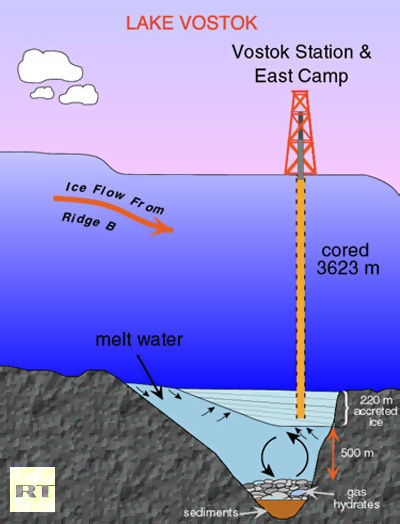
© earth.columbia.edu
If some primitive bacteria or even more complex life-forms are found to have survived the isolation, it could offer an earth-shattering insight into our planet's past.
But if the lake proves to be a closed system devoid of any life, it would offer scientists the chance to test their theories on how to search for extra-terrestrial life on future space trips. Conditions in the lake are often described as "alien," as they resemble lakes on Jupiter's moon Europa.
When drilling work began around Vostok Station in the Antarctic in the 1970s, scientists had no idea a mysterious lake lay under the massive ice sheet. It was only in 1996 that Russian specialists, supported by their British counterparts, discovered with sonar and satellite imaging what later proved to be one of the world's largest freshwater reservoirs. In size, Lake Vostok matches Lake Ontario.
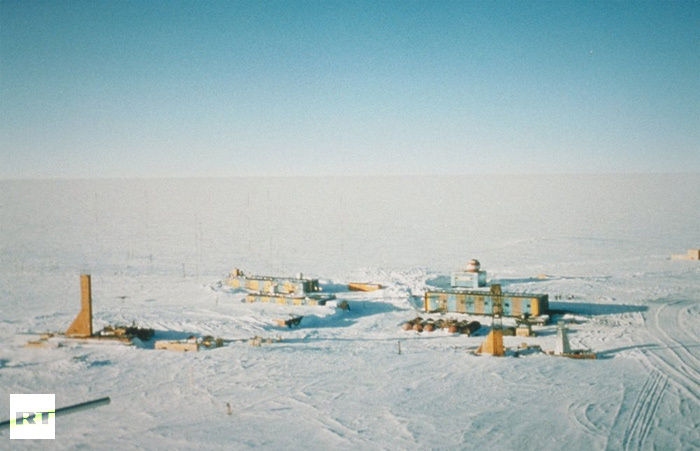
© Todd Sowers LDEO, Columbia UniversityPanoramic photo of Vostok Station showing the layout of the camp.
The relevant technology was developed in 2003 in St. Petersburg. Work resumed in 2005 after tests.
After the 24-hour-a-day drilling work is over, scientists are to take samples of lake water which penetrates through the crack. Specialists at the Russian Arctic and Antarctic Research Institute predict they will find "the only giant super-clean water system on the planet." The pristine water will be "twice cleaner than double-distilled water," they believe.
The Vostok Antarctic research station is no Bali resort. Its temperatures average around - 66 degrees Centigrade. Earth's the lowest ever temperature was recorded there on July 21, 1983, when it hit - 89.2 C.





OMG! Seriously? As if they haven't raped and corrupted Mother Earth enough... now this. All in the name of "scientific research". Idiots. Not only could it pose a threat to the general ecosphere by releasing ancient micro bacteria (gas) or "alien" particiles into our air and water that we are unfamiliar with, but the reverse as well... a pure untouched source, now ruined by ignorant humans. The bubble has been bursed. Unbelievable.
On a related note, I love how "the powers that be" deny the end of the world and assure the public that life will go on... BUT...
They continue to do things as if time is running out. Seed vaults, gold hoarding, tapping into untouched areas. If all this will still be around in years or decades or centuries... what's the hurry? Answer: They Know The Truth. They are doing so many things as if a grand clock is ticking down. How can so many people be blind to this fact?