
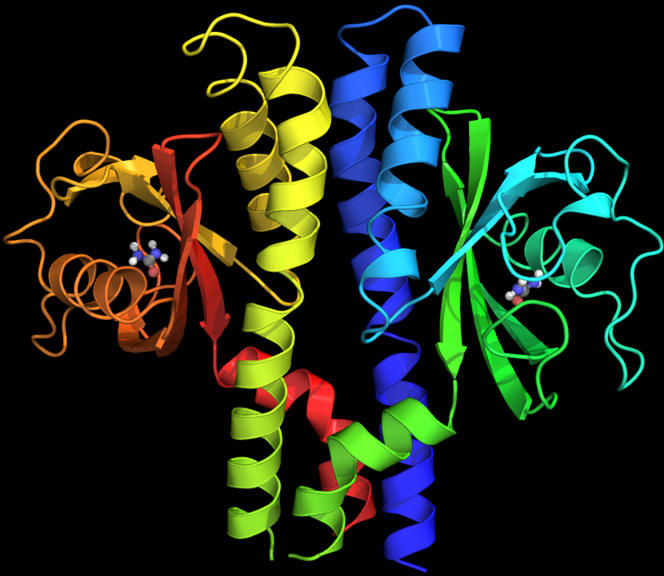
© Ímage courtesy of University of OregonAtomic-resolution view of a receptor reveals how stomach bacterium avoids acid.
Their report -- online ahead of regular publication July 3 in the journal Structure -- unveils the crystal structure of H. pylori's acid receptor TlpB. The receptor has an external protrusion, identified as a PAS domain, bound by a small molecule called urea and is poised to sense the external environment. TlpB is the first bacterial chemoreceptor of known function shown by crystallography to contain an extracellular PAS domain, the researchers reported.
"It is a beautiful structure, and this domain has never been seen before in this class of proteins," said co-author S. James Remington, professor of physics and member of the UO Institute of Molecular Biology. Captured at the atomic resolution of 1.38 angstroms, it is the first new, significant structural view in 20 years of the class of receptors used by bacteria to navigate their chemical environment.











Comment: Is Solar and Cosmic Radiation Playing Havoc With Life on Planet Earth?