Science & TechnologyS


2 + 2 = 4

Risk of Strokes Linked With Lack of Sleep

Image
© Sam Edwards/Getty Images
Adults who routinely get less than six hours of shut-eye a night are four times more likely to suffer a stroke, compared with people getting seven or eight hours, according to a study recently presented at the SLEEP 2012 conference in Boston.

To the surprise of the authors, the risk applied to adults who were at a healthy weight, had no risk factors or history of stroke and no increased risk for sleep apnea or other sleep problems.

"People know how important diet and exercise are in preventing strokes," lead author Megan Ruiter of the University of Alabama in Birmingham told USA Today. "The public is less aware of the impact of insufficient amounts of sleep. Sleep is important - the body is stressed when it doesn't get the right amount."

Alarm Clock

Noisy Hospitals Prevent Healing

Sleepers' heart rates temporarily jumped as much as 10 beats a minute as they were aroused by alarms

Image
© Elise Amendola/Associated PressA sign is posted for quiet time to help patients rest while a nurse works under dimmed lighting at the Newborn Family Unit at the Massachusetts General Hospital in Boston.
Anyone who's had a hospital stay knows the beeping monitors, the pagers and phones, the hallway chatter, the roommate, even the squeaky laundry carts all make for a not-so-restful place to heal.

Hospitals need a prescription for quiet, and new research suggests it may not be easy to tamp down all the noise for a good night's sleep.

In fact, the wards with the sickest patients - the intensive care units - can be the loudest.

Info

Jupiter's Smallest Known Moon Unveiled

S/2010 J 1
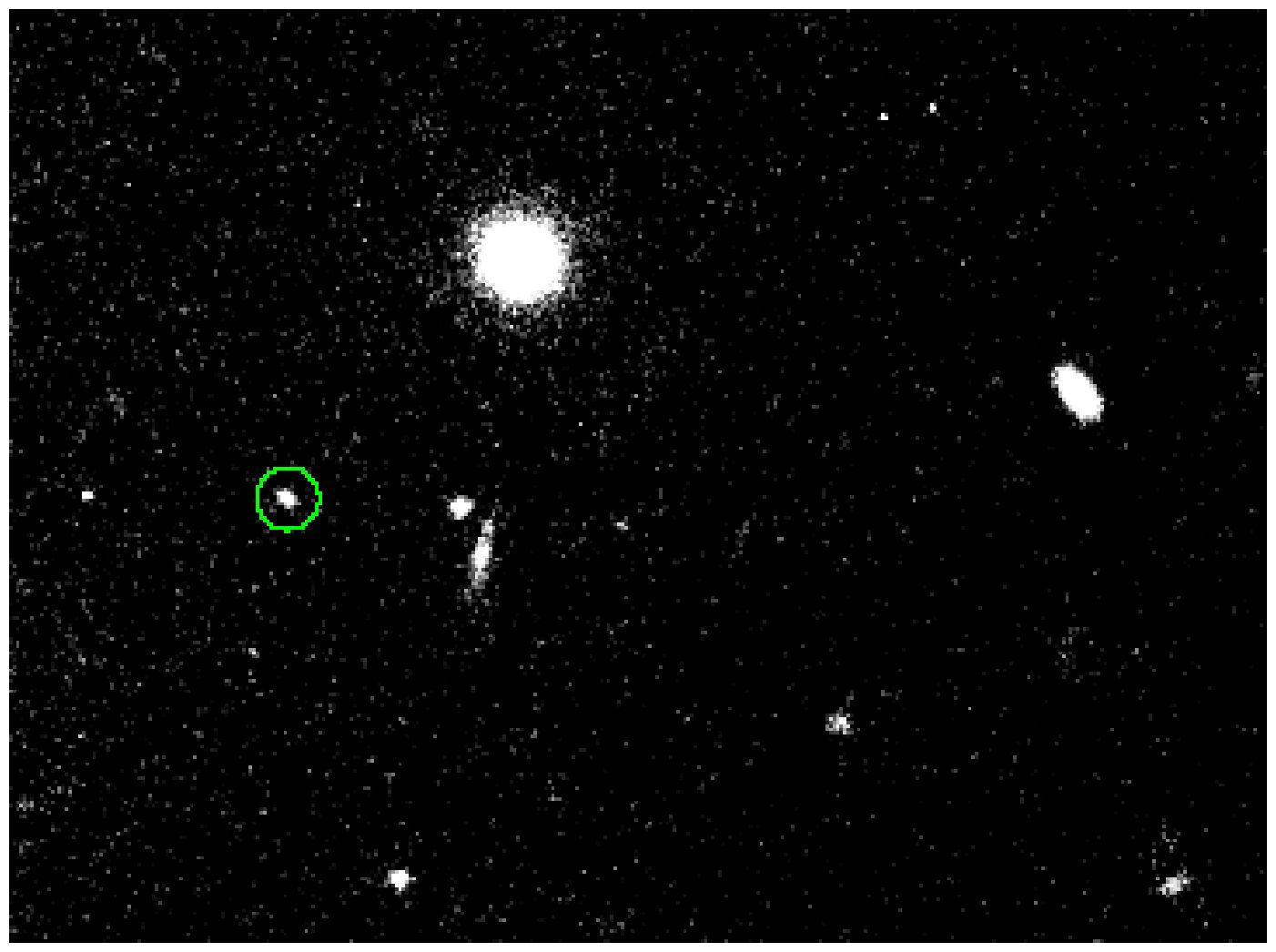
© Palomar Observatory/University of British ColumbiaImage of S/2010 J 1 (circled), a 1.8-mile-wide moon of Jupiter discovered in September 2010.
Astronomers have pinned down details of Jupiter's smallest known moon, a tiny space rock barely a mile across.

The moon, known as S/2010 J 2, was discovered in September 2010 along with a fellow shrimpy satellite called S/2010 J 1. S/2010 J 2 has a diameter of about 1.2 miles (2 kilometers), while S/2010 J 1 is about 1.8 miles (3 km) wide, researchers said. Their discovery brought the number of documented Jovian moons to 67.

Scientists have kept observing the two satellites in the time since their initial detection, and a new study reveals key information about the moons and their orbits.

For example, S/2010 J 1 is now known to circle Jupiter at an average distance of 14.57 million miles (23.45 million km), taking 2.02 years to complete a lap around the solar system's largest planet. S/2010 J 2 takes 1.69 years to zip around Jupiter, and its average distance is 13.06 million miles (21.01 million km).

The new observations also confirm the diminuituve dimensions of the two satellites, which researchers determined based on their brightness.

"It was exciting to realize that this [S/2010 J 2] is the smallest moon in the solar system that was discovered and tracked from Earth," said co-author Mark Alexandersen, of the University of British Columbia, in a statement.

Info

Mammoths Wiped Out By Multiple Killers

Mammoths
© Mauricio AntonWoolly mammoths wandered the planet for about 250,000 years and vanished from Siberia by about 10,000 years ago.
Woolly mammoths were apparently driven to extinction by a multitude of culprits, with climate change, human hunters and shifting habitats all playing a part in the long decline of these giants, researchers say.

Woolly mammoths (Mammuthus primigenius) wandered the planet for about 250,000 years, ranging from Europe to Asia to North America covered in hair up to 20 inches (50 centimeters) long and possessing curved tusks up to 16 feet (4.9 meters) long. Nearly all of these giants vanished from Siberia by about 10,000 years ago, although dwarf mammoths survived on Wrangel Island in the Arctic Ocean until 3,700 years ago.

Scientists have often speculated over what might have driven the mammoths to extinction. For instance, for years researchers suspected that ancient human tribes hunted the mammoths and other ice age giants to oblivion. Others have suggested that a meteor strike might have drastically altered the climate in North America about 12,900 years ago, wiping out most of the large mammals there, the so-called "Younger Dryas impact hypothesis."

Now an analysis of thousands of fossils, artifacts and environmental sites spanning millennia suggest that no one killer is to blame for the demise of the woolly mammoths.

"These findings pretty much dispel the idea of any one factor, any one event, as dooming the mammoths," researcher Glen MacDonald, a geographer at the University of California, Los Angeles, told LiveScience.

Info

Living Stem Cells Discovered in 17-Day-Old Human Corpses

Human muscle
© Fabrice ChretienHuman muscle collected 17 days after the death of the individual and harboring stem cells that are still alive (inset) and capable of being cultivated.
Stem cells can remain alive in human corpses for at least 17 days after death, researchers say.

Stem cells give rise to all other cells in the body, a property that makes them extraordinarily valuable in potential therapies. These potent cells are often rare, only present in small numbers in tissue samples from patients and difficult to distinguish from other cell types in many cases. As such, scientists are investigating novel ways to procure stem cells and improve the viability of the ones they can get.

Past research had suggested that stem cells could actually survive in up to 2-day-old cadavers, but researchers had thought that dead bodies would be poor homes for any cells, lacking the oxygen and nutrients the body's cells need to stay alive. Nevertheless, histologist and neuropathologist Fabrice Chrétien at the Pasteur Institute in Paris and his colleagues were curious to see how long stem cells might keep ticking after a person died.

The researchers only had access to remains 17 days old, suggesting they have not yet seen the limits that stem cells ca reach. "Maybe they can also resist longer," Chrétien told LiveScience.

The cadavers in question had been kept at 39 degrees F (4 degrees C) to keep from rotting. The stem cells the researchers isolated give rise to skeletal muscle, the kind connected to the bones, as opposed to the kind in the heart or other internal organs.

Info

Study Finds New Evidence Supporting Theory of Extraterrestrial Impact

James Kennett
© UCSBJames Kennett
An 18-member international team of researchers that includes James Kennett, professor of earth science at UC Santa Barbara, has discovered melt-glass material in a thin layer of sedimentary rock in Pennsylvania, South Carolina, and Syria. According to the researchers, the material - - which dates back nearly 13,000 years - - was formed at temperatures of 1,700 to 2,200 degrees Celsius (3,100 to 3,600 degrees Fahrenheit), and is the result of a cosmic body impacting Earth.

These new data are the latest to strongly support the controversial Younger Dryas Boundary (YDB) hypothesis, which proposes that a cosmic impact occurred 12,900 years ago at the onset of an unusual cold climatic period called the Younger Dryas. This episode occurred at or close to the time of major extinction of the North American megafauna, including mammoths and giant ground sloths; and the disappearance of the prehistoric and widely distributed Clovis culture. The researchers' findings appear today in the Proceedings of the National Academy of Sciences.

"These scientists have identified three contemporaneous levels more than 12,000 years ago, on two continents yielding siliceous scoria-like objects (SLO's)," said H. Richard Lane, program director of National Science Foundation's Division of Earth Sciences, which funded the research. "SLO's are indicative of high-energy cosmic airbursts/impacts, bolstering the contention that these events induced the beginning of the Younger Dryas. That time was a major departure in biotic, human and climate history."

Morphological and geochemical evidence of the melt-glass confirms that the material is not cosmic, volcanic, or of human-made origin. "The very high temperature melt-glass appears identical to that produced in known cosmic impact events such as Meteor Crater in Arizona, and the Australasian tektite field," said Kennett.

Telescope

Researchers catalog more than 635,000 large impact craters on Mars

Water in Mars
© NASA
It's no secret that Mars is a beaten and battered planet -- astronomers have been peering for centuries at the violent impact craters created by cosmic buckshot pounding its surface over billions of years. But just how beat up is it?

Really beat up, according to a University of Colorado Boulder research team that recently finished counting, outlining and cataloging a staggering 635,000 impact craters on Mars that are roughly a kilometer or more in diameter.

Info

NASA's Fermi Detects the Highest-Energy Light From a Solar Flare

During a powerful solar blast on March 7, NASA's Fermi Gamma-ray Space Telescope detected the highest-energy light ever associated with an eruption on the sun. The discovery heralds Fermi's new role as a solar observatory, a powerful new tool for understanding solar outbursts during the sun's maximum period of activity.


NASA's Solar Dynamics Observatory (SDO) captured dramatic views of the March 7 X5.4 solar flare in extreme ultraviolet light. The gold images show the sun at a wavelength of 171 Angstroms, which corresponds to a temperature of 1 million degrees F (600,000 C). Teal images (131 Angstroms) show features 18 times hotter. The blast triggers waves that traverse the sun at 1 million mph. (Credit: NASA/SDO; NASA's Goddard Space Flight Center)


A solar flare is an explosive blast of light and charged particles. The powerful March 7 flare, which earned a classification of X5.4 based on the peak intensity of its X-rays, is the strongest eruption so far observed by Fermi's Large Area Telescope (LAT). The flare produced such an outpouring of gamma rays -- a form of light with even greater energy than X-rays -- that the sun briefly became the brightest object in the gamma-ray sky.

"For most of Fermi's four years in orbit, its LAT saw the sun as a faint, steady gamma-ray source thanks to the impacts of high-speed particles called cosmic rays," said Nicola Omodei, an astrophysicist at Stanford University in California. "Now we're beginning to see what the sun itself can do."

Omodei described Fermi's solar studies to journalists today at the 220th meeting of the American Astronomical Society in Anchorage, Alaska.

At the flare's peak, the LAT detected gamma rays with two billion times the energy of visible light, or about four billion electron volts (GeV), easily setting a record for the highest-energy light ever detected during or immediately after a solar flare. The flux of high-energy gamma rays, defined as those with energies beyond 100 million electron volts (MeV), was 1,000 times greater than the sun's steady output.

Question

What's Heating Up Io?

Io's Heat
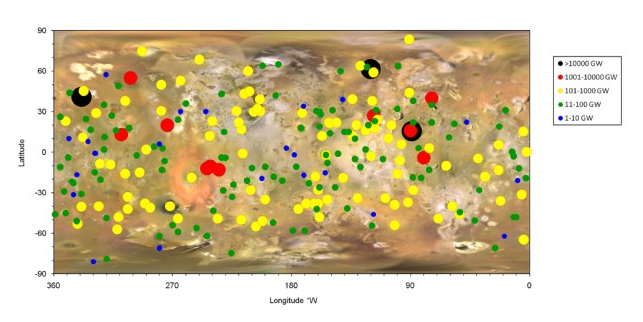
© NASA/JPL-Caltech/Bear Fight InstituteThermal emission from erupting volcanoes on the Jovian moon, Io. A logarithmic scale is used to classify volcanoes on the basis of thermal emission: the larger the spot, the larger the thermal emission.

A new study finds that the pattern of heat coming from volcanoes on Io's surface disposes of the generally-accepted model of internal heating. The heat pouring out of Io's hundreds of erupting volcanoes indicates a complex, multi-layer source. These results come from data collected by NASA spacecraft and ground-based telescopes and appear in the June issue of the journal Icarus.

A map of hot spots, classified by the amount of heat being emitted, shows the global distribution and wide range of volcanic activity on Io. Most of Io's eruptions dwarf their contemporaries on Earth.

"This is the most comprehensive study of Io's volcanic thermal emission to date," said Glenn Veeder of the Bear Fight Institute, Winthrop, Wash., who led the work of a multi-faceted team that included Ashley Davies, Torrence Johnson and Dennis Matson of NASA's Jet Propulsion Laboratory (JPL), Pasadena, Calif., Jani Radebaugh of Brigham Young University, in Provo, Utah, and David Williams of Arizona State University, Tempe, Ariz. The team examined data primarily from the NASA's Voyager and Galileo missions, but also incorporated infrared data obtained from telescopes on Earth.

"The fascinating thing about the distribution of the heat flow is that it is not in keeping with the current preferred model of tidal heating of Io at relatively shallow depths," said Davies. "Instead, the main thermal emission occurs about 40 degrees eastward of its expected positions."

"The pattern that emerges points to a complex heating process within Io," said Matson. "What we see indicates a mixture of both deep and shallow heating."


Info

New Brain Scan Reveals Concussion Effects

Concussion
© Sciepro/Science Photo Library/Corbis
Why do some people seem to suffer no consequences from a concussion while others have symptoms as severe as personality change? A new type of brain scan helps explain why, and could help doctors and patients determine the likely outcomes of a concussion.

The new technique analyzes data from brain imaging studies, according to the study published in the journal Brain Imaging and Behavior today. Concussion victims have unique spatial patterns of brain abnormalities that change over time, researchers found, which could help predict which head injuries are likely to have long-lasting neurological consequences.

Earlier studies identified differences in patients with concussions and those without, but the new technique takes the additional step of parsing out the differences in patients who have concussions.

"In fact, most researchers have assumed that all people with concussions have abnormalities in the same brain regions," said Dr. Michael Lipton, the study's lead author. "But that doesn't make sense, since it is more likely that different areas would be affected in each person because of differences in anatomy, vulnerability to injury and mechanism of injury."