
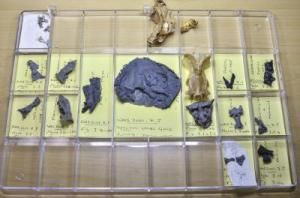
© Megan Doherty/University of ChicagoThese are various latex molds taken from the fossil of Acanthodes bronni.
New research on Acanthodes bronni, a fish from the Paleozoic era, sheds light on the evolution of the earliest jawed vertebrates and offers a new glimpse of the last common ancestor before the split between the earliest sharks and the first bony fishes -- the lineage that would eventually include human beings.
"Unexpectedly, Acanthodes turns out to be the best view we have of conditions in the last common ancestor of bony fishes and sharks," said Michael Coates, PhD, professor of organismal biology and anatomy at the University of Chicago and senior author of the study published in Nature. "Our work is telling us that the earliest bony fishes looked pretty much like sharks, and not vice versa. What we might think of as shark space is, in fact, general modern jawed vertebrate space."
The group gnathostomes, meaning "jaw-mouths," includes tens of thousands of living vertebrate species, ranging from fish and sharks to birds, reptiles, mammals and humans. Cartilaginous fish, which today include sharks, rays, and ratfish, diverged from the bony fishes more than 420 million years ago. But little is known about what the last common ancestor of humans, manta rays and great white sharks looked like.
Coates and colleagues Samuel Davis and John Finarelli found answers to this mystery in an unexpected place: the acanthodians, extinct fishes that generally left behind only tiny scales and elaborate suites of fin spines. But armed with new data on what the earliest sharks and bony fishes looked like, Coates and colleagues re-examined fossils of Acanthodes bronni, the best-preserved acanthodian species.
Davis created highly detailed latex molds of specimens revealing the inside and outside of the skull, providing a valuable new data set for assessing cranial and jaw anatomy as well as the organizations of sensory, circulatory and respiratory systems in the species.
"We want to explore braincases if possible, because they are exceptionally rich sources of anatomical information," Coates said. "They're much better than scales, teeth or fin spines, which, on their own, tend to deliver a confusing signal of evolutionary relationships."
The analysis of the sample combined with recent CT scans of skulls from early sharks and bony fishes led the researchers to a surprising reassessment of what Acanthodes bronni tells us about the history of jawed vertebrates.
"For the first time, we could look inside the head of Acanthodes, and describe it within this whole new context," Coates said. "The more we looked at it, the more similarities we found with sharks."
However, analysis of the evolutionary relationships of Acanthodes bronni -- even with these new data added -- still connected this species to early bony fishes. Meanwhile, some acanthodian species turned out to be primitive sharks, while others were relatives of the common ancestor of sharks and bony fishes.
This result explains some of the longstanding confusion about the placement of acanthodians in vertebrate history. But additional analyses went a step further. Using more than 100 morphological characters, the researchers quantified the mutual resemblance among the earliest jawed fishes. Acanthodians as a whole, including the earliest members of humans' own deep evolutionary past, appear to cluster with ancient sharks.
"The common ancestors of all jawed vertebrates today organized their heads in a way that resembled sharks," said Finarelli, PhD, Lecturer in Vertebrate Biology at University College Dublin. "Given what we now know about the interrelatedness of early fishes, these results tell us that while sharks retained these features, bony fishes moved away from such conditions."
Furthermore, the analysis demonstrated that all of these early members of the modern gnathostomes are clearly separated from what now appear to be the most primitive vertebrates with jaws: a collection of armored fishes called placoderms.
"There appears to be a fundamental distinction between the placoderms and all other vertebrates with jaws," Finarelli said.
This new revision of the lineage of early jawed vertebrates will allow paleontologists to dig into deeper mysteries, including how the body plan of these ancient species transformed over the transition from jawless to jawed fishes.
"It helps to answer the basic question of what's primitive about a shark." Coates said. "And, at last, we're getting a better handle on primitive conditions for jawed vertebrates as a whole."
"This study is an example of the power of phylogenetics combined with the comparative morphology of living and fossil organisms," said Maureen Kearney, program director in National Science Foundation's Division of Environmental Biology, which co-funded the research. "It shows us important evolutionary transitions in the history of life, providing a new window into the sequence of evolutionary changes during early vertebrate evolution."
The study, "Acanthodes and shark-like conditions in the last common ancestor of modern gnathostomes," will be published on June 14 by Nature. The research was also funded by the Natural Environment Research Council.



Quoting Twain, I would facetiously ask, "Yes, but how did it come to pass that we were re-bred with sharks?" but that would unfairly disparage sharks, for they do not have the "moral sense," as per Twain's Mysterious Stranger, and hence they ultimately lack mankind's claimed "moral sense," and hence, mankind's inherent capability of moral culpability.
E.g. from Chapter V:
"I was thinking to myself that I should like to see what the inside of the jail was like; Satan overheard the thought, and the next moment we were in the jail. We were in the torture-chamber, Satan said. The rack was there, and the other instruments, and there was a smoky lantern or two hanging on the walls and helping to make the place look dim and dreadful. There were people there - and executioners - but as they took no notice of us, it meant that we were invisible. A young man lay bound, and Satan said he was suspected of being a heretic, and the executioners were about to inquire into it. They asked the man to confess to the charge, and he said he could not, for it was not true. Then they drove splinter after splinter under his nails, and he shrieked with the pain. Satan was not disturbed, but I could not endure it, and had to be whisked out of there. I was faint and sick, but the fresh air revived me, and we walked toward my home. I said it was a brutal thing.
"No, it was a human thing. You should not insult the brutes by such a misuse of that word; they have not deserved it," and he went on talking like that." It is like your paltry race - always lying, always claiming virtues which it hasn't got, always denying them to the higher animals, which alone posses them. No brute ever does a cruel thing - that is the monopoly of those with the Moral Sense. When a brute inflicts pain he does it innocently; it is not wrong; for him there is no such thing as wrong. And he does not inflict pain for the pleasure of inflicting it - only man does that. Inspired by that mongrel Moral Sense of his! A sense whose function is to distinguish between right and wrong, with liberty to choose which of them he will do. Now what advantage can he get out of that? He is always choosing, and in nine cases out of ten he prefers the wrong. There shouldn't be any wrong; and without the Moral Sense there couldn't be any. And yet he is such an unreasoning creature that he is not able to perceive that the Moral Sense degrades him to the bottom layer of animated beings and is a shameful possession. "
Or, from Chapter VIII
"At the graveyard the body of little Lisa was seized for debt by a carpenter to whom the mother owed fifty groschen for work done the year before. She had never been able to pay this, and was not able now. The carpenter took the corpse home and kept it four days in his cellar, the mother weeping and imploring about his house all the time; then he buried it in his brother's cattle-yard, without religious ceremonies. It drove the mother wild with grief and shame, and she forsook her work and went daily about the town, cursing the carpenter and blaspheming the laws of the emperor and the church, and it was pitiful to see. Seppi asked Satan to interfere, but he said the carpenter and the rest were members of the human race and were acting quite neatly for that species of animal. He would interfere if he found a horse acting in such a way, and we must inform him when we came across that kind of horse doing that kind of human thing, so that he could stop it. We believed this was sarcasm, for of course there wasn't any such horse."
Ultimately, this same point likewise shows the obviously greater ultimate moral culpability of an intelligent puppet of the PTB (e.g., O'Bushma), as contrasted to the semi-moron * puppet who preceded him.
R.C.
* Apologies to A. Huxley.