
That solar context is also why it's worth highlighting the ongoing Super Niño, which mainstream climatology continues to file under "symptom of warming" while missing the deeper signal. Historically, the strongest El Niño events have not been heralds of a runaway greenhouse; they have clustered near major climatic inflection points, preceding sharp cooling phases.
The Super Niño is the visible symptom of a disturbed circuit, a Sun entering a quieter, more electrically stressed configuration. The historical record shows strong El Niños clustering around the onset of cooling periods, with the ocean, which holds the overwhelming share of the climate system's heat, offloading stored energy in large pulses before settling into a colder equilibrium.
Pair that with a weakening geomagnetic field, increased volcanic loading of the stratosphere, and a cometary debris environment dense enough to be putting fireballs on the ground every few days, and the picture sharpens considerably. The violent oscillations, the unseasonal April snow from Moscow to the Tatras, the simultaneous floods and droughts, the jet stream gone meridional... these are the fingerprints of a climate system being forced out of one stable state into another, colder one. The warm spike is the last gasp, not the trajectory.
Down at the surface, water was once again the main story. In Angola, deadly floods killed at least 15 and displaced thousands. Pakistan lost 12 to heavy rain, thunderstorms, and flooding. Türkiye was hit by deadly flash floods after sudden downpours. The Dominican Republic and Haiti counted at least 19 dead between them, with over 1,000 homes damaged in the DR after roughly a foot of rain fell in under 24 hours. Northern Bangladesh saw 17.2 inches in a single day, an early, off-season flood signal. Wellington, New Zealand, declared a state of emergency after three inches dropped in less than half an hour. In Russia's Dagestan, floods killed six and cut power to more than 327,000 people. Aleppo's countryside went underwater after dam surges in Syria. Guwahati, in India's Assam state, was submerged by 8.5 inches in 24 hours. Northern Michigan, too, was inundated, with drone footage capturing the scale of the flooding.
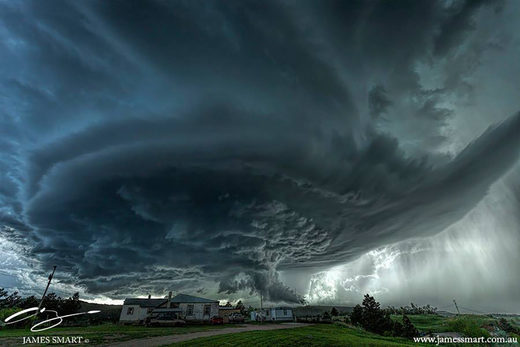
The atmosphere was no less violent on the dry side of the ledger. Tornadoes tore through southern Minnesota alongside baseball-sized hail; Enid, Oklahoma had a tornado peel roofs off buildings and shut down roads; northern Texas reported two dead after twisters, and storm chasers in Oklahoma documented twin tornadoes on the ground at the same time. Hail did extraordinary damage globally: a catastrophic storm in Yunnan, China; giant stones near Springfield, Missouri that destroyed cars and killed an emu at a zoo; 7 cm hail across northern Vietnam; livestock wiped out in Saudi Arabia; record off-season hail in Catalonia, Spain; and a storm that turned Hyderabad, India white in minutes.
Then there was the snow... in April. Poland's Tatra Mountains buried tourists under almost six feet. Saskatchewan got 14.5 inches in a spring storm. Moscow shattered records with 8.3 inches in 24 hours, with at least three dead in Samara. Calgary and southern Alberta took another heavy spring dump. Kars in eastern Türkiye saw over six inches of snow depth, and Jahorina Mountain in Bosnia-Herzegovina the same. In California, Mammoth Mountain and Palisades Tahoe logged up to 22 inches in a single day and approached four feet of total accumulation in places. None of this is what a warming planet looks like.
Volcanoes and tectonics kept pace. Fuego in Guatemala produced a large nighttime eruption; Santiaguito, also in Guatemala, sent tourists scrambling; Indonesia's Mount Semeru erupted again.
Japan was rocked by a magnitude 7.4 earthquake that triggered a tsunami advisory and halted trains, followed by a 6.1 in the country's north.
April extended the extraordinary fireball wave that the American Meteor Society flagged at the end of Q1. As the AMS analysis put it, the signal gets stronger as the report threshold rises at 50+ witness reports. 2026 has produced more than double the 2021-2025 average; at 100+ reports, double again, "the hallmark of a genuine physical change in the incoming material, not a reporting artifact."
The aggregate count of fireballs is roughly normal; what's changed is that the objects are bigger, slower, and more frequently producing delayed sonic booms, meaning they're penetrating deeper into the atmosphere. By the AMS's own count, 41 large fireball events were logged in Q1 2026, nearly double the five-year Q1 average.
April carried that wave forward. Bright daytime and nighttime fireballs were reported across the United States, Canada, Europe, and Asia. A confirmed meteorite fall in Poland left a crater and recoverable fragments. On April 7, a fireball over the US East Coast was tracked, first appearing 48 miles above the Atlantic off Long Island before disintegrating north of Atlantic City. Late in the month, on April 29, a single event over the Pacific Northwest drew 151 witness reports from British Columbia, Oregon, and Washington, with 19 video captures. The pattern of recent months, with multiple major events per week, increasingly with sound, is consistent with what we've long argued: the inner solar system is dirtier than the official models allow, and our planet is moving through a cometary debris environment that is becoming progressively harder to ignore.
All this and more in our SOTT Earth Changes Summary for April 2026:
To understand what's going on, check out our book explaining how all these events are part of a natural climate shift, and why it is taking place now: Earth Changes and the Human-Cosmic Connection
Check out previous installments in this series - translated into multiple languages - here.

Reader Comments
'
Meanwhile..."Officials warn of deadly flesh-eating bacteria" (UK Independent). "The weather phenomenon that could shake the world" (UK Telegraph). "Severe thunderstorms targeting millions, flash flood threat from Texas to Missouri" (ABC News). “Storms target 50 million” (FOX Weather). Geoengineering, what could possibly go wrong? "The looming El Niño could be bad – but much worse is to come" (New Scientist). "Colorado River Basin sliding toward system-wide crash" (FOX). "Colorado declares statewide drought emergency"(Colorado Sun). "The Largest US Groundwater Supply Is Running Out" (Newsweek). These are but a few samples of the bad news build up unfolding and accelerating across the world, what will conditions be like by the end of 2026?" -Dane Wigington Geoengineering Watch Global Alert News, June 6, 2026 [Link]
The Galaxic equator...our galaxy is a spinning disc, and has an equator. Our solar system crosses this equator about every 36,000years...Water goes down the drain clockwise in earths northern hemisphere and counter clockwise in the southern. Basic physics. What happens to the rotation of the planets if our solar system was to cross the Galaxic equator? The same as water down the drain on earth?? Spinning one way today, the other way tomorrow?? The physics of momentum say the oceans and the crust of the earth would keep going in the same direction it was going for a while if the earth changed its rotation. Earths geology may show us...Look at the west coast of the USA...from the ocean to Utah is all old sea bed...Maybe the Grand canyon wasnt formed over millions of years but 100's due to the receding sea from a change in the rotation of earth.
As far as the moon/sun and all the other stuff out there in space...You do get the surface of the earth is constantly changing its speed through space IN RELATIONSHIP to the moon, sun and all the other stuff, speeding up and slowing down....Picture 3 race cars running side by side around a circle track...the car in the outside lane has to go faster then the car in the middle lane and the car in the inside lane has to go slower then the car in the middle lane to stay side by side...Picture the sun in the center of this circle track, the car in the middle lane as the center of the earth(speed constant around the sun) and the 2 other cars are the surface of the earth, say Los angeles and the opposite side of earth the Indian ocean ...since the earth rotates, at midday LA LA land is the car on the inside lane at noon going slowly, but its speed through space in relation to the moon/sun is speeding up as the planet rotates, till midnite, then it starts to slow again till noon...This is why full and new moons are the best time for the big ones. Most big ones here in LA LA land happen early morning, when the pacific plate is going faster(through space, in relation to the moon/sun/planets) and the american plate is going slower, the pacific plate is running into the american plate and applying more pressure to the faults...now add in the gravity of the full or new moon/sun/planets...increasing the pressure on the faults...