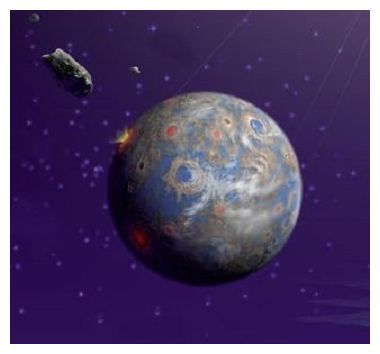
© NASA/JPLAn asteroid believed to have smacked Earth some 65 million years ago likely caused a global firestorm that led to extensive plant and animal extinctions, a new study shows.
Most scientists believe the mass die-off known as the K-T extinction - which saw up to 80 percent of all species vanish - was caused by an asteroid or comet that carved out the 112-mile (180 kilometers) Chicxulub crater in what is today Mexico.
Researchers who created a new model of the disaster say the impact would have sent vaporized particles of rock high above the planet's atmosphere, where they would have condensed into sand-grain-sized bits. Falling back to Earth, the hot ejected rock material may have dumped enough heat in the upper atmosphere to cause it to bake at 2,700 degrees Fahrenheit (1,482 degrees Celsius), turning the sky red for several hours.
This infrared "heat pulse" would have acted like a broiler oven, igniting tinder below and cooking every twig, bush, tree, and basically every living thing not shielded underground or underwater, the researchers say.
"It's likely that the total amount of infrared heat was equal to a 1 megaton bomb exploding every four miles over the entire Earth," study researcher Douglas Robertson, of the Cooperative Institute for Research in Environmental Sciences, or CIRES, said in a statement.