Science & TechnologyS


Bulb

Remembering to remember supported by two distinct brain processes

You plan on shopping for groceries later and you tell yourself that you have to remember to take the grocery bags with you when you leave the house. Lo and behold, you reach the check-out counter and you realize you've forgotten the bags.

Remembering to remember - whether it's grocery bags, appointments, or taking medications - is essential to our everyday lives. New research sheds light on two distinct brain processes that underlie this type of memory, known as prospective memory.

The research is published in Psychological Science, a journal of the Association for Psychological Science.

To investigate how prospective memory is processed in the brain, psychological scientist Mark McDaniel of Washington University in St. Louis and colleagues had participants lie in an fMRI scanner and asked them to press one of two buttons to indicate whether a word that popped up on a screen was a member of a designated category. In addition to this ongoing activity, participants were asked to try to remember to press a third button whenever a special target popped up. The task was designed to tap into participants' prospective memory, or their ability to remember to take certain actions in response to specific future events.

When McDaniel and colleagues analyzed the fMRI data, they observed that two distinct brain activation patterns emerged when participants made the correct button press for a special target.

Meteor

Around the world in four days: NASA tracks Chelyabinsk meteor plume


Atmospheric physicist Nick Gorkavyi missed witnessing an event of the century last winter when a meteor exploded over his hometown of Chelyabinsk, Russia. From Greenbelt, Md., however, NASA's Gorkavyi and colleagues witnessed a never-before-seen view of the atmospheric aftermath of the explosion.

Shortly after dawn on Feb. 15, 2013, the meteor, or bolide, measuring 59 feet (18 meters) across and weighing 11,000 metric tons, screamed into Earth's atmosphere at 41,600 mph (18.6 kilometers per second). Burning from the friction with Earth's thin air, the space rock exploded 14.5 miles (23.3 kilometers) above Chelyabinsk.

The explosion released more than 30 times the energy from the atom bomb that destroyed Hiroshima. For comparison, the ground-impacting meteor that triggered mass extinctions, including the dinosaurs, measured about 6 miles (10 kilometers) across and released about 1 billion times the energy of the atom bomb.

Laptop

Google says Gmail messages not private

Image
© AFP 2013/ POOL/ Robert GalbraithGoogle's global headquarters in Mountain View, California
Google has made it official, casually acknowledging what many people already knew or at least suspected: emails sent through its free Gmail service will be "processed" with no guarantee of privacy.

"Just as a sender of a letter to a business colleague cannot be surprised that the recipient's assistant opens the letter, people who use web-based email today cannot be surprised if their emails are processed," by the recipient's e-mail service provider in the course of delivery," said attorneys for Google in a court brief.

"Indeed, a person has no legitimate expectation of privacy in information he voluntarily turns over to third parties," they added in the June motion to dismiss a class-action data-mining lawsuit.

Cassiopaea

Bright new nova In Delphinus

New Nova
© StellariumThe possible new nova is located in Delphinus alongside the familiar Summer Triangle outlined by Deneb, Vega and Altair. This may shows the sky looking high in the south for mid-northern latitudes around 10 p.m. local time in mid-August. The new object is ideally placed for viewing.
Looking around for something new to see in your binoculars or telescope tonight? How about an object whose name literally means "new". Japanese amateur astronomer Koichi Itagaki of Yamagata discovered an apparent nova or "new star" in the constellation Delphinus the Dolphin just today, August 14.

He used a small 7-inch (.18-m) reflecting telescope and CCD camera to nab it. Let's hope its mouthful of a temporary designation, PNVJ20233073+2046041, is soon changed to Nova Delphini 2013!

Magic Wand

2 left feet? Study looks to demystify why we lose our balance

It's always in front of a million people and feels like eternity. You're strolling along when suddenly you've stumbled - the brain realizes you're falling, but your muscles aren't doing anything to stop it.

For a young person, a fall is usually just embarrassing. However, for the elderly, falling can be life threatening. Among the elderly who break a hip, 80 percent die within a year.

University of Michigan researchers believe that the critical window of time between when the brain senses a fall and the muscles respond may help explain why so many older people suffer these serious falls. A better understanding of what happens in the brain and muscles during this lag could go a long way toward prevention.

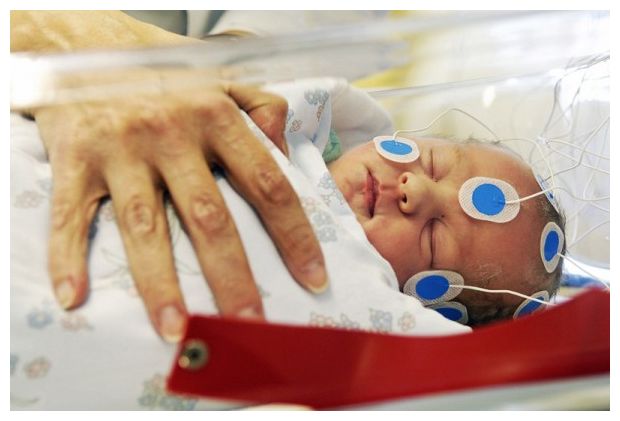
To that end, researchers at the U-M School of Kinesiology developed a novel way of looking at the electrical response in the brain before and during a fall by using an electroencephalogram.

Findings showed that many areas of the brain sense and respond to a fall, but that happens well before the muscles react. Lead researcher Daniel Ferris likened the study method to recording an orchestra with many microphones and then teasing out the sounds of specific instruments. In the study, researchers measured electrical activity in different regions of the brain.

"We're using an EEG in a way others don't, to look at what's going on inside the brain," said Ferris, a professor in kinesiology. "We were able to determine what parts of the brain first identify when you are losing your balance during walking."

Comet

Does one of these asteroids have our name on it? NASA reveals orbits of 1,400 potentially hazardous asteroids

These asteroids are classified as 'hazardous' because they are at least 140 meters in size and could come within 4.7 million miles of Earth's orbit

However, none are considered a threat over the next hundred years

NEOCam mission will track these asteroids and other near-Earth objects


Image
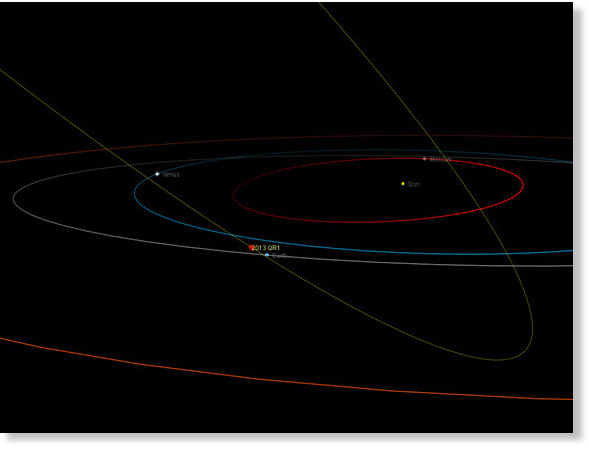
This graphic shows the orbits of all the known Potentially Hazardous Asteroids (PHAs), numbering over 1,400 as of early 2013. These are the asteroids considered hazardous because they are fairly large (at least 460 feet or 140 meters in size), and because they follow orbits that pass close to the Earth's orbit
There are currently 1,400 potentially hazardous asteroids that could pass close to Earth, according to latest data revealed by Nasa.

An image mapping the orbits of all the potentially hazardous asteroids (PHAs) provides a graphic of the crowded cosmic activity.

These asteroids are considered hazardous because they are fairly large - at least 460 feet or 140 meters in size.

Comment: If such an asteroid were detected Earth bound, would NASA necessarily tell us about it?

See -

Military hush up: Incoming space rocks now classified


Info

Could glow in the dark bunnies lead to better drugs?

Transgenic Mice
© Turkish Universities and John A. Burns School of MedicineUniversity of Hawaii Manoa collaboration with two Turkish Universities produced transgenic mice using the technique created at UH Manoa. Birth of Rabbits late July 2013 in Turkey.
What do you get when you cross jelly fish DNA with a cuddly bunny? If researchers from universities in Hawaii and Turkey have anything to say about it, the combination could result in cheaper, more effective drugs for genetic diseases.

Scientists have cloned a litter of rabbits which have been given a gene from a glowing jellyfish, effectively creating two glow-in-the-dark bunnies. Under normal light the rabbits appear just as normal and healthy as their siblings, but in a dark room the animals shine a bright fluorescent green.

The scientists say the transgenic bunnies aren't harmed at all by the foreign DNA and have only been created as a proof of concept. That 25 percent of the cloned rabbits glow tells the scientists they successfully incorporated another animal's DNA into their genome and, if it can be done here, it may be possible in humans as well. They hope that this approach might eventually be used in humans so people with genetic diseases could benefit from receiving a transplant of healthy DNA.

Associate professor Stefan Moisyadi with the University of Hawaii told the Independent the cloned bunnies shine as brightly as LED lights when the room goes dark.

"And on top of it, their fur is beginning to grow and the greenness is shining right through their fur. It's so intense," he said.

Bulb

UCLA researcher invents new tools to manage 'information overload' threatening neuroscience

Image
© UCLA Health SystemAlcino Silva, professor of neurobiology at the David Geffen School of Medicine at UCLA and of psychiatry at the Semel Institute for Neuroscience and Human Behavior
Before the digital age, neuroscientists got their information in the library like the rest of us. But the explosion of neuroscience research has resulted in the publication of nearly 2 million papers - more data than any researcher can read and absorb in a lifetime.

That's why a UCLA team has invented research maps. Easily accessible through an online app, the maps help neuroscientists quickly scan what is already known and plan their next study. The Aug. 8 edition of the journal Neuron describes these new tools.

"Information overload is the elephant in the room that most neuroscientists pretend to ignore," said principal investigator Alcino Silva, a professor of neurobiology at the David Geffen School of Medicine at UCLA and professor of psychiatry at the Semel Institute for Neuroscience and Human Behavior at UCLA. "Without a way to organize the literature, we risk missing key discoveries and duplicating earlier experiments. Research maps will enable neuroscientists to quickly clarify what ground has already been covered and to fully grasp its meaning for future studies." Silva collaborated with Anthony Landreth, a former UCLA postdoctoral fellow, to create maps that offer simplified, interactive and unbiased summaries of research findings designed to help neuroscientists in choosing what to study next. As a testing ground for their maps, the team focused on findings in molecular and cellular cognition.

Ambulance

Werner Herzog's paralyzing case against texting while driving

Image
Warner Herzog
"He looked like he was asleep, until we rolled him over."


Bavarian polymath Werner Herzog's just-released film, From One Second to the Next (below), is 35 minutes of excruciating testimonials by people on the spectrum from affected to devastated by texting and driving. It's part of a campaign by AT&T to raise awareness. Expect it to do that.

Herzog did address the motive of the project in the context of the creeping intrusion of marketing in creative media. He told the Associated Press, "This has nothing to do with consumerism or being part of advertising products. This whole campaign is, rather, dissuading you from excessive use of a product."

Eye 2

Best of the Web: NSA is commandeering the internet

Image
Technology companies have to fight for their users, or they'll eventually lose them.

It turns out that the NSA's domestic and world-wide surveillance apparatus is even more extensive than we thought. Bluntly: The government has commandeered the Internet. Most of the largest Internet companies provide information to the NSA, betraying their users. Some, as we've learned, fight and lose. Others cooperate, either out of patriotism or because they believe it's easier that way.

I have one message to the executives of those companies: fight.

Do you remember those old spy movies, when the higher ups in government decide that the mission is more important than the spy's life? It's going to be the same way with you. You might think that your friendly relationship with the government means that they're going to protect you, but they won't. The NSA doesn't care about you or your customers, and will burn you the moment it's convenient to do so.

We're already starting to see that. Google, Yahoo, Microsoft and others are pleading with the government to allow them to explain details of what information they provided in response to National Security Letters and other government demands. They've lost the trust of their customers, and explaining what they do -- and don't do -- is how to get it back. The government has refused; they don't care.

It will be the same with you. There are lots more high-tech companies who have cooperated with the government. Most of those company names are somewhere in the thousands of documents that Edward Snowden took with him, and sooner or later they'll be released to the public. The NSA probably told you that your cooperation would forever remain secret, but they're sloppy. They'll put your company name on presentations delivered to thousands of people: government employees, contractors, probably even foreign nationals. If Snowden doesn't have a copy, the next whistleblower will.