Science & TechnologyS


Bizarro Earth

Bermuda Triangle earthquake triggered 1817 tsunami

Tsunami
© Susan Hough, USGSA model predicted the tsunami wave height from a Jan. 8, 1817, earthquake offshore South Carolina. The earthquake's magnitude was estimated at 7.4 from newspaper accounts.
A "tidal wave" violently tossed ships docked along the Delaware River south of Philadelphia at about 11 a.m. ET on Jan. 8, 1817, according to newspapers of the time. Turns out, that tidal wave was actually a tsunami, launched by a powerful magnitude-7.4 earthquake that struck at approximately 4:30 a.m. ET near the northern tip of the Bermuda Triangle, a new study finds.

The study links the tsunami to a known Jan. 8, 1817, earthquake. The temblor shook the East Coast from Virginia south to Georgia, where the seismic waves made the State House bell ring several times.

Based on archival accounts of the 1817 shaking, geologists had gauged the quake's size at magnitude 4.8 to magnitude 6. Now, with new geologic detective work and computer modeling of the tsunami, researchers have considerably revised the earthquake's size. A magnitude-7.4 quake releases almost 8,000 times more energy than a magnitude-4.8 earthquake.

The size and location, or epicenter, of the 1817 earthquake has never been pinned down so closely before. U.S. Geological Survey research geophysicist Susan Hough and her colleagues zeroed in on the source from newly uncovered archival records, looking at where the shaking was strongest.

But they weren't sure about the tsunami link: The 11 a.m. arrival time seemed too late for a 4:30 a.m. earthquake. So they created a computer model of the tsunami, testing different locations and magnitudes. The best fit to force a foot-high (30 centimeters) wave up the mouth of Delaware Bay by about 11 a.m. was a magnitude-7.4 earthquake offshore of South Carolina.

"That was the eureka moment," Hough told LiveScience's OurAmazingPlanet. "Darned if that wave doesn't hit the Delaware River and slow way down."

Heart

Revealed! Why mornings are deadliest for heart attack deaths

Heart Attacks
© dnaindia
An Indian scientist has claimed that evidence from people suffering from heart disease supports the existence of the molecular link first discovered in laboratory mice between the body's natural circadian rhythms and cardiac arrest or sudden cardiac death.

Mukesh Jain, M.D., said that it pinpoints a previously unrecognised factor in the electrical storm that makes the heart's main pumping chambers suddenly begin to beat erratically in a way that stops the flow of blood to the brain and body.

Termed ventricular fibrillation, the condition causes sudden cardiac death (SCD), in which the victim instantly becomes unconscious and dies unless CPR or a defibrillator is available to shock the heart back into its steady beat.

The peak risk hours when SCD strikes range from 6 am to 10 am, with a smaller peak in the late afternoon. Scientists long suspected a link between SCD and the 24-hour body clock, located in the brain.

It governs 24-hour cycles of sleep and wakefulness called circadian rhythms that coordinate a range of body functions with the outside environment.

Jain's group discovered a protein called KLF15 that helps regulate the heart's electrical activity, and occurs in the body in levels that change like clockwork throughout the day. KLF15 helps form channels that allow substances to enter and exit heart cells in ways critical to maintaining a normal, steady heartbeat.

They first discovered that patients with heart failure have lower levels of KLF15. Then, they established in laboratory mice that KLF15 is the molecular link between SCD and the circadian rhythm. And mice with low levels of the protein have the same heart problems as people with SCD.

Fireball 4

Huge asteroid 324 Bamberga makes a return visit to Earth's neighborhood on Friday the 13th

Asteroid Bamberga_1
© Created by thAuthor using Starry Night Education softwareThe path of 324 Bamberga through Pisces from September 8th to October 10th.
This week offers a fine chance to catch sight of a unique asteroid.

324 Bamberga reaches opposition this week in the constellation Pisces on (friggatriskaidekaphobics take note) Friday the 13th at 2PM EDT/16:00 Universal Time.

About 230 kilometres in size, 324 Bamberga reaches 0.81 astronomical units from the Earth this week. No other asteroid so large gets so close. Discovered on February 25th, 1892 by Johann Palisa, 324 Bamberga only reaches a favorable opposition once every 22 years.

Shining at magnitude +8.1, 324 Bamberga is also one of the highest numbered asteroids visible with binoculars. Earth-crossing asteroids 433 Eros, which made a close pass last year, and 4179 Toutatis are two of the very few asteroids that possess a larger number designations that can regularly reach +10th magnitude.

Comet

New Comet: P/2013 P5 (PanSTARRS)

Discovery Date: August 15, 2013

Magnitude: 20.9 mag

Discoverer: Pan-STARRS 1 telescope (Haleakala)

P/2013 P5
© Aerith NetMagnitudes Graph
The orbital elements are published on M.P.E.C. 2013-R59.

Galaxy

Monster Earth volcano one of solar system's biggest

Tamu Massif
© Discovery.comA 3D image of the seafloor shows the size and shape of the Tamu Massif volcano under the Pacific Ocean.
The largest volcano on Earth is not in Hawaii, but hidden beneath the western Pacific Ocean and covers an area the size of New Mexico, announced scientists on Thursday. The vast lump of lava is called the Tamu Massif and lies about 1,000 miles (1,600 km) east of Japan and is comparable, though somewhat less voluminous, than the enormous volcano Olympus Mons on Mars. Play Video Volcanoes Slide Silently to Their Death These animations show how giant old volcanoes atop the Pacific tectonic plate travel westward, at up to six centimeters per year. DCI

Tamu Massif itself is not a new discovery, but until now had been considered the product of several undersea volcanoes heaping and clumping up lava on the seafloor. New seismic reflection data showing the structures of the lava flows inside Tamu Massif, along with and specimens from the Integrated Ocean Drilling Program now suggest the entire, very low-relief, 120,000 square-mile (311,000 square kilometer) feature erupted from a single source. For instance, the seismic data show that some of the layers of lava -- representing single eruption events -- are 75 feet (23 meters) thick, spread out over huge distances.

Blackbox

Pew! Pew! Pew! NASA moon probe carries space laser for big "Tech test"?

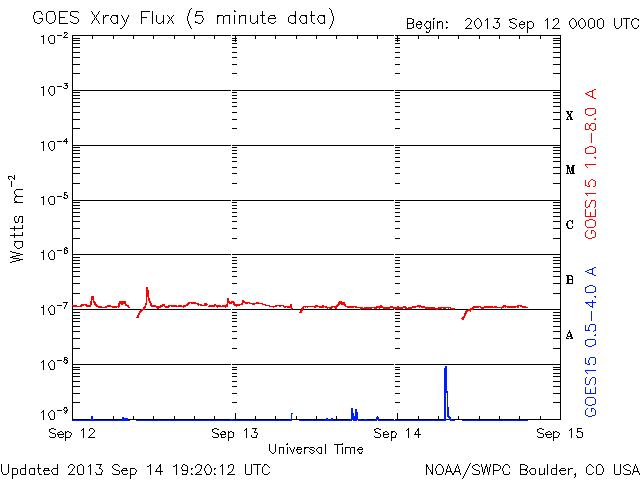
A NASA probe launching toward the moon tonight (Sept. 6) is carrying a high-tech laser experiment designed to improve deep-space communications. NASA's Lunar Atmosphere and Dust Environment Explorer (LADEE) spacecraft - which is slated to blast off from the agency's Wallops Flight Facility in Virginia today at 11:27 p.m. EDT (0327 GMT Sept. 7) - aims primarily to study the moon's wispy atmosphere. But it also totes laser gear to see how well two-way communications can go between a moon-bound spacecraft and the Earth.

The laser experiment may end up helping out a variety of future missions, NASA officials say. [How NASA's Moon Laser Tech Works (Infographic)]

LADEE's short-duration demonstrator, however, is the first dedicated system to send communications to and from Earth using a laser instead of radio. It can send six times more data using 25 percent less power than an equivalent high-end radio-frequency system, NASA officials said. Plus, laser communications are not as likely to be jammed.

Image

Question

The whole internet can't identify this mystery cocoon

Image
© Troy Alexander/Tambopata Research Centre
Like a tiny insect Stonehenge, the mystery of this 2-centimetre-wide structure has captured the imagination of entomologists and amateur bug-spotters around the world.

Troy Alexander, who noticed the unusual construction while volunteering at the Tambopata Macaw Project in Peru, calls it a "maypole with a horse corral". He posted photos on Facebook and Reddit asking if anyone could identify it - and despite his cry for help going viral on blogs and websites around the world, it remains unanswered.

Telescope

Cassiopeia the Queen in northeast after sunset

Cassiopeia the Queen can be found in the northeast after sunset on September evenings. This constellation has the distinctive shape of a W, or M, depending on the time of night you see it. The shape of this constellation makes Cassiopeia's stars very noticeable.
Image
Cassiopeia represents an ancient queen of Ethiopia. The entire constellation is sometimes also called Cassiopeia's Chair, and some old star maps depict the queen sitting on the chair, marked by the five brightest stars of this constellation. These stars are Schedar, Caph, Gamma Cassiopeiae, Ruchbah, and Segin.

If you have a dark sky, you can look below Cassiopeia in the northeast on these September evenings for a famous binocular object. This object is called the "Double Cluster" in the constellation Perseus. These are open star clusters, each of which consists of young stars still moving together from the primordial cloud of gas and dust that gave birth to the cluster's stars. These clusters are familiarly known to stargazers as H and Chi Persei.

Blue Planet

Pacific underwater volcano one of Solar System's biggest

tamu massif
© IODP, Texas A&M UniversityEarth's largest volcano: a 3-D map of the Tamu Massif formation
Geologists on Thursday, September 5, announced they had uncovered a stupendous volcano that is the biggest in the world and rivals the greatest in the Solar System.

Dubbed Tamu Massif, the volcano is part of the Shatsky Rise, a deep plateau on the floor of the Pacific located around 1,600 kilometers (1,000 miles) east of Japan, they said.

It comprises a single, immense, rounded dome in the shape of a shield, formed of hardened lava from an eruption around 144 million years ago.

It covers around 310,000 square kilometers (119,000 square miles) - the equivalent area of Britain and Ireland combined - and slopes upwards to a height of around 3.5 km (2.2 miles) above the sea floor.

Info

Stem cells mimic human brain

Image
© Madeline A. LancasterA cross-section of a brain-like clump of neural cells derived from human stem cells.
With the right mix of nutrients and a little bit of coaxing, human stem cells derived from skin can assemble spontaneously into brain-like chunks of tissue. Researchers provide the first description and application of these 'mini-brains' today in Nature1.

"It's a seminal study to making a brain in a dish," says Clive Svendsen, a neurobiologist at the University of California, Los Angeles, who was not involved in the study. "That's phenomenal." A fully formed artificial brain might still be years away, he notes, but the pea-sized neural clumps developed in this work could prove useful for researching human neurological diseases.

Researchers have previously used human stem cells to grow structures resembling the eye2 and even tissue layers similar to the brain's cortex3. But in the latest advance, scientists developed bigger and more complex neural-tissue clumps by first growing the stem cells on a synthetic gel that resembled natural connective tissues found in the brain and elsewhere in the body. Then, they plopped the nascent clumps into a spinning bath to infuse the tissue with nutrients and oxygen.

"The big surprise was that it worked," says study co-author Juergen Knoblich, a developmental biologist at the Institute of Molecular Biotechnology in Vienna. The blobs grew to resemble the brains of fetuses in the ninth week of development.