
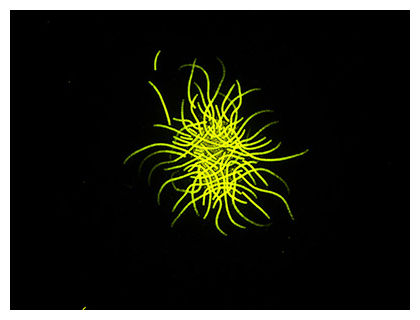
© RedOrbitResearchers from Princeton University and the Swiss Institute of Technology in Zurich found that the wobble of the Earth on its axis controls the production of fertilizing nitrogen essential to the health of the ocean. The wobble, known as axial precession, causes an upwelling of nitrogen-poor (but phosphorus-rich) water from the deep ocean roughly every 23,000 years. Blue-green algae such as Trichodesmium (above) feed on the phosphorous as they convert, or “fix,” nitrogen in the air into a biologically active form that becomes part of the ocean’s nitrogen cycle. (Image courtesy of the Center for Microbial Oceanography, University of Hawaii)
According to the study authors, the discovery will give scientists new insight into how the ocean regulates its own life-support system, which in turn influences the planet's climate as well as the size of marine fisheries. They explain that, over the past 160,000 years, nitrogen fixation rose and fell in a pattern closely resembling the changing orientation of the Earth's axis of rotation (also known as axial precession).
The phenomenon of axial precession occurs on a cycle of approximately 26,000 years, and occurs because the planet wobbles slightly during the rotation process. Previous research revealed that precession results in a regular upwelling of deep water in the Atlantic Ocean, near the equator, roughly every 23,000 years.
That upwelling causes nitrogen-poor water to reach the surface, where blue-green algae draws nitrogen from the air and converts it into a biologically-usable form, they explained. The discovery that the nitrogen fixation process was determined by precession-driven upwelling would seem to indicate that the ocean's fixed nitrogen reservoir is resilient, and that the ecosystem is capable of overcoming dramatic ecological changes.
"By studying the response of nitrogen fixation to different environmental changes in the Earth's past, we have found connections that may ensure that the ocean's fixed nitrogen level will always rebound," second author and Princeton University professor Daniel Sigman said in a statement. "This suggests that an ocean over time has a relatively stable nutrient reservoir, and thus stable productivity."
Sigman explained that the rise of deep water spurs on nitrogen fixation. The reason for this is that the deep water is low in nitrogen but high in phosphorus, which serves as a catalyst for the blue-green algae's nitrogen-fixing process. He and his colleagues tracked changes in the nitrogen fixation process in the North Atlantic Ocean by measuring the amount of fixed nitrogen contained in marine animal shells recovered from sediment in the Caribbean.
The research team measured the amount of two different types of nitrogen (14N and 15N) contained within the shells of minute marine animal plankton known as foraminifera. They then used the 15N-to-14N ratio to reconstruct the nitrogen fixation rate, and found that the pattern matched the historical record of both axial precession and the oceanic upwelling that followed.
Sigman and his associates also compared changes in nitrogen fixation to historical records of water temperature and levels of another nutrient (iron), each of which have an impact on cyanobacteria survival and thus nitrogen fixation. They found no correlation, leading them to conclude that upwelling was the dominant influence on the process.



...'professor Daniel Sigman said in a statement. "This suggests that an ocean over time has a relatively stable nutrient reservoir, and thus stable productivity." '
Until modern industrialised fishing with drift nets 20 - 30 - 40miles long and purse sein trawler nets the size of cathedral or football stadium domes plus the use of sonar and radar they are capturing and killing enormous quantities of an unknown resource. There is very little knowledge of life cycles, breeding patterns, interrelationships, it's like raiding someones vegetable garden and hoping that next year it will be restocked for you to plunder again; without knowing how preparation, planting and growing takes place. An indication of the imbalance in biodiversity is begining to reveal itself with the rising populations of jellyfish. They should ban all sophistcated electronic technical fish finding aids for a generation; allow time for recovery.