
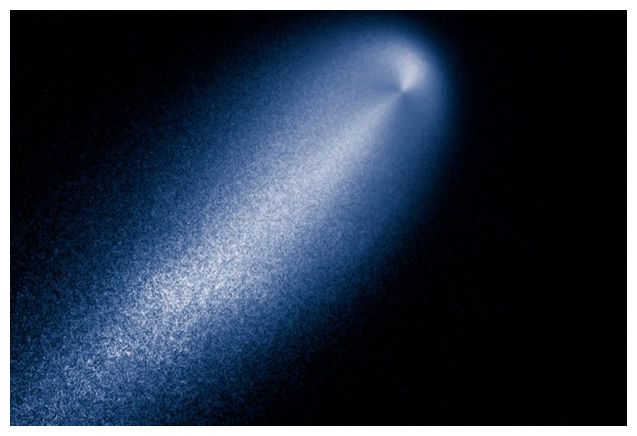
© NASA, ESA, J.-Y. Li (Planetary Science Institute), and the Hubble Comet ISON Imaging Science TeamThis is a contrast-enhanced image produced from the Hubble images of Comet C/2012 S1 (ISON) to reveal the subtle structure in the inner coma of the comet. In this computer-processed view, the Hubble image has been divided by a computer model coma that decreases in brightness proportionally to the distance from the nucleus, as expected for a comet that is producing dust uniformly over its surface. ISON's coma shows enhanced dust particle release on the sunward-facing side of the comet's nucleus, the small, solid body at the core of the comet. This information is invaluable for determining the comet's shape, evolution, and spin of the solid nucleus.
Comet ISON has been closely watched by several astronomers over the past year with great anticipation, but also with a little hesitation. It is a tricky balance, because comets have been notorious for disappointment in the past, particularly when media grabs hold of the subject and helps hype up events like this.
In August, Comet ISON emerged from behind the sun and was first picked up by amateur astronomer Bruce Gary. Reports said that according to Gary's observations, this comet was headed for disappointment, rather than the fall spectacle that news sources hyped it up to be. Since then, not a lot of new information has emerged about the comet from the media outlets, so redOrbit reached out to Karl Battams, an astrophysicist and computational scientist at the US Naval Research Laboratory, to get an update about Comet ISON.

















Comment: Comment: Baby elephant in China can't stop crying after being stomped by mom