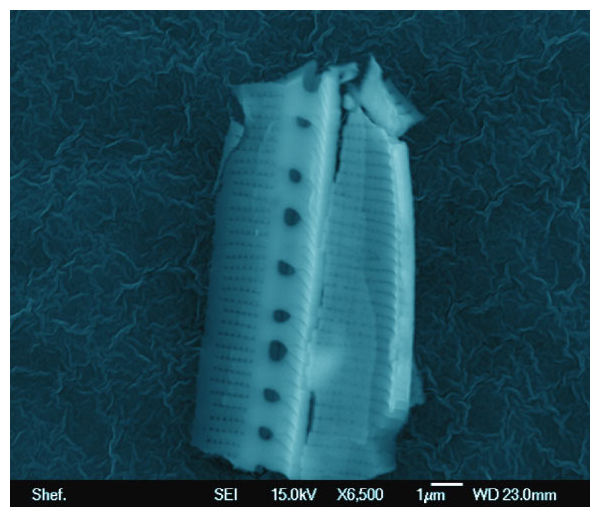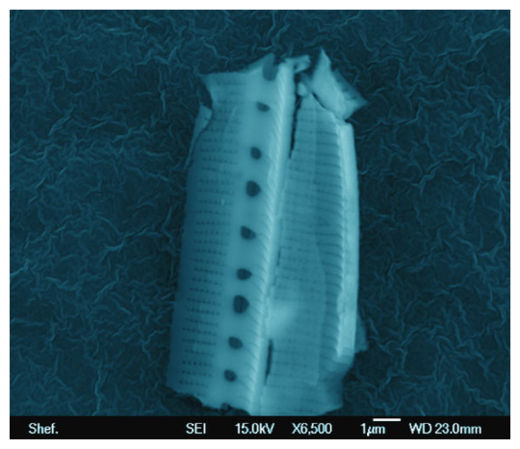
© Milton Wainwright et al.This image shows a diatom frustule, possibly a Nitzschia species, captured on a stud from a height of 25 km in the stratosphere. Image
British scientists believe they have found small bugs from outer space in the Earth's atmosphere.
Tiny organisms were discovered by University of Sheffield experts on a research balloon they had sent 27 kilometres into the atmosphere during last month's Perseids meteor shower. The microscopic bugs were detected when the balloon landed back on the ground in Wakefield, West Yorkshire in England.
But the scientists insist the samples could not have been carried from the Earth's surface into the stratosphere - the second layer of our atmosphere, which stretches up to 50 kilometres from the ground. Strict tests were taken to avoid any contamination, they said.
Professor Milton Wainwright, who led the team, said: 'Most people will assume that these biological particles must have just drifted up to the stratosphere from Earth, but it is generally accepted that a particle of the size found cannot be lifted from Earth to heights of, for example, 27 kilometres.
'The only known exception is by a violent volcanic eruption, none of which occurred within three years of the sampling trip.' He went on: 'We can only conclude that the biological entities originated from space.
'Our conclusion then is that life is continually arriving to Earth from space, life is not restricted to this planet and it almost certainly did not originate here.' The findings are to be published in the
Journal of Cosmology.'If life does continue to arrive from space then we have to completely change our view of biology and evolution,' Prof Wainwright added. 'New textbooks will have to be written.'
He said further 'crucial' tests on the samples are planned and researchers will carry out further experiments during a meteor shower in October.