Science & TechnologyS


Comet 2

Comet ISON looking 'downright weird' as it approaches the sun

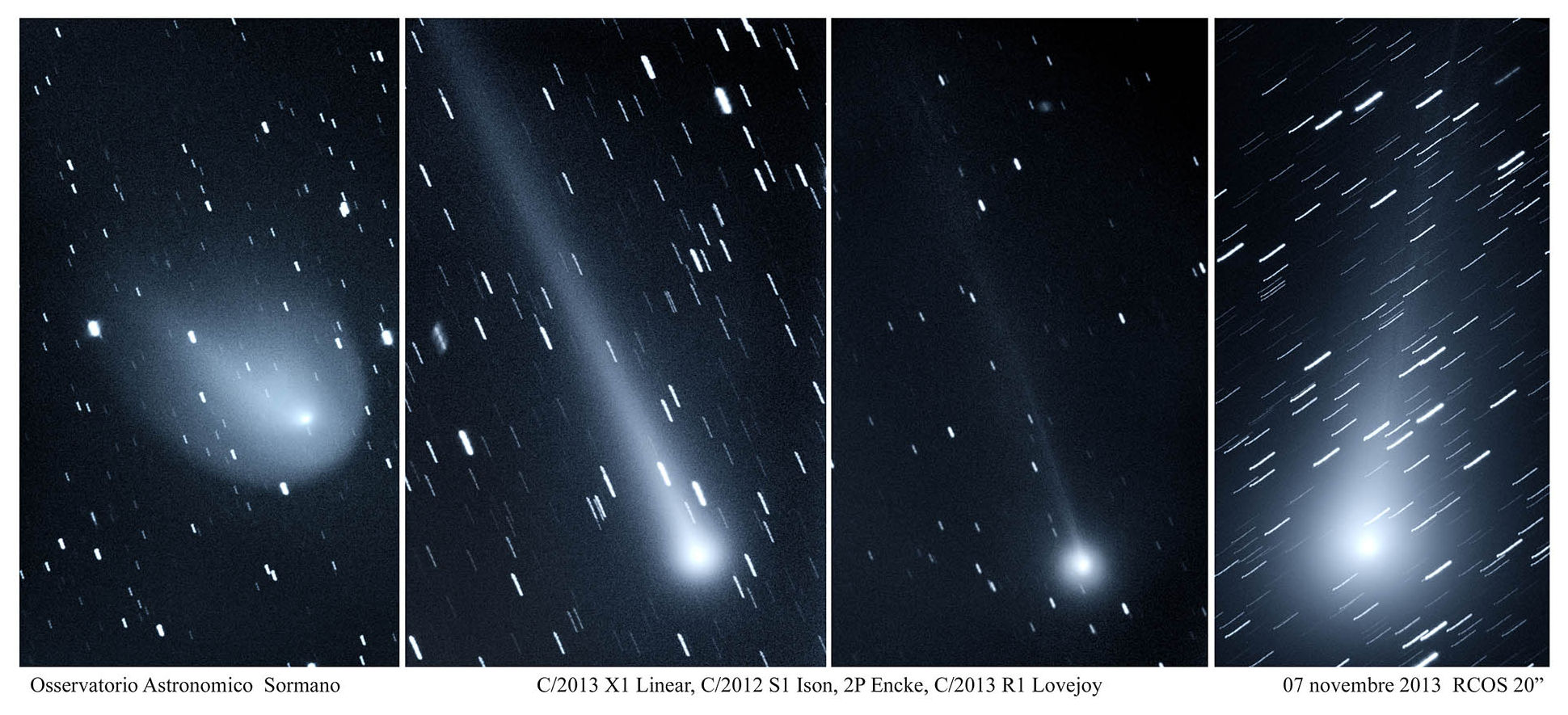
The newest 'comet of the century' has been making a name for itself since it was discovered last year, with claims that it's Nibiru, a doomsday comet, or even an alien spacecraft. However, this comet has been behaving very strangely recently, and a recent analysis of comet images have shown a structure unlike anything scientists have seen from previous comets.
Comet ISON
© Yahoo! News Canada
"There is a bright, miniature, long-tailed comet situated within a much larger, but very much fainter and diffuse halo of a coma," said veteran comet-hunter John Bortle, according to Space.com.

Dr. Jian-Yang Li, of the Planetary Science Institute, put together the computer simulation of the comet that took the Hubble Space Telescope images and removed the signal for the diffuse coma that surrounds the central core. What's left is an image of the comet's nucleus and the concentrated tail of debris behind it.

"At this stage of the game, with the comet about to cross the orbit of Earth, I cannot recall any previous comet in my 50-plus years of comet observing looking quite like this," Bortle said. In fact, comet ISON is crossing Earth's orbit as of today, as it plummets towards a November 28th pass around the sun. After that, it will swing around the sun's north pole and head back out towards the outer solar system, passing almost directly over Earth around the end of the year.

Sun

Rjukan, Norway celebrates giant mirrors which reflect winter sun into shrouded mountain town

Image
© Ntb Scanpix/ReutersPeople gather during the official opening of giant sun mirrors erected on the mountainside in Rjukan.
Celebrations as project to illuminate mountain town during winter months results in first deflected sunrays reaching its main square

Residents of the small Norwegian town of Rjukan have finally seen the light.

Tucked in-between steep mountains, the town is normally shrouded in shadow for almost six months a year, with residents having to catch a cable car to the top of a nearby precipice to get a fix of midday vitamin D.

But on Wednesday faint rays from the winter sun for the first time reached the town's market square, thanks to three giant mirrors placed on a mountain.

Cheering families, some on sun loungers, drinking cocktails and waving Norwegian flags, donned shades as the sun crept from behind a cloud to hit the mirrors and reflect down onto the faces of delighted children below.

TV footage of the event showed the centre of the crowded square light up a touch, but not as if hit by direct sunlight. Still, residents said the effect was noticeable.

"Before when it was a fine day, you would see that the sky was blue and you knew that the sun was shining. But you couldn't quite see it. It was very frustrating," said Karin Roe, from the local tourist office. "This feels warm. When there is no time to get to the top of the mountains on weekdays, it will be lovely to come out for an hour and feel this warmth on my face."

Bad Guys

Tech giants infuriated over reports that NSA taps into Google and Yahoo data hubs

Image
© Walter Bieri/APGoogle said in a statement: 'We have long been concerned about the possibility of this kind of snooping
Files obtained from Edward Snowden suggest NSA can collect information sent by fibre optic cable between Google and Yahoo data hubs 'at will'

Google and Yahoo, two of the world's biggest tech companies, reacted angrily to a report on Wednesday that the National Security Agency has secretly intercepted the main communication links that carry their users' data around the world.

Citing documents obtained from former NSA contractor Edward Snowden and interviews with officials, the Washington Post claimed the agency could collect information "at will" from among hundreds of millions of user accounts.

The documents suggest that the NSA, in partnership with its British counterpart GCHQ, is copying large amounts of data as it flows across fiber-optic cables that carry information between the worldwide data centers of the Silicon Valley giants. The intelligence activities of the NSA outside the US are subject to fewer legal constraints than its domestic actions.

The story is likely to put further strain on the already difficult relations between the tech firms and Washington. The internet giants are furious about the damage done to their reputation in the wake of Snowden's revelations.

Network

Google denies NSA cooperation but takes steps to expand encryption

Google confesse surveiller des milliers de comptes d’internautes pour le FBI et la CIA/Camera,Google logo et ordinateur
© Inconnu

Google says it is surprised by new reports of government spying on its private data centers, but it's taking steps to defend against just that.

The National Security Agency has tapped internal communication links between data centers owned by Google and Yahoo, according to leaked documents former NSA contractor Edward Snowden shared with the Washington Post

A Google spokeswoman said in a statement: "We're troubled by allegations of the government intercepting traffic between our data centers, and we are not aware of this activity. However, we have long been concerned about the possibility of this kind of snooping, which is why we continue to extend encryption across more and more Google services and links."

The ability to access data stored in so-called private clouds expands what we know of the scope of the intelligence agency's surveillance and could add urgency to U.S. Internet companies' efforts to better secure the information they store. Google said in September it was working to encrypt data flowing between its servers as a defense against large-scale snooping of user accounts.

Eye 2

Intelligence officials and tech execs react to NSA bombshell: "Why in the world would we burn Google?"

Image

Former intelligence officials and technology industry executives reacted with anger and anxiety over the latest revelations that the National Security Agency is reportedly infiltrating some of the world's biggest technology companies and making off with the private communications of millions of their customers. And if the reports are accurate, it could be very bad news for U.S. technology companies, who have been complaining for months that their government's secretive intelligence operations are threatening their business and driving customers towards their foreign competitors.

"I think they're in an almost impossible situation," Rep. Adam Schiff, a senior member of the Intelligence Committee, told The Cable. Speaking of Silicon Valley firms who are obligated to cooperate with the NSA, Schiff said recent leak revelations threatened to negatively impact their bottom lines. "It's definitely going to hurt their business and I think we ought to do everything we can to mitigate that damage. I'm very sympathetic to what they have to confront."

The Washington Post reported today that the agency "has secretly broken into the main communications links that connect Yahoo and Google data centers around the world." According to documents provided by former NSA contractor Edward Snowden, the agency is intercepting emails, documents, and other electronic communications as they move between the companies' privately controlled facilities and the public Internet, giving the NSA access to data in nearly real-time.

The latest revelations are likely to inflame an already tense relationship between the Obama administration and American technology companies, many of whose customers live outside the United States and are not protected by laws that prohibit the NSA from spying on Americans en masse.

Fireball 5

Russian fireball explosion shows meteor risk greater than thought

Supercomputer simulation
© Randy Montoya/SandiaSupercomputer simulation shows details of a fireball that might be expected from an asteroid exploding in Earth's atmosphere. A team led by Sandia National Laboratories researcher Mark Boslough devised the simulation.
Denver - As researchers recover more leftover pieces from the space rock that detonated earlier this year near the Russian city of Chelyabinsk, the event is helping to flag a worrisome finding: Scientists have misjudged the frequency of large airbursts.

Computer simulations also imply that such airbursts cause more damage than nuclear explosions of the same yield, which are typically used as an analogue to ballpark impact risk.

The meteor explosion over Chelyabinsk gives the bottom-line message that the risk from airbursts is greater than previously thought.

Info

Weird forests once sprouted in Antarctica

Fossilized Tree Trunk
© Patricia RybergA fossilized tree trunk protrudes through ice near Antarctica's Mount Achernar.
Denver - Strange forests with some features of today's tropical trees once grew in Antarctica, new research finds.

Some 250 million years ago, during the late Permian and early Triassic, the world was a greenhouse, much hotter than it is today. Forests carpeted a non-icy Antarctic. But Antarctica was still at a high latitude, meaning that just as today, the land is bathed in round-the-clock darkness during winter and 24/7 light in the summer.

The question, said Patricia Ryberg, a postdoctoral researcher at the University of Kansas Biodiversity Institute, is how plants coped with photosynthesizing constantly for part of the year and then not at all when the winter sun set.

"The trees are the best way to figure this out, because trees record physiological responses" in their rings, Ryberg told LiveScience.

Question

Origins of syphilis still a mystery, researchers say

Syphilis
© CDC
Syphilis has been infecting people for centuries, and many researchers have tried to pinpoint the part of the world where the bacterium that causes the disease first appeared, before spreading across the globe and becoming the international disease that it is today.

Yet, despite researchers delving into studying the disease - looking at it from the angles of history, politics, paleopathology and molecular chemistry - the origin of syphilis remains an enigma, say researchers who recently reviewed the literature about syphilis.

The main hypotheses about the origin of syphilis revolve around the voyages of Christopher Columbus to the New World. According to the "Columbian" theory, the crews of Columbus brought the disease from America to Europe when they returned home in 1492. Not long afterward, the first recorded epidemic of syphilis happened, during the French invasion of the Italian city of Naples in 1495.

However, critics of the Columbian theory claim that syphilis may have existed in Europe prior to Columbus' return, and the disease simply wasn't distinguished from other conditions such as leprosy until 1495.

Syphilis - a sexually transmitted disease that can damage the heart, brain, eyes and bones, and even cause death if untreated - first appears in the historical record in the 1496 writings of a man named Joseph Grünpeck. But it was the Italian physician and poet Girolamo Fracastoro who first used the term "syphilis" in 1530 in a Latin poem.

Info

Brain-machine interface puts anesthesia on autopilot

Induce Coma
© itsmejust/Shutterstock.com
A new brain-machine interface could replace human administration of anesthetics to patients in a medically induced coma.

The machine monitors a patient's brain activity and automatically delivers just the right amount of anesthetic to keep the patient in a coma - thus reducing the amount of anesthetic needed and preventing an overdose, researchers say. Doctors could also use the system to awaken patients periodically from a coma to do neurological assessments.

In a medically induced coma, physicians administer drugs to inactivate a patient's brain, usually to treat high pressure in the skull or uncontrollable epilepsy. Doctors maintain these comas, which often last for several days, by monitoring a patient's electroencephalogram (EEG) brain activity and delivering a precise dose of anesthetic.

Controlling the delivery of the anesthesia by hand is a bit like flying a plane manually for several days, the researchers say. In contrast, the brain-machine interface puts the process on autopilot.

Bizarro Earth

Supervolcanoes found in Maine? (Yes, Maine)

Maine has supervolcanoes. Wait, Maine has volcanoes? Yes, and their eruptions could have been among the biggest ever on Earth, geoscientist Sheila Seaman reported here Tuesday (Oct. 29) at the Geological Society of America's annual meeting.

"Long before there were these things called supervolcanoes, we've known about giant, big, horrific silicic volcanic eruptions," said Seaman, of the University of Massachusetts at Amherst. The most massive of these blasts in recent history was Toba, which blew up an island in Indonesia 2.5 million years ago. The explosion heaved 700 cubic miles (2,800 cubic kilometers) of magma out of the Earth's crust.Around 420 million years ago, a series of super-eruptions dropped thick piles of ash and lava fragments along the proto-East Coast. There are at least four volcanoes spread out along 100 miles (160 km) of Maine's coast, Seaman said.
Image
© Edwin ChaseMount Desert Island in Maine's Acadia National Park as seen from across the Mount Desert Narrows.
The huge volcanic rock piles are consistent with caldera-forming eruptions, Seaman said. These explosions empty a magma chamber, leaving a gaping wound in the Earth - think Yellowstone National Park, or the San Juan volcanic field in Colorado.

Since they formed, the ancient volcanic layers have been tilted up by tectonic forces, providing a top-to-bottom slice through a supervolcano. For example, Isle au Haut, part of Acadia National Park, exposes the heart of a volcano. "The whole magma chamber is lying on its side," Seaman said.