Best of the Web:


Gold Seal

Best of the Web: Syrian Army wraps up successful liberation operation in southern Syria

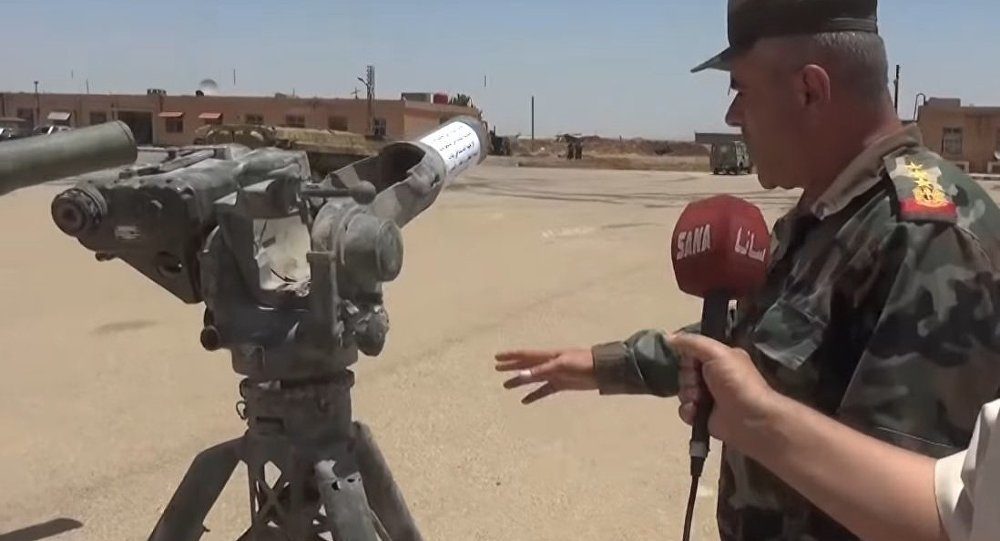
us weapons syria
© SANAThe Syrian Army displays some of the sophisticated US weapons ISIS surrendered in southern Syria
On August 2, the Israeli Defense Forces (IDF) claimed that warplanes of the Israeli Air Force had bombed several fighters of the ISIS-affiliated Khalid ibn al-Walid Army near the occupied Golan Heights. Seven militants were killed in the strikes according to the Israeli media.

This was the second attack by the IDF on the Khalid ibn al-Walid Army during the last two weeks. On July 26, Israeli warplanes destroyed a rocket launcher allegedly belonging to the group in southwestern Syria.

An official of the Jordanian Armed Forces (JAF) announced that members of the Khalid ibn al-Walid Army are attempting to cross the border from Syria. According to him, the JAF's 10th Border Guard Battalion clashed with the terrorists in the Yarmouk Valley killing a number of them.

According to Syrian sources, some number of terrorist group members are still hiding near the Golan Heights and at the border between Syria and Jordan. They are attempting to flee the area in order to hide from the ongoing security operation by the Syrian Arab Army (SAA).

Comment: Notice that Israeli and Jordanian forces are suddenly fighting against, rather than fighting for, ISIS in Syria. A sea-change indeed, if this new pattern holds. Russia's patience is paying off; regional countries are cooperating with the new World Policeman.


Blue Planet

Best of the Web: Pepe Escobar: A US attack on Iran would be an attack on BRICS and Global South

Potin
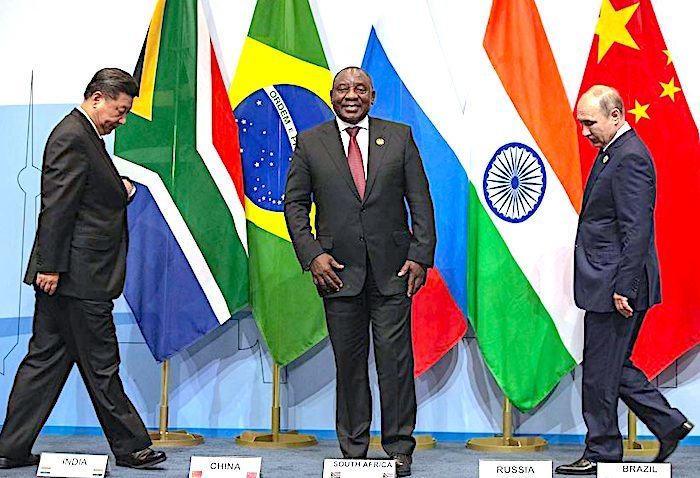
© AFP/Gianluigi GuerciaPresident Xi Jinping, President Cyril Ramaphosa, President Vladimir Putin
Rhetorical war has far-reaching consequences, including a potential economic slump via the disruption of global oil supplies

The key takeaway from the BRICS summit in Johannesburg is that Brazil, Russia, India, China and South Africa - important Global South players - strongly condemn unilateralism and protectionism.

The Johannesburg Declaration is unmistakable: "We recognize that the multilateral trading system is facing unprecedented challenges. We underscore the importance of an open world economy."

Closer examination of Chinese President Xi Jinping's speech unlocks some poignant details. Xi, crucially, emphasizes delving further into "our strategic partnership." That implies increased BRICS and Beyond BRICS multilateral trade, investment and economic and financial connectivity. And that also implies reaching to the next level:
"It is important that we continue to pursue innovation-driven development and build the BRICS Partnership on New Industrial Revolution (PartNIR) to strengthen coordination on macroeconomic policies, find more complementarities in our development strategies, and reinforce the competitiveness of the BRICS countries, emerging market economies and developing countries."
If PartNIR sounds like the basis for an overall Global South platform, that's because it is.

Comment: If there is a forthcoming new world design, it seems to be heading towards a consensus of common aims, vision, and economic platforms that share power and responsibility. Regarding the US and Iran: It's all speculation until it happens, whatever 'it' is going to be.


Clipboard

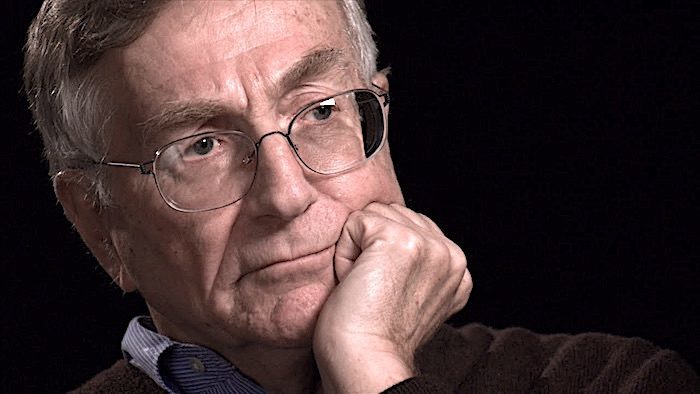
Best of the Web: Endangered species: US journalist Seymour Hersh on 'novichok', Russian links to Donald Trump and 9/11

Seymour Hersh
© MediumSeymour Hersh
In a rare interview, veteran investigative journalist Seymour Hersh talks about his illustrious career and how he believes the official versions of some the biggest news stories of our time just don't add up

I'm about to interview the 81-year-old doyen of investigative journalism Seymour Hersh. Sy Hersh - as he is affectionately known by those close to him - was once described by the Financial Times as "the last great American reporter". Hersh has brought out his memoir Reporter covering the span of his career as one of the iconoclastic journalists of the 20th century - the man who exposed the My Lai massacre in Vietnam and who later brought the abuses at the Abu Ghraib prison in the Iraq War to the attention of the world.

Hersh has recently been in London for a talk at the Centre for Investigative Journalism at Goldsmiths. It makes for a raucously entertaining two hours in which he holds court on everything from Vietnam and the war on terror to the Skripal novichok poisoning, Trump and the alleged Russian hacking of the election. Octogenarian Hersh is already back in Washington by the time we speak on the phone.

Comment: In the US, Hersh is among the last of a dying breed: journalists who can think.


Pirates

Best of the Web: Big revelation: UK's Royal Navy rescued Manchester bomber from Libyan war 3 years before he killed 22

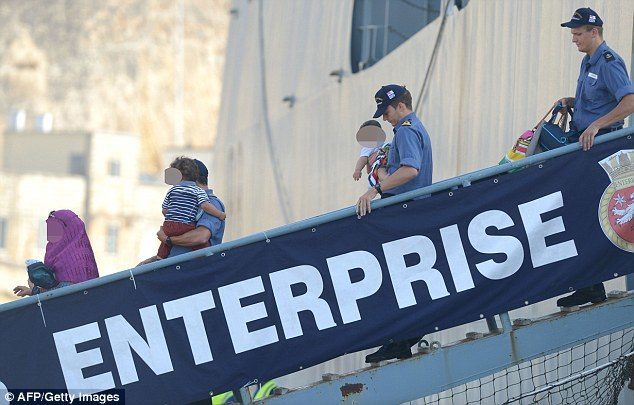
HMS Enterprise
© AFP/GettyHMS Enterprise arrives in Malta in 2014, with Abedi among the 110 evacuees from Libya
The Manchester suicide bomber was rescued by the Navy from war-torn Libya three years before his pop concert atrocity, the Mail reveals today.

HMS Enterprise plucked Salman Abedi, then 19, from the Libyan coast and took him to Malta for a flight home to Britain in August 2014.


Comment: 'Home' to Britain? He was a refugee (of Libyan birth/nationality) at that point, surely?


Last May he set off a bomb in Manchester Arena that killed 22, including seven children.

Abedi's younger brother, Hashem, who is in jail in Tripoli facing trial over the attack, was also rescued by HMS Enterprise.

The pair had been caught up in fighting in Libya and were among more than 100 British citizens taken to safety.


Comment: Whoa! So they were British 'subjects' who went to Libya to 'free' it with NATO, then got lucky on the return trip.


Photographs released by Ministry of Defence officials at the time showed the group being brought on board the Navy vessel.

Comment: Not that it comes as much of a surprise. The UK establishment never met a jihadist it didn't like.

See also: British-Libyan terrorists: "MI5 gave us free passage to fight Gaddafi"


USA

Best of the Web: Robert Fisk found missile casings in terrorist-held parts of Syria. Guess which US arms manufacturers he traced them back to...

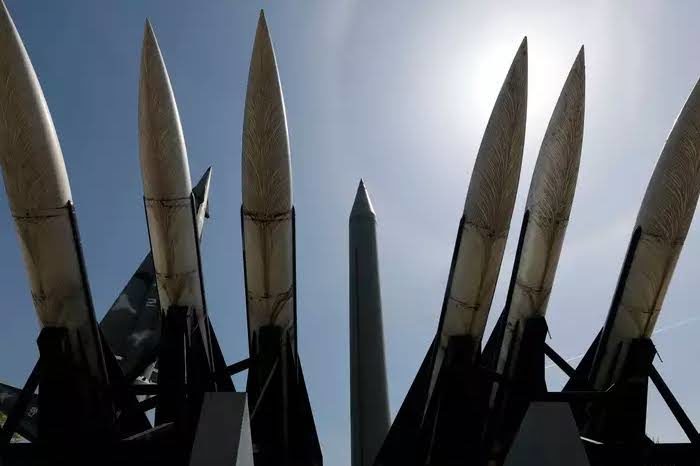
Missiles
© EPA
Readers, a small detective story. Note down this number: MFG BGM-71E-1B. And this number: STOCK NO 1410-01-300-0254. And this code: DAA A01 C-0292. I found all these numerals printed on the side of a spent missile casing lying in the basement of a bombed-out Islamist base in eastern Aleppo last year. At the top were the words "Hughes Aircraft Co", founded in California back in the 1930s by the infamous Howard Hughes and sold in 1997 to Raytheon, the massive US defence contractor whose profits last year came to $23.35bn (£18bn). Shareholders include the Bank of America and Deutsche Bank. Raytheon's Middle East offices can be found in Saudi Arabia, the United Arab Emirates, Israel, Egypt, Turkey and Kuwait.

There were dozens of other used-up identical missile casings in the same underground room in the ruins of eastern Aleppo, with sequential codings; in other words, these anti-armour missiles - known in the trade as Tows, "Tube-launched, optically tracked and wire-guided missiles" - were not individual items smuggled into Syria through the old and much reported CIA smugglers' trail from Libya. These were shipments, whole batches of weapons that left their point of origin on military aircraft pallets.

Bizarro Earth

Best of the Web: Finian Cunningham: When does a 'blessed democrat' become an 'authoritarian strongman' leader?

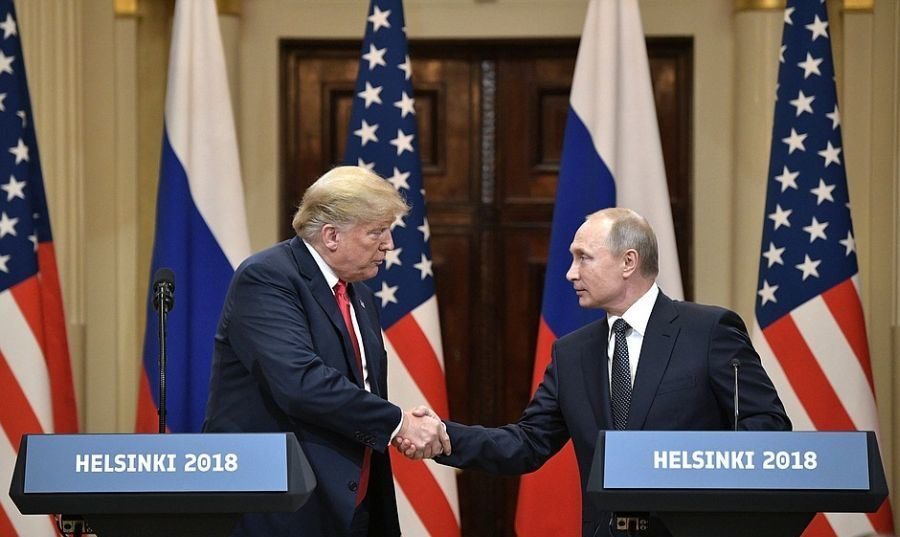
Trump and Putin
Former US President Barack Obama was in South Africa last week for the centennial anniversary marking the birth of the late Nelson Mandela. Obama delivered a speech warning about encroaching authoritarianism among nations and the "rise of strongman politics".

Coming on the heels of the summit in Helsinki between Donald Trump and Russian President Vladimir Putin, media reports assumed that Obama was taking a swipe at these two leaders for supposed growing authoritarianism.

Obama's casting of the "strongman" as a foreboding enemy to democracy is a variant of the supposed threat of "populism" that Western political establishments also seem concerned about.

Trump, Putin, Turkey's Erdogan, Italy's Salvini, Victor Orban in Hungary and Sebastian Kurz in Austria, among many others, are all lumped together as "strongman politics", "populists" or "authoritarians".

Here we are not trying to defend the above-mentioned political leaders or to make out that they are all virtuous democrats.

The point rather is to debunk the false narrative that there is some kind of dichotomy in modern politics between those who, on one hand, are supposedly virtuous, liberal, democratic, multilateralists, and on the other hand, the supposedly sinister "strongman", "authoritarian", or "populist".

Russian Flag

Best of the Web: The Real Reason The US Must Talk to Russia: Its Military Prowess

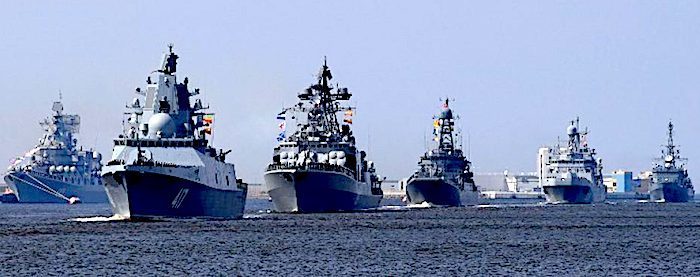
Russian warships
© AFP/Olga MaltsevaRussian Warships
Future historians may well identify Russian President Vladimir Putin's landmark March 1 speech as the ultimate game-changer in the 21st-century New Great Game in Eurasia. The reason is minutely detailed in Losing Military Supremacy: The Myopia of American Strategic Planning, a new book by Russian military/naval analyst Andrei Martyanov.

Martyanov is uniquely equipped for the task. Born in Baku in the early 1960s, he was a naval officer in the USSR era up to 1990. He moved to the US in the mid-1990s and is now a lab director in an aerospace firm. He belongs to an extremely rarefied group: top military/naval analysts specializing in US-Russia.

From quoting Alexis de Tocqueville and Leo Tolstoy's War and Peace to revisiting the balance of power during the Soviet era and beyond, Martyanov carefully tracks how the only nation on the planet "which can militarily defeat the United States conventionally" has reacted to a situation where any "meaningful dialogue between Russia and America's politicians is virtually impossible."

Russian Flag

Best of the Web: Keiser Report: Kremlin's 'nerves of steel' are what allowed Russia to overcome ruble crisis and Western sanctions

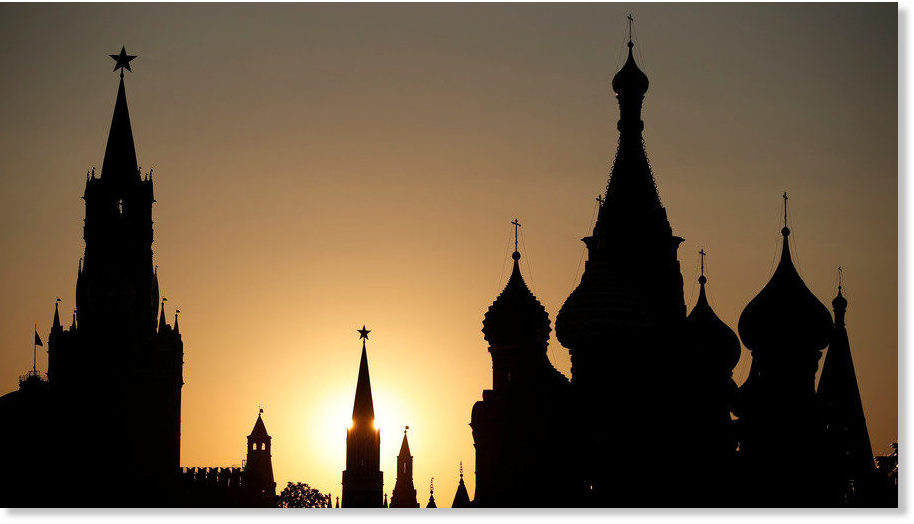
red square
© Christian Hartmann / Reuters
RT's Keiser Report remembers the media hysteria of 2014, when many Western news outlets claimed Russia wouldn't survive the introduction of international sanctions and the ruble crisis that followed.

Max and Stacy also discuss a claim by the IMF's former representative in Russia that there "will never be a debt crisis" with the country's current economic team in charge, which is the world's best, according to him.

In the second half, Max interviews author and banker, Chris Whalen, about Trump's trade war, tax cuts and economic policies.


Biohazard

Best of the Web: Latest novichok poisoning: The silence of the media whores

amesbury poisoning sturgess rowley
Dawn Sturgess and Charlie Rowley
The mainstream media are making almost no effort today to fit Charlie Rowley's account of his poisoning into the already ludicrous conspiracy theory being peddled by the government and intelligence agencies.

ITV News gamely inserted the phrase "poisoned by a Russian nerve agent" into their exclusive interview with Charlie Rowley, an interview in which they managed to ask no penetrating questions whatsoever, and of which they only broadcast heavily edited parts. Their own website contains this comment by their journalist Rupert Evelyn:
He said it was unopened, the box it was in was sealed, and that they had to use a knife in order to cut through it.

"That raises the question: if it wasn't used, is this the only Novichok that exists in this city? And was it the same Novichok used to attack Sergei and Yulia Skripal?
But the information about opening the packet with a knife is not in the linked interview. What Rowley does say in the interview is that the box was still sealed in its cellophane. Presumably it was the cellophane he slit open with a knife.

Comment:


Bullseye

Best of the Web: Trump drops the EU's value as an ally to zero

EU puzzle
Maybe we are misreading things. Not a small number of commentaries have suggested that President Trump intended for Helsinki to re-set the Kissinger-esque triangulation between the US, Russia and China. And there are good grounds for making such a hypothesis. At a 2015 press conference, Trump, himself, took the Kissinger line - that the US should always try to keep Russia and China divided, and never allied together against America):
"...One of the worst things that can happen to our country, is when Russia ever gets driven to China. We have driven them together - with the big oil deals that are being made. We have driven them together. That's a horrible thing for this country. We have made them friends because of incompetent leadership. I believe I would get along very nicely with Putin - okay? And, I mean [that] where we [the US] have the strength. I don't think we need the sanctions. I think that we would get along very, very well."
This makes a lot of sense, but maybe in Helsinki Trump was doing something a little less strategic and more down-to-earth - something more in line with his Art of the Deal philosophy.

Comment: This analysis makes a lot of sense. Trump has been hinting at dissolving NATO and generally treating his EU counterparts with disdain for the last little while. The idea that the Helsinki summit was, at least in part, theater with the goal of sticking it to the EU is actually a refreshing take amid all the 'treason' hysteria, and actually lines up rather nicely with Trump's "art of the deal" methods.

See also: