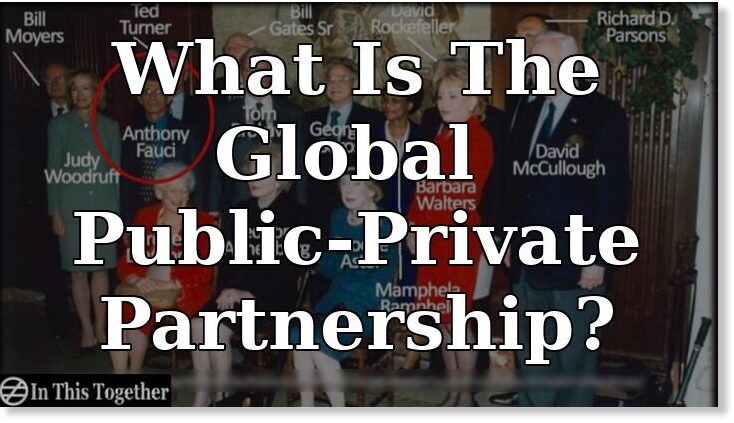
The Global Public-Private Partnership (GPPP) is a world-wide network of
stakeholder capitalists and their partners. This collective of stakeholders (the capitalists and their partners) comprises of global corporations (including central banks), philanthropic foundations (multi-billionaire philanthropists), policy think-tanks, governments (and their agencies), non-governmental organisations, selected academic & scientific institutions, global charities, the labour unions and other chosen
"thought leaders." The GPPP controls global finance and the world's economy. It sets world, national and local policy (via global governance) and then promotes those policies using the mainstream media (MSM) corporations who are also
"partners" within the GPPP.
Often those policies are devised by the think-tanks before being adopted by governments, who are also GPPP partners. Government is the process of transforming GPPP global
governance into hard policy, legislation and law.
Under our current model of
Westphalian national sovereignty, the government of one nation cannot make legislation or law in another. However,
through global governance, the GPPP create policy initiatives at the global level which then cascade down to people in every nation. This typically occurs via an intermediary policy distributor, such as the IMF or IPCC, and national government then enact the
recommended policies.
The policy trajectory is set internationally by the authorised definition of problems and their prescribed solutions. Once the GPPP enforce the consensus internationally, the policy framework is set. The GPPP stakeholder partners then collaborate to ensure the desired policies are developed, implemented and enforced. This is the oft quoted
"international rules based system." In this way the GPPP control many nations at once without having to resort to legislation. This has the added advantage of making any legal challenge to the decisions made by the most senior
partners in the GPPP (it is an authoritarian hierarchy) extremely difficult.
















Comment: More reporting from journalist Richard Medhurst:
It's unclear who instigated the gunfire, but we do know that hijacking protests to further regime change agendas, or to simply sow chaos, has been a common tactic of the West & its allies, such as Israel, we also know that the catastrophic explosion at Beirut's port back in August - notably the reason for the protest - was incredibly suspicious, and even had writers at Forbes asking 'Was Israel responsible?'
Lebanon has been suffering blackouts and hyperinflation of its currency amidst political turmoil, and for those forces pursuing a nefarious agenda the situation was ripe to be taken advantage of: Lebanon's Crippling Financial Crisis