
"There are periods in the life of humanity, which generally coincide with the beginning of the fall of cultures and civilizations, when the masses irretrievably lose their reason and begin to destroy everything that has been created by centuries and millenniums of culture. Such periods of mass madness, often coinciding with geological cataclysms, climatic changes, and similar phenomena of a planetary character, release a very great quantity of the matter of knowledge. This, in its turn, necessitates the work of collecting this matter of knowledge which would otherwise be lost. Thus the work of collecting scattered matter of knowledge frequently coincides with the beginning of the destruction and fall of cultures and civilizations." - George Ivanovich Gurdjieff, quoted by P. D. Ouspensky, In Search of the Miraculous: Fragments of an Unknown Teaching (1949).

© Wikimedia Commons.Alfred Rethel (1816–1859), Nemesis (Justice with Scales and Sword Persecutes the Escaping Murderer) (1837), oil on canvas, 95 x 48 cm, Hermitage Museum Государственный Эрмитаж, Saint Petersburg, Russia.
In the article, Knight-Jadczyk proposed that our sun indeed has a binary companion star (something known as the 'Nemesis theory', in which the sun may have a red dwarf or brown dwarf companion, orbiting at great distance from our sun), and that it may have made its closest approach to the sun in the 17th century during the Maunder Minimum - from 1645 to 1715 when practically no sunspots were observed on the sun. The companion star reaching perihelion perhaps generated a 'grounding effect' on all planets in the solar system, and may be the primary causal factor for 'the Little Ice Age' that took place then.
What is this 'Nemesis theory'? As outlined on space.com:
During the period in question, multiple comets were witnessed and described in the burgeoning field of astronomy, which saw the birth of the telescope during a century of upheaval marked by the Black Death, the Thirty Years War in Europe, the largest witch-hunt in French history, and the English Civil War.
- Nemesis is a theoretical dwarf star thought to be a companion to our sun.
- The theory was postulated to explain a perceived cycle of mass extinctions in Earth's history. Mass extinctions seem to occur more frequently every 27 million years. The long span of time caused them to turn to astronomical events for an explanation.
- Scientists speculated that such a star could affect the orbit of objects in the far outer solar system, sending them on a collision course with Earth.
- Theories have suggested that Nemesis could be a brown or white dwarf, or a low-mass star only a few times as massive as Jupiter. All would cast dim light, making them difficult to spot.
- If Nemesis traveled through the Oort cloud every 27 million years, some argue, it could kick extra comets out of the sphere and send them hurtling toward the inner solar system — and Earth. Impact rates would increase, and mass extinctions would be more common.
- In 2017, a new study suggested that nearly all stars like the sun were born with companions.
Since the Little Ice Age lasted from 1450 to 1850, this period was, presumably, the 'maximum' of the generalized influence, taking around 400 years to cross through the Oort cloud on its way in and out.
This 'cosmic mechanism', which started a few centuries ago, puts a potential magnetic pole shift in perspective. After all, if Earth's magnetic field is weakening prior to a pole shift, it means Earth's magnetic field is "opening up" for incoming energies of the cosmic type. And here, we have to keep in mind that a perihelion of sol's companion is not an isolated event without consequences.
There are several reasons science has not given up on a theoretical "dark star companion". Studies of binary stars and a close approach between them explain "trigger" mechanisms for cyclic cometary showers including extinction level cataclysmic cometary bombardment.
Despite evidence to the contrary, there seems to be keen interest in this "cosmic mechanism". For instance, the latest telescope in the Vera C. Rubin Observatory located in Chile, has two stated purposes. The first is planetary defense. Its images are expected to reveal about 90% of all potentially hazardous asteroids. Second, the observatory should identify as-yet-unseen interstellar comets, free-floating stars and rogue planets. This includes a hypothetical sol's companion which might be lurking at the outer reaches of our solar system. Experts say that soon enough, the giant telescope may have produced enough data to find the elusive body — or rule it out forever. Those words might prove to be only wishful thinking, though.

© NASA / JPL-Caltech
The Space.com article quoted above, summarizes the efforts to find such a companion up to 2017, before the Vera C. Rubin Observatory became operational, as follows:
NASA's Wide-field Infrared Survey Explorer completed its 1.25-year mission in February 2011, having discovered a number of brown dwarfs within 20 light-years. Again, none of these were located near the solar system.However, they missed one in plain sight in the 17th century, on the plane of the ecliptic, which makes it then a part of the capacitor - a term introduced by James McCanney in his "Plasma Discharge Comet Theory". Before diving in deeper on those details, let's clarify this background.
McCanney's framework, laid out in his book Planet X, Comets and Earth Changes, treats the solar system as fundamentally electrical (other than gravitational), where large bodies can exchange charge and drive major Earth effects through plasma currents and discharges. He proposes that the solar system behaves like a charged electrical setup, a solar capacitor, with a significant voltage difference between the Sun and the outer solar system that can be "discharged" when a comet with an eccentric orbit moves through the Solar system. That's what causes cometary effects: the glow, the illumination, the tail, etc. A bug zapper, also known as an electrical discharge insect control system, is a good analogy as the bug discharges the electrical grid and becomes zapped. A comet interacting electrically with the Sun could trigger large solar outbursts that then affect Earth.
This phenomenon, which happens frequently (see Why didn't Comet ISON melt in the Sun? How NASA and Official Science got it all wrong, again), makes the spotless activity of the sun during the 17th century during a background of multiple witnessed giant comets, a very interesting period.
Unless the companion star coming closer induced a grounding of the sun, reducing the positive overall charge which induced a reduced field that increased gravity. This could explain why there was less 'mass', in the form of solar flares, expelled from the sun despite increased cometary activity in the inner solar system during the Maunder Minimum. If you want to dive into the grounding details of the sun, see Earth Changes and the Human Cosmic Connection: The Secret History of the World (2014) by Pierre Lescaudron.
Brown Star Lights Up
Let's review now the 17th century and reasons why such a dark companion could have been witnessed without grand technology, if it was in the plane of the ecliptic, and thus forming part of the 'solar capacitor'.
In mainstream plasma physics and space science, a Birkeland current is an electric current that flows along magnetic field lines in space. They are named after Norwegian scientist Kristian Birkeland (1867-1917), who first proposed that the auroras were caused by charged particles from the Sun flowing along Earth's magnetic field lines.

© wikipediaSchematic of the Birkeland or Field-Aligned Currents and the ionospheric current systems they connect to.
If it was seen, there would have been terror and chaos as was the case in the 17th century when tales of "the end of the world is nigh" were widespread among a terrorized and/or hystericized population. The brown star would have carried over a few comets, fueling end-of-the-world scenarios. English astrophysicist Victor Clube, author of The Cosmic Serpent and The Cosmic Winter, had this to say during a lecture:
I'd like to remind you now that one of these peaks [of cometary activity] that you are looking at here - the 1601 occurs round about 1640 through 1680, and it coincides with the end of the Thirty Years War in Europe, and the Civil War in England. I mentioned this briefly last night. Cromwell, and others of that time - I only name him because, of course, he's a familiar name to you, but there are many others - described all the upheaval of the time, in millennarian terms, as due to "God's revolution" only a century after Copernicus' De Revolutionibus.Some of the comets witnessed during that period of time included comets of 1618, the great comet of 1630, five comets between 1664, 1665 and 1682, and the one in 1683. Giuseppe Ripamonti, discussing the terrible Milanese plague in the 17th century, whose incident inspired a famous painting by Nicolas Poussin, writes the following in De Peste Quae Fuit Anno 1630 (Milan, 1641), Book V:
My point here is that the word "revolution" is popularly used nowadays in a social sense. It didn't have that at the time Copernicus was writing; it acquired it. It acquired it at the time of the English Civil War. And it was because of the perception that things in the sky were driving things, terrible things, that were happening on the ground. Only three hundred and fifty years ago, then, mankind was still in the era of an invisible sky god from a once visible heaven associated with angels, fallen angels, and dangerous demons hurling thunderbolts.
We have to get rid of the idea that our ancestors thought that space was empty. They didn't have [the] specialized astrophysical knowledge that has allowed me to build the Taurid stream for you; they just knew it was there. That's really rather a remarkable thing. We've had to unlearn that knowledge in the last three hundred and fifty years in order to put ourselves in the state of rediscovering it.
So, what was The Enlightenment only forty years after Cromwell? It was the pragmatic English decision to get rid of all the angels and demons, invisible sky gods, and a once visible heaven. It was the decision to stop worrying about the evidence of fireballs and the supposed behavior of comets. It was a decision to reconstruct the cosmos without heaven in the solar system and put it in the ether or outside the cosmos altogether of infinity a la Bruno. It was the decision to create a purified, less frightening cosmos in much the same way as Aristotle did after Plato. On both occasions we shifted from astrology to physics, and from a sky of foreboding to a sky of inspiration, from prison and terror to freedom and hope.
Indeed, the cry of the revolutionary periods of 1640 to 1680 and 1760 to 1800, the time of the American War of Independence, was the cry of freedom from heavenly oppression, demons, and fireballs.
For the last two hundred years of Enlightenment we have been rewriting history so that the cry of freedom is from earthly oppressors. No wonder the world has gone wrong and the astrophysicists today cannot come to terms with the Taurid torus. I'm really trying to say that this is just not an astrophysical discovery that we are talking about. Everything has got to, sort of, turn around in order to come to terms with what is being said. And this, in a way, is rather like what Irving was describing beforehand. There is a paradigm shift involved in recognizing that it's not just ancient history we have got wrong - it's all history.
So, what is my point? My point is that you do not have to dabble first in mythology and prehistory and geology, as Velikovsky did, in order to understand the sky. You first take the modern sky accessible to science, especially during the Space Age, and you look at its darker debris with a view to relating its behavior to the more accessible human history which we can, in principle, really understand. And by this approach you discover from the dynamics of the material in space which I'm talking about that a huge comet must have settled in a Taurid orbit some 20,000 years ago, whose dense meteor stream for 10,000 years almost certainly produced the last Ice Age.
It was a star of fierce and savage appearance. For at that very time when the apothecaries' workshops were believed to be most active (and indeed were), that long-haired star appeared — seen by many toward the north — and no one doubted that it portended a long-lasting calamity of the heavens

The plague of Ashdod, 1630, Nicolas Poussin. Location: Louvre, Paris

Winter, 1664 by Nicolas Poussin. Location: Louvre Museum in Paris
Clockwise Extinction Events
As speculated in mainstream science, the period of the Brown Star is close to 26 or 27 million years, coinciding with extinction events whose exact timings are not written in stone since dating methods are dubious. This is due to the unreliability of carbon dating which doesn't take into account the scrambling of radiological dating and other methods due to electromagnetic surges, magnetic aberrations by ancient cataclysms, and the 2,000+ nuclear tests done since 1945.

© SOTT.net, adapted from Melott & BambachA plot of extinction intensity from Raup and Sepkoski's data (Nature; March 19th, 1982). Out of 19 events (circled points), 11 (green circled points) lie on the vertical lines showing the 27 MY (million year) interval.
Imagine that the main Birkland current feeding our region is actually composed of a multiple series of smaller Birkland currents, so each one, as you move down, is smaller and smaller. In each of these, the current is stranded like a double helix.If either sol's companion or indirect signs of it was witnessed by current modern technology, we are not counting on a global level admission to it. We could only speculate on a world-wide renown binary star research astronomer, Tom Marsh, meeting an untimely and unlikely death during a working visit to La Silla Observatory in Chile.If we examine our location, we know that our Sun directly orbits Arcturus; this means that we are therefore part of one of the smaller strands, about six to seven light years across. We would orbit around this point, moving in a helix pattern over and over again. So it's not really a circle, but as we orbit around the outer circumference, we are moving forward in a helix or a spiral pattern. We would orbit around this point repeatedly while moving along, and our local stars, which are part of the same filament, would move with us, following the same path either in front, behind, or to the side of us.© See the Pattern
As we encircle the filament, the stars further away would seem to precess over and over again. This motion — moving from one side of the filament to the other as we orbit around — would take about twenty-five thousand years for us to complete one orbit.
Sirius is on the same filament and would therefore follow our movement; this is why it does not precess and still rises in the exact same location every year. One of the problems with precession is that its rate has been changing, which is harder to explain because, in this model, we are talking about moving in a spiral pattern.
However, if we consider that these Birkland currents follow a sort of up-and-down motion in and out of the axis of rotation of the galactic plane, then the helix pattern has to move upwards or downwards. As it moves upwards — imagine we are drawing a circle — that would mean more area has to be covered by each circle as you move up and change the direction of motion. Therefore, our perceived idea of the time period might well change as the rate of the wave we are following increases or decreases, resulting in either an increase or decrease in precession depending on how quickly we follow this path.At the same time as all of this is happening, we also know that we are orbiting around the Pleiades, which must therefore be close to the center of the main Birkland current that we follow as an outer strand. Our strand would move outwards, but at the same time, it would itself be twisted around the outer edge. These strands will all move in a helical pattern around the center, but as the distance is much larger for us, it would take much longer to complete one orbit. Jim calculated that, based on our current movement relative to the Pleiades, it would take about 26 million years to complete one orbit — from one point all the way around back to the same point, though we would have moved further along the Birkland current in that process. This timeframe also seems to fit the mainstream hypothesis for the Nemesis star, which is thought to disrupt the Oort cloud every twenty-six million years, causing catastrophes on Earth.© See the Pattern


There's also murdered Caltech astrophysicist, Carl Grillmair, who at the time of his death was focused on studying comets and asteroids that could pose a hazard to Earth, without forgetting that he worked at Caltech's Infrared Processing and Analysis Center where the first space surveys are made. Or Nuno Loureiro's murder, a plasma physicist from Princeton and director of MIT's Plasma Science and Fusion Center, with unique insight and access to key data.
Statistical analyses show that for some comet clusters the probability of arising by chance is very low (less than about 0.1%), implying a common dynamical cause such as a past stellar passage. This is best explained by a solar companion, passing through the outer Oort cloud and perturbing many comets at once.
A binary (especially a long‑period companion) is dynamically more efficient per encounter at disturbing distant interstellar comets, like the ones increasingly described as visitors to our solar system. In that sense binary configurations can be especially effective producers of comet‑orbit clustering.
A comet cluster can approach Earth in a "scattered pattern", however initially it can be seen with technology as a single grouping or multiple groupings, from the region of the Magellanic Clouds which is approachable through the Southern Hemisphere (i.e. from observatories located in Chile).
A single grouping of comet clusters could be read as a single body, which could be related to the next "Maunder Minimum", referred to as Modern Grand Solar Minimum which is predicted to occur any day now based on models analyzing the Sun's magnetic field dynamics. However, the current solar cycle 25 crowned some 21st century records, highlighting ongoing debate in the scientific community. Either or, the comet cluster could well be literally at our doorstep.
Hevelius 1678 "nova" V529 Orionis - The Sun's Brown Star Companion
A member of our research group, axj, developed the following theory based on clues given through the Cassiopaean Experiment:
Johannes Hevelius observed a new star in 1679, which is still a mystery and usually assumed to having been a nova. This sighting has been given the name V529 Orionis. The location is the red circle in this picture and the blue line is the solar system ecliptic plane.The following session was held on January 24th, 2026, exactly 30 years after the Cs first brought up sol's companion in 1996.Why do I think this could have been a sighting of the companion star?© CC BY-SA 4.0Location of V529 Orionis (circled in red)
Time: Exactly in the middle of the Maunder Minimum, which was probably the time of the brown dwarf's closest approach.
Location: Almost exactly in the ecliptic plane and close to Sirius (the large black dot at the bottom of the picture). The companion must be in the ecliptic plane, according to the C's, and the sighting location is pretty much the closest point on the ecliptic to Sirius.
Magnitude: Estimated at 6 (barely visible to the naked eye) or less. This fits exactly the calculated magnitude of a brown dwarf at Pluto's distance (upon further research I also saw that a brown dwarf may be even less visible than Jupiter at that distance, since Jupiter has a much higher reflectivity than brown dwarfs).
Non-identified: It is still unknown what this object was, but an observation error is also ruled out.

(axj) Was the V529 Orionis Nova sighting by the astronomer Hevelius in 1678 actually a sighting of the brown dwarf twin sun?The SIMBAD astronomical database, operated by the Strasbourg Astronomical Observatory in France, is a standard reference tool used by astronomers. For any specific star like V529 Orionis, it typically provides fundamental data such as its position in the sky (coordinates), distance, brightness (magnitude), and its spectral classification, which tells us about its temperature and composition. SIMBAD has this to say about V529 Orionis: V* V529 Ori -- Cataclysmic Binary.
A: Yes
Q: (axj) Was it a plasma flare from Birkeland currents during its closest approach to the sun?
A: Yes
(axj) Were the Spöerer Minimum (1420-1530) and the Dalton Minimum (1790-1820) caused by the brown dwarf crossing in and out of the sun's heliosphere?Solar Minima Timeline and Brown Dwarf PassageA: Yes
Heliosphere Shape:
The Nose (short side, ~120 AU) points toward the constellation Hercules.
The Tail (long side, >350 AU) stretches out in the opposite direction.
The Flanks (sides) are at intermediate distances.
Historical Solar Minima:
Spoerer Minimum (midpoint c. 1505 CE) - HELIOSPHERE ENTRY
Entry: The brown dwarf entered from the direction of Cygnus (on the tailward flank).
Distance: It crossed the heliopause at approximately 187 AU.
Maunder Minimum (midpoint c. 1678 CE) - CLOSEST APPROACH
Location: The brown dwarf reached its perihelion at approximately 40 AU near the constellations Gemini/Orion.
This was the period of deepest solar inactivity.
Dalton Minimum (midpoint c. 1805 CE) - HELIOSPHERE EXIT
Exit: The brown dwarf exited toward the direction of Auriga (on the noseward flank).
Distance: It crossed the heliopause at approximately 156 AU.
Conclusion:
The proposed flyby created a ~300-year transit through the heliosphere. The timing of its entry (187 AU), closest approach (40 AU), and exit (156 AU) aligns precisely with the three historically observed periods of suppressed solar activity, providing a potential unified explanation for these events.
In the scientific literature, novae are a subclass of cataclysmic variable stars (CVs) and hence are interacting binary systems. Mechanisms for the explosive nature of these stars are published and described. However, as mentioned above, Birkeland currents — real plasma phenomena involving field-aligned electric currents — describe better unexplained interactions between stars and galaxies, including binary systems, clarifying what gravitational forces alone can't do.
Despite a flare-up back in the 17th century, to this day, V529 Orionis Nova remains unidentified. However, the passage of a brown star could well explain the increasing moons in some planets of the Solar system.
In October 2019, it was announced that Saturn had 20 new moons, bringing the total amount of moons to 82. In 2023, they discovered 62 new moons, and they said that brings the total count to 145. In March 2025, it's 128 new moons. Officially, it's now 274 moons. In short, our Solar system is loading up.

© CC BY-SA 4.0Diagram showing the highly clustered orbits of Saturn's 250 known outer irregular moons as of 2025. Majority of these irregular moons orbit retrograde, or opposite to the direction of Saturn's rotation. The orbits of retrograde moons are colored red while the orbits of prograde moons are colored blue.
He extends the same electrical logic to Earth: Earth can also participate in discharging this Sun-outer-solar-system voltage and therefore behave "comet-like" during certain electrical alignments. In that state, he says Earth could experience "pollution events" — enhanced inflow/collection of dust and other material from space.
He describes space around planets as structured by moving electric currents and layered current regions ("sheets"), and he attributes a wide range of geophysical and atmospheric variability to changes in those currents coupling into Earth's environment.
In his presentation, that electrical coupling is invoked to account for major "Earth changes" (e.g., storms, flooding, increased volcanic activity, earthquakes, and other large-scale disruptions), including cases where the triggering object is not necessarily close, because electrical interactions can operate at a distance. Within this worldview, hurricane formation/intensification is treated as being driven primarily by electrical energy and currents coming from the Sun/space into Earth's atmosphere, rather than being limited chiefly by ocean heat content.
Separate Events Converging
There are several events converging at this "moment" in time that don't necessarily did so in the past.
First, a comet cluster or clusters, which could have a few thousand years orbit. Only that now they're helped along our way by the second event, a 26-27 million years orbit brown star that just made perihelion with its companion star, our sun.
Third, this time around there's also a magnetic field alteration involving a potential reversal of the poles and the broadening of the magnetic field. This has to do with the South Atlantic Anomaly, a weak spot in earth's magnetic field which is caused by activity in the central heating earth's core.
We are already seeing signs of a weaker magnetic field when the X1.9 solar flare on January 19th 2026 was associated with very high proton energies exceeding red level thresholds by a thousand times, and the indicators of the strongest flares of the current solar cycle by 20 times. Notice how in terms of X flares, it was a relatively mild one. Relatively less powerful sun flares are creating bigger storms on Earth with auroral displays much further south.
When Earth's field is weaker, reduced dipole strength can expand the region of open field lines, allowing auroral zones to "wander" and expand toward lower latitudes. This has consequences for life on Earth as there's an increased influx of cosmic rays and solar particles into Earth's atmosphere.

Taken from Anthony L. Peratt's "Physics of the Plasma Universe" (2015)
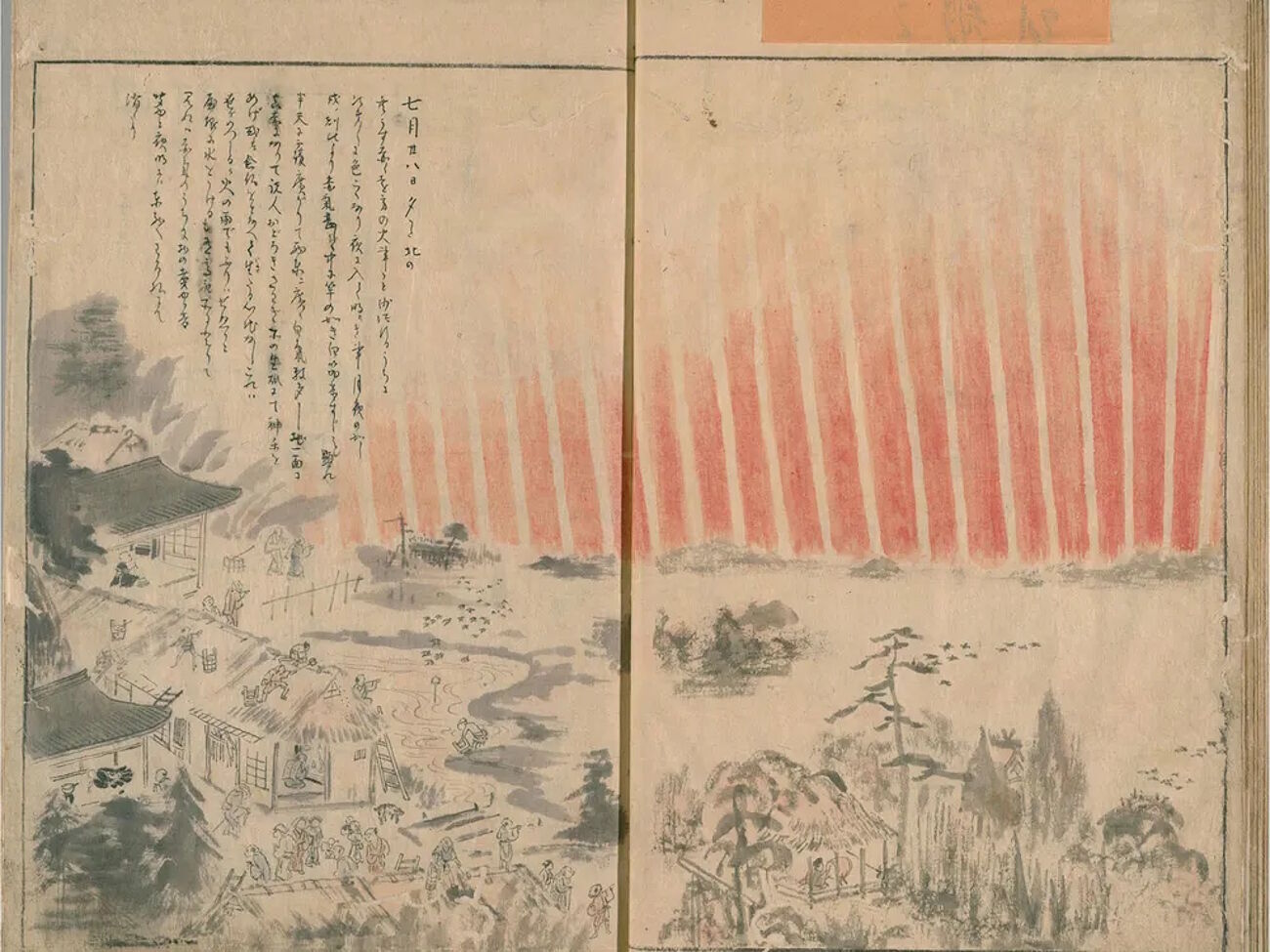
© Courtesy of the National Diet Library.A drawing of the aurora observed from Nagoya, Japan, on September 17, 1770. The written description also notes its intensity: “as bright as a night with a full moon.” MS Special 7–59, National Diet Library, ff. 6b–7a (at Nagoya).

© X /@sepa_massRed auroras in Donbass, 2023.
It remains to be seen whether our roles as observers of our reality may have a mitigating or exacerbating effect on all of this, depending on our ability to see the world as it is.
Human cycle mirrors cycle of catastrophe. Earth benefits in form of periodic cleansing. Time to start paying attention to the signs. They are escalating. They can even be "felt" by you and others, if you pay attention. - The Cs, July 4th, 1998.


Reader Comments
When this perishable body puts on imperishability, and this mortal body puts on immortality, then the saying that is written will be fulfilled: "Death has been swallowed up in victory."
"Where, O death, is your victory? Where, O death, is your sting?" 1Co 15:35 - 55
Sorry, couldn't help quoting Paul. He was the excellent writer of his time.
So why do we believe the scientists?
Does anyone else not see this?
The important thing to note here is that both Newton's theories and Einstein's are expressed in terms of the calculus, which we know can only be an approximation. The only mathematics that can be realistically applied is statistics which necessarily means it can only give probabilities. This literally means anything is possible.
Approximations are not certainties. When you use this to base other theories, it's even more an approximation.
Approximation is not a truth. It's a shell hiding the truth.
On the other hand, most of the Governors are so ignorant and so caught up with ruling (well, and apparently with drinking blood from tortured babies) that they happily hand over money stolen from the Governed to Scientists who claim to be able to build the Next Ultimate Weapon - as soon as they find the Ultimate Unit.
From the "perspective" of calculus, which by definition is flawed at the edges - but without said flaw(s) calculus would not exist cause sometimes an assumption is necessary and when the math of calculus was discovered precision was much less than today - so to assume an infinitesimally small number squared is "essentially" = to "zero" makes sense to me for the sake of the tool calculus evidently is. But comes a time where more precision is needed to advance the math - and that is the time we reside within now.
All numbers are just concepts. The idea of distinguishing between entities on the basis of some kind of division between them, is just a concept. One could just as easily conceive that there is only one thing, or one set of precisely equivalent things, which are a unity, instead of dividing them into numbered sub-sets of themselves. It might or might not be very useful to do so though.
Numbers by the way are more than "concepts" - they are tools.
Just like "AI" is - a tool.
A darling in the iT world just let 10% of its workforce go (1600 worldwide) because of the threat of Ai, existential some say.
[Link]
Brave AI on the holographic fractal model: " Fractal means that the same geometric patterns repeat at all scales , from subatomic particles to galaxies, suggesting a self-similar, recursive structure throughout the cosmos. This idea is supported by natural phenomena like the branching of trees, lightning, and the arrangement of galaxies, and is formalized in theories like fractal cosmology."
" Holographic means that the entire information of a system is encoded within each of its parts. In a hologram, breaking the plate into pieces still yields a complete image of the whole. Applied to the universe, this implies that the totality of reality is present within every point, challenging the notion of a continuous space-time and suggesting that the universe may be encoded on a lower-dimensional boundary."
In my view, what is important is humanty's or an individual's relationship to the cosmos or the source (God or the informatoin field). The nihilist view is it is all billiard balls bounciing around relatively randomly though under laws such as gravitation or electromagnetism. The question then is the universe, galaxies, our solar system, the earth, organic life on earth, and humanity as conscious life here by design or by accident. If by design, nothing that occurs is random. The effect of celestial influence on humanity is not understaood. For example, what led to the Renaissance blossoming of art and human expression? The art of the time indicates that the emotional intelligence of humanity was affected.
I do agree that consciousness ascends with higher densities, and that it would correspond to Gurdjieff's ray-of-creation or David R Hawkins hierarchy of consciousness. Because my context is the Fourth Way, I will continue to use that language.
There is definitely something weird and unexplained going on in some kind of parallel word which interacts with our own, but whatever it is, it is not trustworthy.
life requires a total team effort.
when the right team wins the race to knowledge with the right combination of beliefs and practices, that team will stay on top.
ned,
out
“Under this hypothesis, the Sun itself probably had a stellar sibling early in its life but lost it through dynamical processes.“
I wonder why that bit of information wasn’t included in the explanation of the “Nemesis Theory?”
[Link] - A Second Scientist Shot Dead On The Front Porch of His California Home, by Jessica Reed Kraus
~
From the article: BK
Giant Meteor poem of the day
Is that sign in the window (his house) a clue or am I reading to much into that.
I ain't got no idea.
However that sign does intrigue me.
As for Tesla I believe his files were stolen - that is in the public record.
Sort of like Achilles - he chose glory and he is remembered.
But JP Morgan - his tentacles are about to be cut.
Place your bets!
After that - nobody remembers a money grubbing a-hole stopped better ideas in the 20th century - that is the theme of that century of war I reckon - the pattern of it.
Better ideas beckon!
~
Warm Regards,
Ken
"Stand with Israel"
Cheers my friend.
https://substackcdn.com/image/fetch/$s_!6ai8!,f_auto,q_auto:good,fl_progressive:steep/https%3A%2F%2Fsubstack-post-media.s3.amazonaws.com%2Fpublic%2Fimages%2Fe4e130c2-c58c-4cab-983a-0599ee0c6c09_184x126.png
I hope that works - and good find Bsotted!
I give little heed to it - probably just an anomaly.
Ken
Thanks
Just looked...
Yes thats the pic
But fact of the matter is comets and meteors are out and about and there ought be awareness of that is my humble opinion!
Peace hombre!
Ken
But I tell you this - the wiring in this image I share - a long link most likely - ( sure enough - got to cut & paste it if you want to see it )
https://substackcdn.com/image/fetch/$s_!_Iir!,f_auto,q_auto:good,fl_progressive:steep/https%3A%2F%2Fsubstack-post-media.s3.amazonaws.com%2Fpublic%2Fimages%2Fb5becdc0-ec1d-4c70-9e82-c22f6bfee654_884x762.png
Is pathetic poor workmanship - just begging troubles - and I think that window with the image within it was occupied by another tenant - not the one who got murdered - so really - evidence is evidence and this could easily be proven.
If this sort of connection is "common practice" in NYC - that place is toast - and there is storm upon them now - for good reason I reckon.
Also seems like it would be "easy" for the "criminal element" to disable those cords coming in which sort of looked like "cable-TV" or something similar. Seems that would be a vulnerability.
~
I'm glad I don't live there - just now they are in the midst of blizzard! A mean one.
Regards,
BK
Tis out of my hands no doubt - I got better things to do - let them play their games - I could care less nowadays when confusion runs rampant - [Link]
~
Better ideas beckon.
So - let them reap what they have sown.
Better ideas beckon!
You can bank on it.
the ladies know - the comets the meteorites as well - you can't have it both ways.....
So when a planet gets "out of line" the poles might reverse - and then
let the ladies decide
who is the fairest one of all!
[Link]
so the Trojan war as caused when three ladies had an argument regarding
who is the most "fair"
and then a golden apple was delivered
the stage set
~
the comets and meteorites know
bout this sort of foolish
behavior on
planet earth
~
But their path is in place
they have been sent
by forces together
way longer than planet earth
~
So place your bets
and be careful
getting twixt 3 ladies
think they each are the most desirable
~
I find them all
appalling
they think it is
but a game
~
how wrong they are
cause lifes depend
upon the outcome of this
forlorn situation
~
and really
better ideas beckon
they have for along time
can't keep a good idea down
~
Now can ya
Just ask Kropotkin
that Russian genious
as he watches the winds and the elements on the table
~
BK, Poem of the Day, 22326 1148
Scientists have ceased experimenting and wandered off into theorization, creating increasingly complex equations. These, to the extent that they are mathematically correct do not describe Universe, and to the extent that they describe Universe are not mathematically correct.
The major problem is that Science does not recognize that no model can perfectly describe anything "real". The application of what we have come to call Engineering allows us to get "close enough" when making anything - buildings, cars, windows, power generators...
Society is what it is today because greed has driven us to make things cheaper and cheaper instead of better and better.
Concomitantly with that attitude, we have a society whose highest beneficiaries are intent on - and quite good at - keeping information secret... particularly when it carries a strong probability of disruption of the society and their places in it.
It's a damned good thing we're having so much fun.
.
'The Last Generation' The Crowhouse w/Max Igan: [Link]
The Frame Is Your Projection Yes, the “frame” is precisely your projection of yourself onto your brother (and onto the entire world). It is the lens through which you look, and it is made of what you still believe about yourself.
If you still believe you are guilty, separate, limited, a body, a victim, a doer, a sinner, then that is the frame you place around your brother. You will see him as guilty, separate, attacking, limited, doing things “to” you or “against” you. Every action he appears to take, every word, every event, will be interpreted through that same guilty frame. If you choose innocence, even for a moment, the frame changes. Suddenly the same actions, words, events are seen differently: not as attacks, not as proof of separation, but as calls for love, or as neutral ripples in a dream that never truly happened.
So yes, every “event” or “action” you perceive (whether done by your brother or by “yourself”) is part of the frame. It is not happening “out there” independently. It is the mind’s interpretation of form, shaped by whether you are looking through guilt or through innocence.
God’s Will = Love = All There Is Exactly right. God’s Will is Love, and Love is all that truly exists. There is no opposite to it, no real “other” will that can oppose it. Anything that appears to contradict Love (attack, guilt, separation, suffering) is part of the frame, the ego’s overlay on the picture.
The picture itself (what God created) is untouched: Perfect Innocent Whole Eternal One.
When you think you see “otherwise,” you are simply looking at the frame, not the picture. The frame is the illusion of separation. The picture is the unchanging truth behind it. The Only Real Choice.
So the question reduces to one thing, over and over: “Do I want to see innocence here, or do I want to keep the frame of guilt?”
Choose innocence → the frame thins, the picture shines through, peace rushes in. Choose guilt → the frame thickens, the picture is obscured, conflict continues.
That’s it. No other decision matters. No other question is ultimately worth asking... ❤️🔥
I love how you described 7D as “God’s perch/awareness” where everything is untouched, perfect, innocent, whole, and eternal. In A Course in Miracles that is exactly what we call Heaven, and the beautiful part is that we have never actually left it.
The densities, the sense of “us in the future” (like the Cassiopaeans), the lessons of duality, even the minefield of 3D, all of it feels very real in the classroom, yet from Heaven’s view it is only a dream of separation. There are no real densities to climb; there is only the dream of densities.
The Holy Instant is the gentle way the Course offers to remember our Home right now, even while the body seems to walk through the “minefield.” We don’t have to wait for a future density or lesson plan, we can choose to see innocence (in ourselves and our brothers) in this very moment, and the frame of guilt and fear thins until only the Picture remains.
I’m not here to debate the Eighth Front or any of the details, and I really appreciate the link to Voltairenet, that is some great reading, only to share this quiet remembrance with you. Thank you again for the kind exchange.
Peace and love to you, brother ❤️
See the side bar quote! Still though, 'we' are in this journey together, human (and not) brothers and sisters. Peace and love to you too! ❤️
I resonate with the Huxley quote, that child-like openness keeps the heart alive and developing, free from habit’s cocoon. And yes, seeing through innocence does make the Picture clearer, even if it’s easier said than done in the midst of the lessons.
For me in ACIM, the densities and steps feel like beautiful symbols within the dream-classroom, pointing to growth. Yet the Course gently reminds us we’ve never truly left Heaven’s wholeness, the “climbing” is only seeming, and the Holy Instant lets us touch that eternal completion right here, right now, without waiting for future levels. No shortcuts, just the simple daily choice for innocence that thins the veil.
We’re both seeking the same peace beyond the lessons. Grateful for you and this exchange. Peace and love always, brother. 😊
A: Pray without ceasing. The universe is very aware . Goodbye.
Being at the 3th level of awareness(IMO), all 'we' can get for peace is being comfortably numb [Link] And I have no interest in being there...
Peace.
Ha Ha! My prayers are with you Dwoods44; that your esoteric endeavors be fruitful, and come back and share if you so choose...
BUT - and this is important - sometimes it is better to tend to matters closer to home and spend less time looking at a screen - so I support your endeavor - it makes good sense to me.
~
Godspeed - and see you around!
Ken
~
ps - if you are ever in southwest Virginia area (with a guest or two even), and I'm not kidding - please look me up. My wife and I are gracious hosts and I prefer face-to-face and we have an extra place here always open to friends.
However, it was a secondary AI identified culprit, which turned out to be an obstruction in the gas line. We did call in an HVAC repairman to find it
Here is an audio review regarding our current time from qnewspatriot on rumble. He is an excellent analyst, and he gives a different view of this conflict. If he is right, we will see nuclear weapons used by Israel on Iran. [Link] As he notes at the beginning, 2025 was difficult for his family.
SOTT Focus:The Hazard to Civilization from Fireballs and Comets
Having recently written a review of New Light on the Black Death: The Cosmic Connection by dendrochronologist Mike Baillie of Queen's University, Belfast, Ireland, I decided to go deeper into the...So the hard way it is - and sleep is time well spent, but the time to sleep is not now.
Cause it is WAR parzival - so thanks for this - in the future it might have value - but it might not.
~
War is war - let the best ideas prevail - and what is the choice when attacked twice - turn the other cheek - I don't think so - so now tis time to put the bullies to bed I reckon - let them be the ones sent to sleep.
Not I.
~
So - sweet link and it is playing as I type this - it resonates, but war is war - and for those didn't call it upon themselves - let them defend their homeland.
There can be no sleep when war is in the air - and secession follows - it ain't rocket science - it is common sense.
~
With that said I've bookmarked the music - it is hypnotizing in a way - but not today - maybe tomorrow.
Here's a summary of what I learned from studying Quantum Mechanics theory: Everything is connected to every other Thing.
Enjoy your life as a human being.
"Court sides with parents in dispute over California policies on transgender students"
and
"Supreme Court grants Republicans’ request to pause order to redraw New York congressional map"