
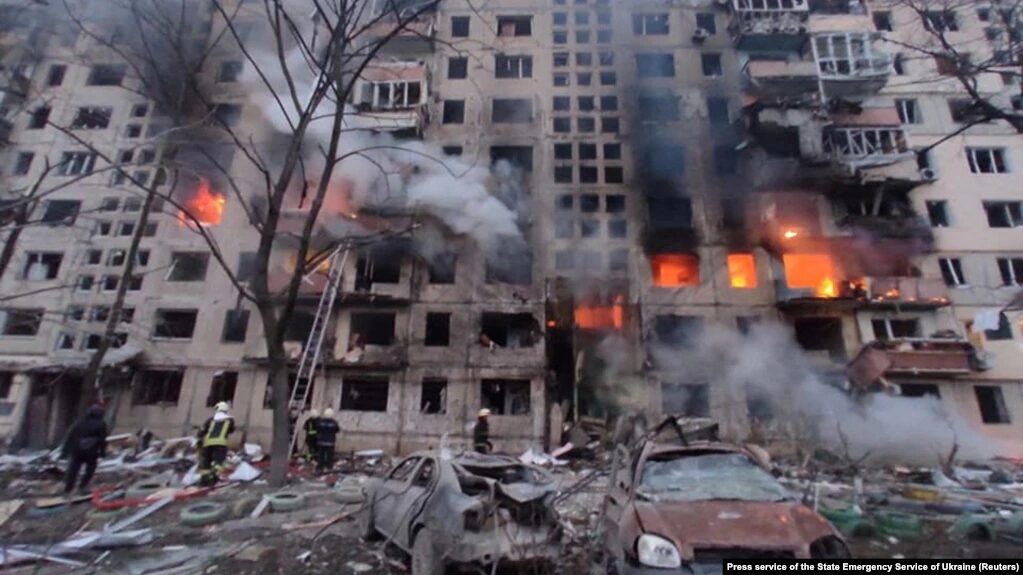
Rescuers work next to a residential building damaged by shelling in Kyiv on March 14.
Mykhaylo Podolyak, a senior adviser to Ukrainian President Volodymyr Zelenskiy, said the pause was to allow for "additional work in the working subgroups and clarification of individual definitions."
Podolyak said ahead of the talks that he expected a "difficult discussion" on reaching a cease-fire, immediate troop pullout, and security guarantees.
The discussions, which are being held via video link after three previous in-person meetings, come as Russia intensifies strikes across Ukraine.
The diplomatic efforts have raised hopes that Moscow might open the way for more civilians to evacuate even as Russian forces keep up their pressure on the capital and other major cities.
Comment: Russia is evacuating civilians.
- Donbass: DPR and Russian soldiers evacuate civilians from Mariupol and Volnovackha is liberated
- Russia says it will continue to evacuate civilians without Kiev's approval
- Moscow says Ukraine is raising 'absurd' demands on corridors to evacuate civilians
- DPR: Ukrainian militants preventing evacuation of civilians from Volnovakha
Previous talks have not led to major breakthroughs or a solution for getting aid or evacuation convoys to the strategic city of Mariupol, where hundreds of thousands of people faced extreme shortages of food, water, and medicine.
A Russian delegate to the talks, Leonid Slutsky, was quoted by the RIA Novosti news agency before the latest round as saying the previous discussions had made significant progress and it was possible the delegations could soon reach draft agreements.
Ukrainian and European leaders have pushed for Russia to grant safe passage to civilians trapped by fighting. Ukrainian authorities said on March 13 that more than 10 humanitarian corridors were set to open, including to Mariupol, but such promises have repeatedly crumbled.
Comment: See:
The International Committee of the Red Cross said suffering in Mariupol was "simply immense" and that the bodies of civilians and combatants remain trapped under the rubble or "lying in the open where they fell."
The fight for Mariupol is crucial because it lies in an area that could help Russia establish a land corridor to Crimea, which it seized from Ukraine in 2014.
Petro Andryushchenko, adviser to the mayor of Mariupol, said on March 14 that a local cease-fire arranged with the Russian forces besieging the city held long enough for the first cars to leave for the city of Zaporizhzhya, about 225 kilometers away.
He said about 150,000 residents had left the city using humanitarian corridors, while some 350,000 residents remained in the city.
"They are living in a dramatic situation right now. No water, no electricity at the moment in some areas," he said. "People collect snow to melt it and use it for drinking and cooking."
Some areas have been completely destroyed and it may not be possible to repair the houses in them. Some people have had to bury their loved ones in backyards, he added.
Andryushchenko also expressed concern that the situation in the city may worsen within hours.
The fighting near the Ukrainian capital included Russian forces firing artillery on suburbs northwest of Kyiv, a major political and strategic target for the invasion, as well as points east of the city, according to a Kyiv regional administration chief, Oleksiy Kuleba, speaking on Ukrainian television.
Kuleba said a member of the town council for Brovary, east of Kyiv, was killed in fighting there and shells fell on the towns of Irpin, Bucha, and Hostomel.
Russian forces also fired at the airport in the western city of Ivano-Frankivsk, which is less than 150 kilometers north of Romania and 250 kilometers from Hungary.
Local authorities in a district in northern Kyiv said an artillery shell hit a nine-story residential building, killing two people, and a pregnant woman who was injured last week in an air strike on a maternity hospital in the city of Mariupol died along with her unborn child.
U.S. President Joe Biden has sent his national-security adviser to Rome to meet with a Chinese official over worries that Beijing is amplifying Russian disinformation and may help Moscow evade Western economic sanctions.
Jake Sullivan is meeting with China's top diplomat, Yang Jiechi, on March 14. Sullivan has warned that Beijing would "absolutely" face consequences if it helped Moscow evade sanctions.



Comment: See also: