Sarah Marsh, Nelson Acosta
ReutersFri, 16 Apr 2021 02:35 UTC
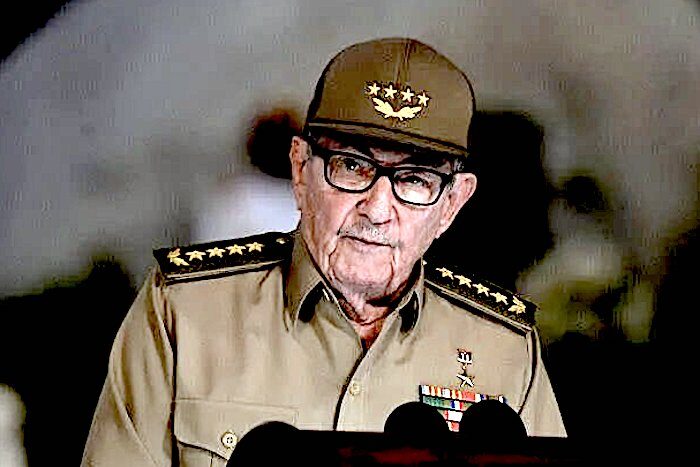
© file photoCuban First Secretary of the Communist Party, Raul Castro
Raul Castro confirmed he was handing over the leadership of the all-powerful Cuban Communist Party to a younger generation that was "full of passion and anti-imperialist spirit" at its congress that kicked off on Friday.
In a speech opening the four day closed door event, excerpts of which were broadcast on state television, Castro, 89, said he had the satisfaction of handing over the leadership to a group of party loyalists that had decades of experience working their way up the ranks.
Castro told hundreds of party delegates gathered at a convention center in Havana:
"I believe fervently in the strength and exemplary nature and comprehension of my compatriots, and as long as I live I will be ready with my foot in the stirrups to defend the fatherland, the revolution and socialism,"
Comment: Retirement marks the
end of a 62-year history under a Castro control:
The Castro era has come to an end in Cuba. Raúl Castro, who has governed the island nation since his brother, Fidel, fell ill in 2006, officially announced his retirement from his powerful position as head of the Cuban Communist party as it opened its 8th party congress yesterday in Havana.
"As far as I'm concerned, I've concluded my task as first secretary of the Communist Party's Central Committee," Castro declared at the opening ceremony of the party meeting. A formal transfer of leadership to his successor as party leader — presumed to be President Miguel Díaz-Canel — will take place before the party congress adjourns on Monday.
The changing of the old guard — Castro is turning 90 in June--to a new generation of leadership in Cuba has been expected since April 2018, when he yielded his position as president of the country to Díaz-Canel. At the time, Castro stated he would stay on as leader of the Communist Party until 2021.
He was now retiring, Castro said yesterday, with "the satisfaction of having fulfilled the mission and confident in the future of the fatherland."
Although Díaz-Canel has adopted the slogan of "continuity" there is mounting pressure on Cuba's new leadership to adopt bold new initiatives to reduce state-centric control of the economy and remove restrictions on private sector initiative.
After Fidel Castro fell ill with diverticulitis in July 2006, he ceded his duties as president of the country and first secretary of the party to his younger brother. Raúl Castro officially assumed the title of president in 2008 and of first secretary of the party in 2011.
As maximum leader, Raúl Castro tentatively initiated economic reforms in an effort to modernize Cuba's stagnant economy. To create incentives for agricultural production, he authorized farmers to sell a percentage of their crops in private farmer's markets; he designated a limited number of occupations to be licensed for small businesses and self-employment; permitted the use of cell phones, expanded Internet access and more.
Of most consequence for Cuba's economic development, Castro secretly negotiated a modus vivendi with the Obama administration. The historic accord to re-establish official diplomatic relations and work toward normalized economic ties was announced in December 2014, and resulted in a dramatic, if short-lived, expansion of Cuba's tourist sector. The Trump administration rescinded Obama's policy of positive engagement with Cuba, and the pandemic forced Cuba to close its borders to tourism for most of 2020.
As Cuba moves into its post-Castro era, he also reiterated his commitment to sustaining the revolution he led with his brother. Nobody should doubt, Castro said, "that while I am alive I will be ready, with a foot in the stirrup, to defend Socialism, the Revolution, and the Homeland."





Comment: Retirement marks the end of a 62-year history under a Castro control: