
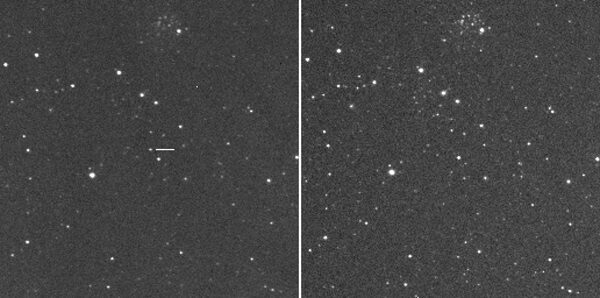
© Yuji NakamuraThe discovery image (left) of a new nova that recently appeared in the constellation Cassiopeia. The right image shows how the same region of the sky appeared just four days prior.
Researchers at Kyoto University quickly followed up using the 3.8-meter Seimei Telescope atop Mt. Chikurinji in Japan. They obtained a spectrum of the new object, hoping to determine its nature based on clues hiding in its light.
They discovered that the object, which is cataloged as PNV J23244760+6111140, is a classical nova: An outburst from a white dwarf that's stealing matter from its nearby companion star.
The new nova is growing brighter, too. At the time of its discovery (March 18), it was shining at magnitude 9.6. But within a matter of hours, it had brightened to magnitude 9.1. Images taken earlier today (March 19), show it has brightened yet again, reaching magnitude 7.8. That's bright enough to spot it with binoculars from your backyard.
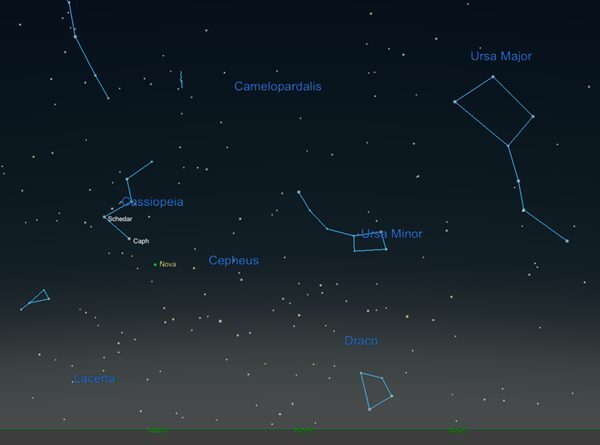
© Alison Klesman via TheSkyXLook for the new nova after dark by finding the W of Cassiopeia, then using Schedar and Caph as pointer stars.
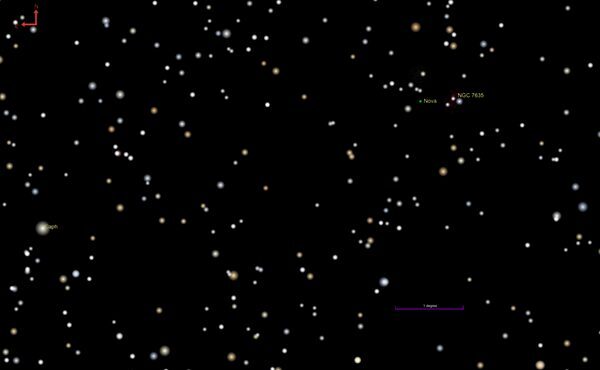
© Alison Klesman (via TheSkyX)The nova PNV J23244760+6111140 is located just under 6° from Caph, and 30' from the Bubble Nebula (NGC 7635).
For those with go-to instruments, you can slew directly to PNV J23244760+6111140 by inputting the following coordinates:
Right Ascension: 23h 24m 47.60s
Declination: +61° 11' 14.0"
It's hard to tell how long PNV J23244760+6111140 will be visible or how bright it will ultimately get. And that means you should track it down as soon as possible. So, turn your binoculars or telescope to Cassiopeia this weekend and stay tuned as astronomers following this exciting event!













Comment: See also: