

© Cedida por Coleccionista/Europa Press 2020Bartolomé Esteban Murillo's original work (left) and two attempts at restoring it.
A private art collector in Valencia was reportedly charged €1,200 by a furniture restorer to have the picture of the Immaculate Conception cleaned. However, the job did not go as planned and the face of the Virgin Mary was left unrecognisable despite two attempts to restore it to its original state.
The case has inevitably resulted in comparisons with the infamous "Monkey Christ" incident eight years ago, when a devout parishioner's attempt to restore a painting of the scourged Christ on the wall of a church on the outskirts of the north-eastern Spanish town of Borja made headlines around the world.
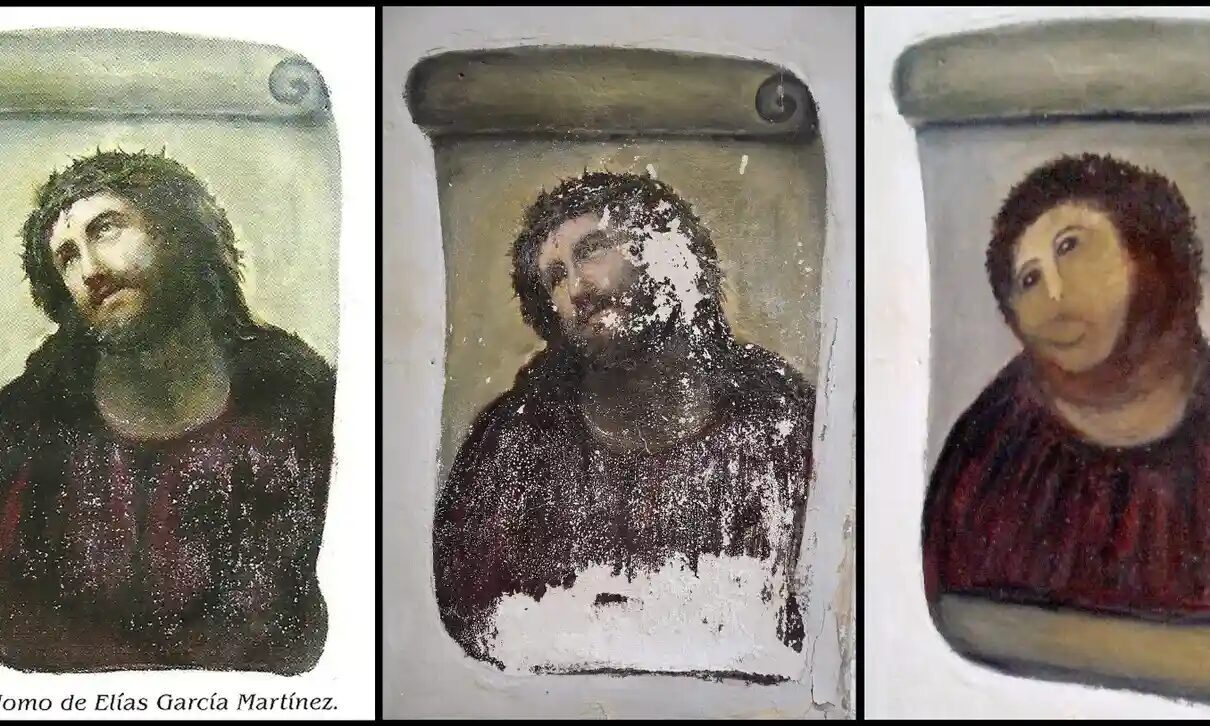
© Centro de Estudios Borjanos/EPABotched restoration of an Elias Garcia Martinez fresco on the walls of the Santuario de Misericordia de Borja church in Zaragoza, Spain.
Fernando Carrera, a professor at the Galician School for the Conservation and Restoration of Cultural Heritage, said such cases highlighted the need for work to be carried out only by properly trained restorers.
"I don't think this guy - or these people - should be referred to as restorers," Carrera told the Guardian. "Let's be honest: they're bodgers who botch things up. They destroy things."
Carrera, a former president of Spain's Professional Association of Restorers and Conservators (Acre), said the law currently allowed people to engage in restoration projects even if they lacked the necessary skills. "Can you imagine just anyone being allowed to operate on other people? Or someone being allowed to sell medicine without a pharmacist's licence? Or someone who's not an architect being allowed to put up a building?"
While restorers were "far less important than doctors", he added, the sector sill needed to be strictly regulated for the sake of Spain's cultural history. "We see this kind of thing time and time again and yet it keeps on happening.
"Paradoxically, it shows just how important professional restorers are. We need to invest in our heritage, but even before we talk about money, we need to make sure that the people who undertake this kind of work have been trained in it."
María Borja, one of Acre's vice-presidents, also said incidents such as the Murillo mishap were "unfortunately far more common than you might think". Speaking to Europa Press, which broke news of the Murillo repair, she added: "We only find out about them when people report them to the press or on social media, but there are numerous situation when works are undertaken by people who aren't trained."
Non-professional interventions, Borja added, "mean that artworks suffer and the damage can be irreversible".
Carrera said Spain had a huge amount of cultural and historical heritage because of all the different groups that have passed through the country over the centuries, leaving behind their marks and monuments.
Another part of the problem, he added, was that "some politicians just don't give a toss about heritage", meaning that Spain did not have the financial resources to safeguard all the treasures of its past. "We need to focus society's attention on this so that it chooses representatives who put heritage on the agenda," he said.
"It doesn't have to be at the very top because it's obviously not like healthcare or employment - there are many more important things. But this is our history."



Reader Comments
I do agree with the general concept, except that we can't demand privately (or church*) owned items to be compelled to use such. After all, I have a 1947 Epiphone that's a work of art, but I'll be damned before I let some government compel me to use their 'approved' restorer.
R.C.
*Which I understand in Spain to be far too government merged, which too much muddies that issue.
RC
RC
I have a lot of 'inventions' that I will hold back on giving details about. But I have no hesitation to speak when I come across things, as here, where I'm fairly certain they have either been already invented, or, if not, certainly would be before I could come up with such as patentable inventions.
RC
R.C.
Is Tucker the mouse waving his arms while the elephants run amok not knowing what to do?
R.C.
Based on what I see here, these are definitely cases requiring swift executions.
-Which, I suppose, is usually the order of operations on the school yard. -The budding little sociopath can freely torment the nerds first, because they have skinny little arms and can't fight back, and everybody hates them anyway. But when you grow more bold, why you can start going after the regular kids!
Now the larger idea, I believe, in Marxist terms is that to destroy a culture, you first need to remove the anchors to its own mythology.
But I think the most direct agents of destruction are not nearly so highly evolved.
I look at the galumphing idiots pulling ropes, and the Karens and male apologists penning all the atrocious stories... It all strikes me as the expanded version of that screwed up mono-brow kid in kindergarten who derived pleasure from kicking over the other kid's blocks and botching their paintings.
When Nephilim incarnate... they look like bitter single women in their 40's and soy-infused street ninjas.
R.C.
And THOSE are the people destroying beautiful objects because of their beliefs. There are also countless works of art that have been destroyed just for fun, by pigs walking on two legs.
There are two alternatives: (a) Kill all the pigs who have no sense of beauty, which is about 2/3 of the human race, or (b) get used to it.
I highly doubt any of these artists thought their works were going to live into infinity. Every ice age grinds all of that into rubble anyway.
Being the Guardian, the focus is of course on "experts" meaning an academic, or at least someone with a few letters after their name, and who will return an email.
No mention of who hired the incompetents who undertook these abortive restorations. Such mention might also disclose who owns the artwork, usually a local church parish or diocese, not the State.
So we get abstract "What must be done" pronouncements, ever imploring the state apparatus to intervene, with no mention of practical responsibility.