
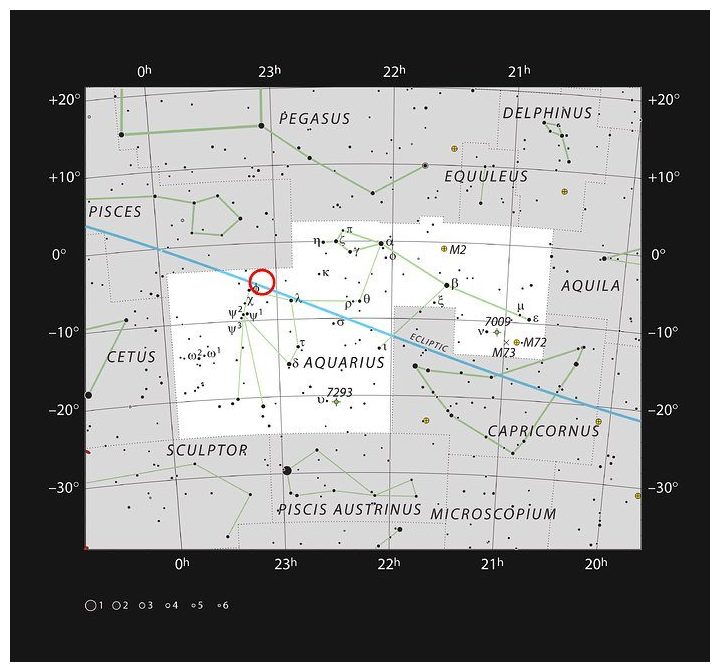
© ESO, IAU AND SKY & TELESCOPELocation of HR 6819 in the constellation of Telescopium (red circle). The chart shows most of the stars visible to the unaided eye under good conditions.
It forms part of a triple system located in the constellation of Telescopium and can be viewed without binoculars or a telescope on a dark and clear night in the southern hemisphere.
The international team originally observed the system, called HR 6819, as part of a study of double-star systems. However, as they analysed their observations, they were amazed when they revealed a third body - the black hole.
The observations with the FEROS spectrograph on the MPG/ESO 2.2-metre telescope at ESO's La Silla Observatory in Chile showed that one of the two visible stars orbits an unseen object every 40 days, while the second star is at a large distance from this inner pair.
"We were totally surprised when we realised that this is the first stellar system with a black hole that can be seen with the unaided eye," says Petr Hadrava from Academy of Sciences of the Czech Republic, a co-author of a paper in the journal Astronomy & Astrophysics.
The black hole is one of the very first stellar-mass black holes found that do not interact violently with their environment and, therefore, appear truly black. But the team could spot its presence and calculate its mass by studying the orbit of the star in the inner pair.
"An invisible object with a mass at least four times that of the Sun can only be a black hole," says ESO scientist Thomas Rivinius, who led the study from Chile.
Only a couple of dozen black holes have been spotted in our galaxy to date, nearly all of which strongly interact with their environment and make their presence known by releasing powerful X-rays in this interaction.
However, astronomers estimate that, over the Milky Way's lifetime, many more stars collapsed into black holes as they ended their lives.
The researchers say the discovery of a silent, invisible black hole in HR 6819 provides clues about where the many hidden black holes in the Milky Way might be.
They already suspect another system called LB-1, a bit further away from Earth but still pretty close in astronomical terms, may also be a triple.
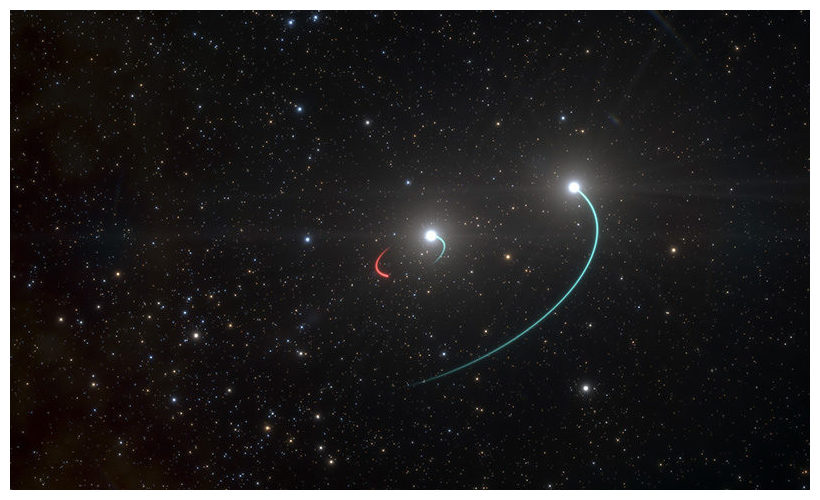
© ESO / L. CalçadaThis artist’s impression shows the orbits of the three objects in the HR 6819 triple system: an inner binary with one star (orbit in blue) and a black hole (orbit in red), as well as another star in a wider orbit (also in blue). The objects in the inner pair have roughly the same mass and circular orbits.
Some astronomers believe that the mergers can happen in systems with a similar configuration to HR 6819 or LB-1, but where the inner pair is made up of two black holes or of a black hole and a neutron star. The distant outer object can gravitationally impact the inner pair in such a way that it triggers a merger and the release of gravitational waves.
Although HR 6819 and LB-1 have only one black hole and no neutron stars, these systems could help scientists understand how stellar collisions can happen in triple star systems.



Reader Comments