
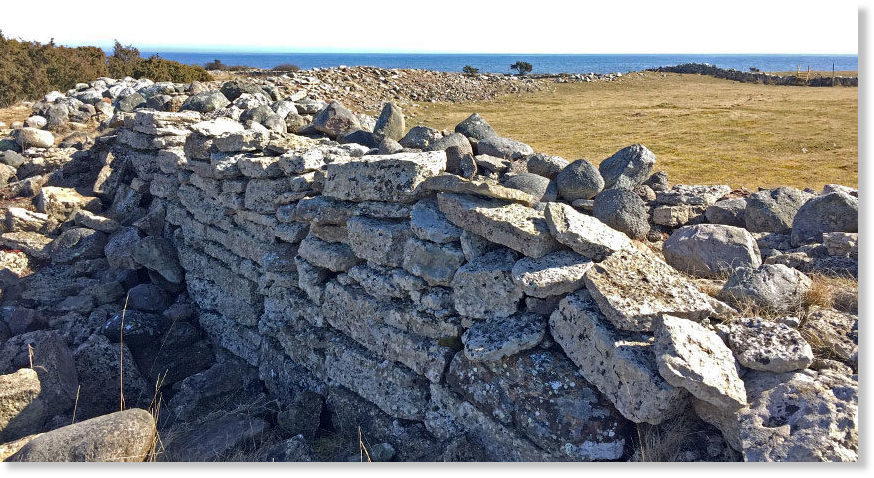
© BAIRUILONG/WIKIPEDIA (CC BY-SA 4.0)Excavations at Sandby borg, an ancient ringfort on an island off Sweden’s southeastern coast, have uncovered evidence of a possible surprise attack and massacre of the site’s inhabitants around 1,500 years ago.
It's unclear why the seaside ringfort of Sandby borg, on the Baltic Sea island of Ӧland, was targeted at a time of political turmoil following the Roman Empire's fall in Western Europe. Adults, teenagers and children died suddenly and brutally - their skeletons showing bones fractured by clubs, but no defensive wounds, say archaeologist Clara Alfsdotter of Bohuslӓns Museum in Udevalla, Sweden, and her colleagues. When the slaughter was over, the attackers left the sheep and other animals to starve and the valuables untouched, the scientists report in the April Antiquity. No one came back to bury the dead.
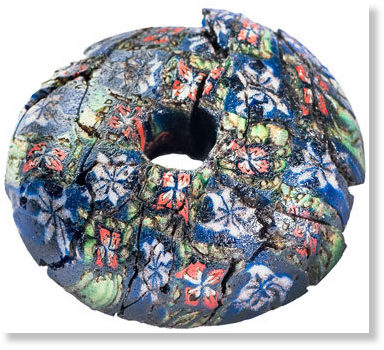
© DANIEL LINDSKOGValuable items left behind by attackers of a Scandinavian fort settlement, including this glass sword bead, point to a politically motivated slaughter around 1,500 years ago that had nothing to do with plunder, researchers say
The bones from Sandby borg have yet to undergo radiocarbon dating, making it impossible to say precisely when the massacre occurred, says archaeologist Ian Armit of the University of Bradford in England, who did not participate in the Sandby borg research. But the researchers suspect the killing happened after 476, when the fall of the Western Roman Empire left a power vacuum and power struggles broke out across parts of Europe and southern Scandinavia. Sandby borg's attackers may have installed themselves as the new local rulers, the team suggests.
"It was not the killing that was the point, but the statement toward those witnessing it from a distance that 'if you mess with us, this is what happens,'" says study coauthor Ludvig Papmehl-Dufay of Kalmar County Museum in Sweden.
Sandby borg, spanning roughly 5,000 square meters contained by an eroded oval stone wall, has been a center for archaeological excavations since 2011. Aerial photographs and ground surveys have revealed stone structures buried inside the ringfort off Sweden's southeast coast. Investigators have located 53 houses, some within a central block circled by a street. By 2016, two houses had been fully excavated and seven others had undergone some investigation. Inside, researchers found gilded silver brooches, glass beads and silver bell pendants, in styles suggesting the fort was occupied in the late 400s.

© C. ALFSDOTTER, L. PAPMEHL-DUFAY AND H. VICTOR/ANTIQUITY 2018Remains of an Iron Age massacre at a Swedish fort settlement included a teenager's skeleton with its feet on top of an adult man's midsection. After being struck on the head, the teen fell backwards over the dead or dying adult, researchers suspect
Scientists are working on radiocarbon dating the Sandby borg skeletons as the annual excavations continue, Papmehl-Dufay says. With more than 90 percent of the ringfort settlement yet to be excavated, there are likely more clues to the killing to be found.
Citations
C. Alfsdotter, L. Papmehl-Dufay and H. Victor. A moment frozen in time: evidence of a late fifth-century massacre at Sandby borg. Antiquity. Vol. 92, April 2018, p. 421. Doi:10.15184/aqy.2018.21.
Further Reading
B. Bower. 6,000-year-old skeletons in French pit came from victims of violence. Science News. Vol. 189, January 23, 2016, p. 7.









"Perhaps this wasn't an attack by a separate group of humans, but rather an extreme weather event like giant hail or even a meteor/fireball catastrophe. That would certainly account for the fact that none of the valuables and animals were left untouched and other odd details in this story."
The first sentence is fine, but the second sentence gets lost midway and reads, "...none of the valuables and animals were left untouched...". That's simply wrong. In fact, the story says the exact opposite, that the valuables and animals were not touched. The sentence as written suggests that the writer forgot how they started this short sentence by the time they got to the end of it.
Get a grip, SOTT!