
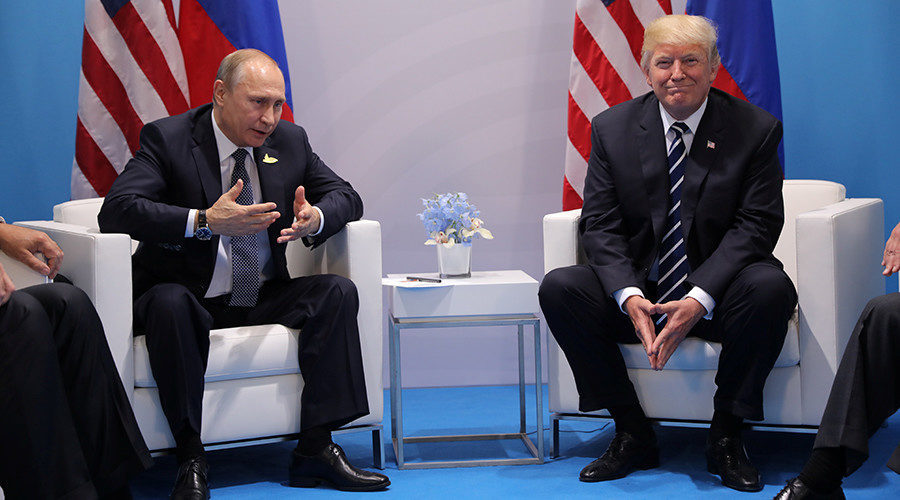
© Carlos Barria / Reuters
Huntsman takes office at the time the bilateral relations are on a downward spiral of sanctions and accusations, reaching the lowest ebb since the nadir of the Cold War. The "diplomatic war" is raging, arms control is in doldrums with the future of two remaining major treaties in question. Europe is turning into a hotbed. The fate of the INF Treaty is unknown as the parties exchange accusations of non-compliance. A dispute over the Treaty on Open Skies may lead Washington to announce new restrictions on Russian military flights over US territory in the coming days.
The two powers view the world differently and the gap appears to be too wide to bridge. But a closer look at the recent events gives a glimmer of hope for the complex Russia-US relationship.
It was reported in late September that US officials were seeking ways to improve communication with Moscow and build "some degree of trust." Russian Deputy Foreign Minister Sergei Ryabkov told Russian Izvestia newspaper that his regular meetings with Under Secretary for Political Affairs Thomas A. Shannon were of great importance and will continue despite of the fact that no tangible progress has been achieved so far. He said there were some certain results. The deputy minister did not elaborate.
It has been reported recently that Russian and US generals held a meeting in September to discuss the situation in Syria. It was the first contact of its kind. Col. Ryan Dillon, the Pentagon's spokesman, said there would be more such meetings in future. Last month, Russian Foreign Minister Sergei Lavrov and US Secretary of State Rex Tillerson met twice at the sidelines of the UN General Assembly to talk privately. The situation in the Middle East, and Syria in particular, topped the agenda. US officials are now considering the prospects of reviving military-to-military contacts.
There has been a lot of speculation that Russia might not comply with the New START limits by the February 2018 deadline. On October 2, a US State Department report was published to say that Russia is in compliance with the provisions of the treaty. Last month, Director of the Russian Foreign Ministry's Department for Nonproliferation and Arms Control Mikhail Ulyanov said Moscow intends to discuss with the US the possibility of the New START Treaty's prolongation.
In February, President Trump decried the New START as an agreement favoring Moscow. Now he appears to change his position on the issue. The remarks by the Trump administration officials suggest the treaty will remain in force and the door remains open to pursuing an extension of the accord, which is set to expire in 2021.
Space exploration is one of the few areas where international cooperation between Russia and the US has not been affected by the deterioration of the bilateral ties. On September 27, Russian Roscosmos signed a joint statement with NASA at the 68th International Astronautical Congress in Adelaide, Australia, to collaborate on a future spaceport orbiting the moon called Deep Space Gateway. Igor Komarov, the head of Roscosmos, said the first modules would be built between 2024 and 2026. The facility would serve as a gateway to both deep space and the lunar surface and would be developed, serviced and used in collaboration with commercial and international partners.
Russia and the United States also discussed using Moscow's Proton-M and Angara rockets as well as other spacecraft to help create the infrastructure of the lunar spaceport. The main works were slated to begin in the mid-2020s. Russia and the US work side by side on the International Space Station.
The recent flurry of international activity involving Libya makes it expedient for the two powers to explore the ways to cooperate on this problem and bring other Libyan forces to the negotiating table. Moscow and Washington could discuss the ways to address this acute international issue at the UN Security Council.
The contacts are maintained against all the odds. The sides continue to cooperate in some areas. The relationship has nosedived but it's not all doom and gloom. There is still a chance for better times.

Comment: As in the last year or so of the Obama administration, the main area of conflict is on the battlefield. Despite the positive trends mentioned above, this is what is currently going on in Syria: