
Clearly, my colleague had been watching and reading age old sources, the printed press and trusted television news stations, all with years of experience providing a narrative for such events. The other guy...well, I obviously had been watching and reading who knows what on the internet, in books of all sorts and of course in the "alternative media". How could this happen? How could such an intelligent human being such as I fall victim to not only a crazy conspiracy theory, but somehow stumble into what seems to be a "completely alternate version of reality"?
To answer this question, I conducted a rudimentary search on Google about why such seemingly intelligent people believe conspiracy theories and thankfully found several recent articles by our leading narrative builders like the New York Times, CNN, Scientific American, The Times, The Guardian and of course the BBC.
All the articles I dug up were backed up by academics in the fields of politics, history and psychology and generally promoted the same ideas:
Conspiracy theories are held by people who; "...feel a lack of control over their lives", and "...see patterns and casual connections that are not there, especially when we feel that events are beyond our control" or, at "moments of great upheaval". Belief cuts "...across gender, age, race, income, political affiliation, education level and occupational status" and is "...near impossible to destroy" although only one concedes "one of the many reasons people believe in conspiracies is because conspiracies actually happen".
The other common feature of these articles and academic arguments was the complete lack of examination of each or any claim. It could be suggested that the lack of credible investigation by these age-old sources and academics, who all have years of experience building a narrative around incidents of great importance, could be blamed for people seeking alternative sources of information. It's simply not enough to say, for example, a belief that the 9/11 attacks were not carried out by 19 hijackers alone is 'crazy'. You need to logically and rationally show why you think that theory is 'crazy'.
Branding those who stepped outside the centrally fed [AP, Reuters] mainstream narrative as "conspiracy theorists", even in the face of sound research and hard facts, had previously sufficed. However, we no longer have to rely on a New York Times Op-eds, or BBC special reports to explain the intricacies of the divisions within Syria, because the average person today has instant access to nearly unlimited information, without it being influenced or filtered by "the car industry, retail business and financial services sector, the former "...sturdy legs of a stool..." that the old media "rested comfortably on".
Whilst I had lost my belief in the mainstream completely on that "catastrophic and catalysing" morning of September 11th, 2001 [our generations big lie], my colleague and many others have maintained their faith in the mainstream media. So, when we are told by age old sources that Bashar Al Assad is an evil butcher, willing to carry out chemical and biological attacks on densely populated areas of his own people and willing to subvert and oppress the democratic wishes of his suffering population, it is taken as gospel by the faithful, like my colleague, but not by me.
Because the new media is mostly internet based, there is no need to regurgitate the polished set of lies agreed upon by the mainstream shills, instead, arguments can be based on the raw data, and are unshackled by any need to spare the blushes of political notables or to conceal connections between seemingly parallel and opposing entities, usually forcing the hand of the mainstream to offer (literally and figuratively) some coverage.
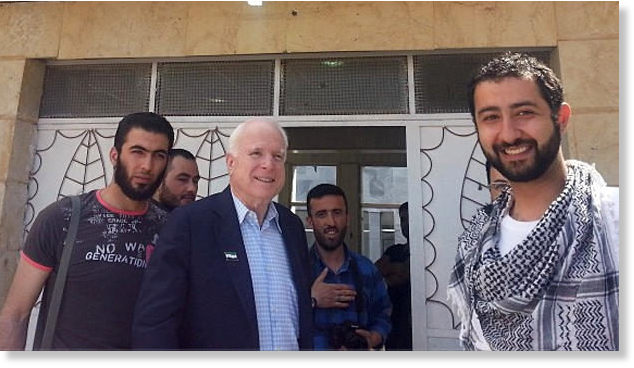
John McCain meeting with confirmed jihadist kidnappers in Turkey
Obama was also accused by "conspiracy theorists" of using eerily similar allegations of gas attacks as a pretext to wage war on Syria. The recent gas attacks in Syria during Trump's administration should pose some serious questions! Foremost, is this the continuity of agenda between Democrats and Republicans we were told was fantasy? Do Presidents mastermind anything at all or is there really a "deep state" operating towards goal established several years in advance, regardless of who we the people elect?
The complete refusal by some to accept that any conspiracies exist at all is worrying. Attempts to detach the Intelligence agencies from the inner-city drug epidemics of the 1980's and 1990's still occurs today. A simple Google search brought up this mainstream article which had links to this Senate Committee report from 1989. It states:
"The subcommittee identified a number of cases in which law enforcement operations and criminal prosecutions were subordinated to other foreign policy concerns...Instances in which foreign policy considerations took precedence over the war on drugs included the Barry Adler Seal episode, law enforcement investigations into illegal activities associated with the Contras on the Southern Front, a narcotics sting operation directed at a high Bahaman government official, the intervention of U.S officials on behalf of the Honduran General convicted in a narco-terrorism plot, and the handling of Panama's General Manuel Antonio Noriega".The "internet made things worse" argument, admittedly, can apply in a few areas, but the serious independent, internet-based journalism being done can no longer be ignored. The LIBOR scandal and the Syrian gas attack are two good examples, among many, of reporting done better by those outside the mainstream.
I have used sources from the right, the left and others outside that paradigm. Some I like, others, I don't see eye to eye with on many issues. Follow each hyperlink; the top of the page has more mainstream articles, while the bottom links lead to examples of new media.







That's funny. That's what I think about Guardian readers.
"David Quinn"
Hey Joe, was that your dad? LOL.