
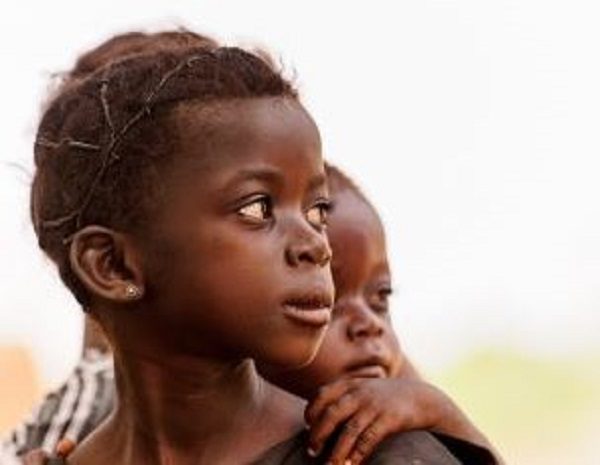
© Anton_Ivanov / Shutterstock.comACCRA, GHANA: Unidentified Ghanaian girl and her little brother. Children in Ghana suffer due to the county's unstable economic situation.
For 700 million or more kids around the world, childhood ends too soon. This is the premise that prompted a new report called the End of Childhood Index, which ranks 172 countries based on whether or not childhood has ended early for the children living there. Inadvertently, the report maps out the best and worst places to be a kid in today's world.
Save the Children created the 44-page report using eight primary indicators:
- Malnutrition that stunts growth
- Under-5 mortality
- Out-of-school children
- Child labor
- Early marriage
- Adolescent births
- Displacement by conflict
- Child homicide
The report's intro reminds readers it's "no accident" that certain children in a given nation or region eat, thrive and live into adulthood while others starve, suffer and die.
"Lost childhoods are a result of choices that exclude particular groups of children by design or neglect. Millions of children have their childhoods cut short because of who they are and where they live. There have been major gains for children in the last 25 years, but recent progress in fighting extreme poverty has often not reached those children who need it most—because of geography, gender, ethnicity, disability or because they are victims of conflict."
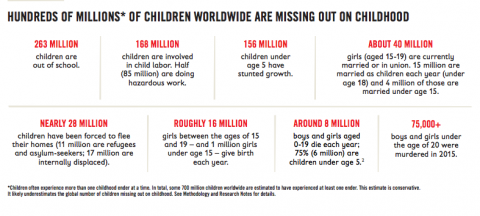
The report provides the following breakdown of the ways in which hundreds of millions of children lose out on childhood globally.
The U.S. is a world leader in childhood poverty, as AlterNet has reported. At least 13 million U.S. kids live in food-insecure households, meaning they do not have access to nutritious foods on a regular basis, according to the latest statistics. While the U.S. has relatively strict child labor laws, the amount of oversight of labor in general has declined in recent decades, and as the Atlantic reported in a 2014 article, the U.S. may have many more child workers than presumed.
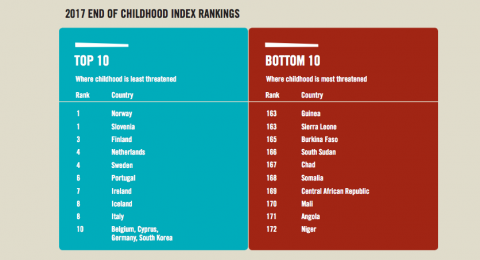
Here is a list of the top and bottom 10 countries according to the End of Childhood Index:



R.C.