
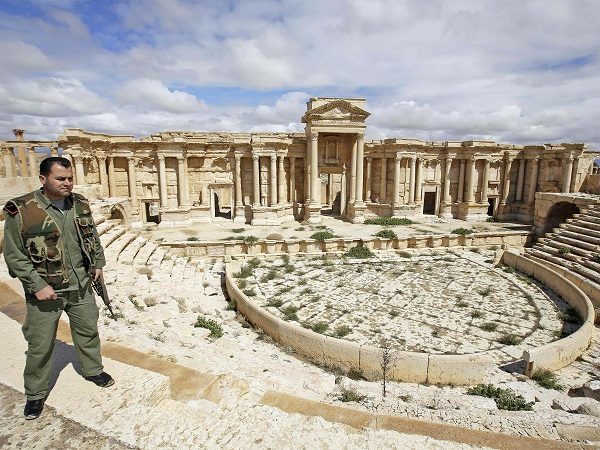
The Russian General Staff has commented on the progress army as it continues offensive in central Syria against ISIS.
Starting in December ISIS launched a major offensive in central and eastern Syria. This captured Palmyra and a belt of gas fields west of Palmyra, and also involved a major attack on the besieged eastern desert city of Deir Ezzor.
The Syrian army's counter offensive began in earnest at the end of January, but has been slow to develop as the Syrian army has been obliged to deploy some of its best troops elsewhere in Syria, for example against ISIS in the strategically important town of Al-Bab, and against Al-Qaeda in Wadi Barada near Damascus. The Syrian army's counter offensive against ISIS in central Syria, and the Syrian garrison's defence of Deir Ezzor against ISIS, have however been supported by heavy bombing by the Russian air force, including by TU22M3 medium bombers flying from Russia.
Recently there have also been reports that Russian Special Forces have also been deployed to the area around Palmyra. This comes shortly after reports that the Syrian army has deployed its elite Desert Hawks unit to the same area. The report from Al-Masdar discusses the scale and purpose of the deployments:
A convoy of Russian special forces arrived in the western countryside of Palmyra on Saturday evening after traveling from the coastal city of Jableh, a military source in east Homs told Al-Masdar News.Though Al-Masdar is careful to avoid mentioning the city of Palmyra - a consistent feature of Syrian news reports from the area, and one which is apparently intended to emphasize Palmyra's lack of military importance - there is no doubt that its recapture is a high priority, and is part of the plan for the offensive.
These soldiers from the Russian special forces will be tasked with advising the newly formed 5th Legion of the Syrian Arab Army as they attempt to liberate the Hayyan Gas Fields some 40km west of Palmyra.
According to the same military source, two large convoys of Syrian Arab Army soldiers also traveled to the western countryside of Palmyra from the Latakia Governorate this weekend; these units numbered well over 1,000 personnel.
In the coming days, the Syrian Arab Army, alongside Hezbollah, will launch another massive offensive in western Palmyra in order to retake the imperative gas fields that are currently under the Islamic State's control.
The Russian General Staff has now spoken of the progress of the Syrian troops near Palmyra.
The Syrian government troops are continuing their offensive towards Palmyra with the support of Russia's aviation. A distance of less than 20 km remains to be covered. Over the past week, Russian warplanes have conducted over 90 sorties in the Palmyra direction....Overall, the Syrian government troops have liberated 805 square kilometres of the territory in the province of Homs from terrorists of the [ISIS] since they launched their operation with the support of the Russian air task force.News of the Syrian army's advance, its closeness to Palmyra, and of the deployment of Russian Special Forces to the area has - understandably enough - provoked some excitement in Moscow, with Dmitry Peskov, President Putin's spokesman, being asked to comment. Very properly he refused to say anything about the plans for Palmyra's liberation:
I cannot tell you anything about the strategy or tactic of the operation in Syria.When ISIS was driven out of Palmyra in March 2016 the organization chose not to defend its positions in the town. Also it turned out that the damage it had done to the antiquities - though extensive - was less than expected.
It remains to be seen whether on this occasion ISIS decides to quit Palmyra quite so quietly.
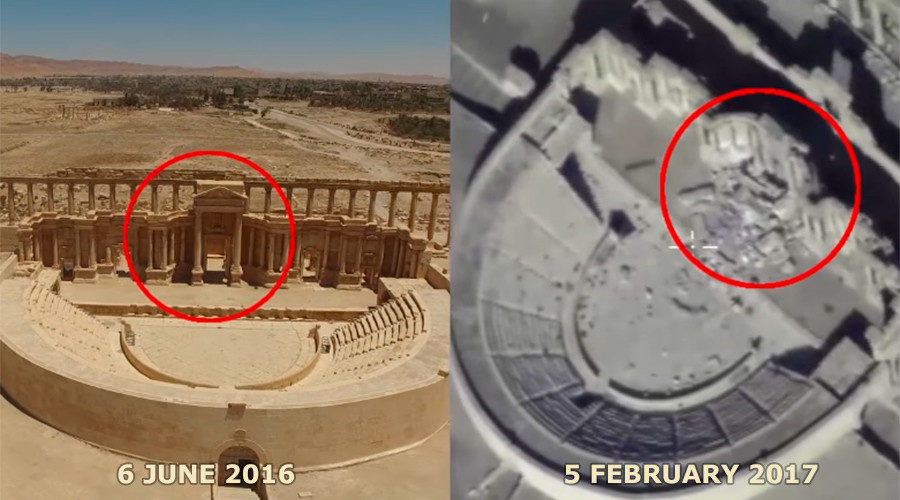
Russian MoD releases drone footage of Roman theater in Palmyra blown up by ISIS
© Минобороны России / YouTube
The video compares the state of the architectural landmark from June 6, 2016, when all four columns and the facade of the theater were intact, to their present state from February 5.
The Russian Ministry of Defense (MoD) said the terrorists blew up the proscenium - the central part of the ancient theater.
The reports on yet another savage crime committed by Islamic State (IS, formerly ISIS/ISIL) emerged in late January. At the time, Maamoun Abdulkarim, the Syrian director-general for antiquities and museums, said that if the terrorists were not flushed out from the city, it awaits even "more destruction."
The Russian Defense Ministry said the latest activity by IS near Palmyra indicates that they intend to finish off the remains of the ancient city's architecture, reducing it to rubble before they retreat.
"We have detected an upsurge in truck movement near the ancient city amid Syrian troops' successful advance on Palmyra. This indicates that IS wants to bring in explosives to deal maximum damage to the remaining architectural relics before they leave," the Russian Defense Ministry said in a statement on Monday.
Russian presidential spokesman Dmitry Peskov on Monday expressed hope that Palmyra, along with its invaluable monuments, will be freed from terrorists soon.
"Unfortunately, these barbarian terrorists continue to cause destruction of the relics of human civilization. It is regrettable. And we hope that sooner or later these historical sites will finally be freed from these - one can hardly call them human - these barbarians," Peskov said in a conference call with reporters. However, Peskov refused to comment on "matters of tactics and strategy" of the Russian troops with the media.
The act was also decried by UNESCO Director-General Irina Bokova as "a new war crime and an immense loss for the Syrian people and humanity."
The ancient city of Palmyra, a UNESCO World Heritage Site, was one of the most important centers of the Roman Empire. After the site was recaptured by Syrian government forces last year, reconstruction work began to repair the extensive damage done by IS.
In particular, experts were working on a remarkable Lion of Allat statue from the first century AD, as well as the Arch of Triumph, the Temple of Baalshamin, and the iconic 2,000-year-old Bel Temple.


Reader Comments