
© Northrop Grumman / Chad Slattery / Handout via Reuters
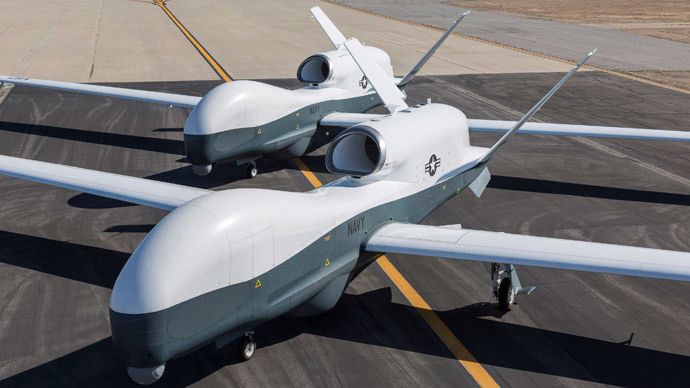
While unmanned drones have become a popular weapon of choice during the United States' wars in Iraq and Afghanistan, a new report reveals that hundreds of them have been involved in major accidents around the world.
Following an investigation into more than 50,000 pages of federal and military records, the Washington Post found that more than 400 large American drones have crashed since 2001, with almost half of the accidents each causing millions of dollars in damages.
The news also highlights the potential risks of opening up American airspace to commercial, police, and military drone use, as the Federal Aviation Administration plans to in 2015. The government has argued its testing sites will allow for the safe use of domestic drones, particularly since warzone conditions won't be replicated on American soil, but the recent data shows there are still significant hurdles to overcome.
According to the Washington Post, no one has died as a result of a drone accident, but many times the disaster was avoided simply by chance or a difference of a few feet. The unmanned aerial vehicles (UAVs) have crashed into homes, farms, roads, and even, in one case, an Air Force plane in midair.
Through various Freedom of Information Act requests, it was revealed that the military classifies its drone accidents in two different categories: Class A and B. Class A is made up of 194 drone accidents, each of which either destroyed the aerial vehicle involved or resulted in at least $2 million in damage. More than half of these accidents took place in Afghanistan and Iraq, but nearly 25 percent were in the US.
Class B accidents, meanwhile, caused anywhere between $500,000 and $2 million in damages. There have been 224 of these incidents in total.
These records do not, however, include data on the drones operated by the CIA, which employs 30 of its own Predator and Reaper drones.
Although the reasons for accidents vary from one situation to another, the majority of the them occurred in warzones, while the US was still adapting to drone technology. Since 2009, the Class A accident rate for the Predator model has been 4.79 crashes per 100,000 flight hours - that's down markedly from 13.7 in the drone's first decade or so of its existence.
The Air Force stated that the Reaper's accident rate over the last five years (3.17), meanwhile, is gradually nearing the same rate of the F-16 (1.96) and F-15 (1.47).
"Flying is inherently a dangerous activity. You don't have to look very far, unfortunately, to see examples of that," said Dyke Weatherington, director of unmanned warfare for the Pentagon, to the Post. "I can look you square in the eye and say, absolutely, the [Defense Department] has got an exceptional safety record on this and we're getting better every day."
Still, there are multiple areas which drone operators need to address before flying the UAVs can be considered more secure. Although they are equipped with cameras and other sensors, it's still difficult for pilots to notice trouble ahead before its too late. Most drones do not feature radar or anti-collision systems, making them vulnerable to mishaps while airborne.
Other problems arise simply from mistakes made by the pilot, such as an incident in 2010 which saw a drone equipped with a hellfire missile crash nearby Kandahar, Afghanistan. The pilot did not realize she was flying it upside down. The same year, another pilot crashed a drone because he pushed the wrong button on his joystick and sent the vehicle spinning into the ground.
When coupled with manufacturing defects and unstable wireless communications, these issues can make for some unreliable flights. In one case, a 375-pound drone flown by the Army crashed into an Air Force transport plane's left wing, forcing it to land and jet fuel to spill out of the aircraft. No one was injured, but less than a minute after it landed a drone operator called in to report he'd "lost track of his aircraft."
When accidents started to rise, some pilots started to complain about General Atomics, the company who manufactures the drones. The company, however, pinned the blame primarily on pilot errors.
"I don't want to be the one that crashes a plane, but I hope that this causes folks, and when I say folks, I mean GA [General Atomics], I hope we hold them accountable for some of this stuff," Air Force Maj. Elizio Bodden, a Predator instructor pilot, said to an investigation board in 2007, as quoted by the Post. "We know we are flying with some defective stuff, but we still do it."
Drone accidents in the US have also been documented over the last couple of years. As RT reported previously, a US Navy battleship suffered $30 million in damages after a UAV crashed into it off the coast of California. About 300 sailors were onboard at the time, and two were treated for minor burns.
Another incident this year saw a drone crash near an elementary school in Pennsylvania. The aircraft was being flown on a training exercise out of a nearby Army post before it fell. Luckily, no one was hurt.



. . . are due to both defects in equipment (&/or software) as well as operator error. While drone mishap per flying hour rates will probably get better over time, IMO, they are unlikely to get as low as the overall rates associated with piloted aircraft.
Past history demonstrates that it is not uncommon for contractors to "meet the letter of the contract" and still deliver defective equipment and then get paid even more money to fix/redesign/whatever when the defects start showing up. (Win-win for both the military brass who get a bigger budget and promotions and for the contractor who gets more money. Of course both care little about the taxpayers who foot the bills.) Nevertheless, drone mishaps due to this are "par for the course" and should be expected to occur at rates not too much higher than that of other military aircraft, with the difference being due to generally higher quality being required for man-rated equipment.
The operator errors are a whole different issue. While it is almost axiomatic that most government employees care little about the waste of taxpayer money by doing things in a half-a$$ed manner, the aircrews of piloted aircraft have a vested interest in performing their flying duties well, as carelessness/poor performance could easily cost them their lives. Drone operators have no such constraint. They have the best of all worlds, i.e., they get the (vicarious) thrill of flying, incurring no physical risk to themselves while doing so, and, as gov't employees, get to fly really neat toys, knowing that even if they screw things up, there's plenty of OPM to make things right - sort of like a video game: get your character killed by doing something stupid, you can always start over with no real cost to you. Thus, it should not be surprising that accident rates due to operator error will always be higher with drones than with other aircraft.
Of course total numbers (not rates) of drone accidents can be expected to increase in rough proportion to the numbers of them in use.