

© dailybail.comBill Clinton
The Manufactured Crisis Maker
The Manufactured Crisis Maker
Porter writes,
"That ramping up of pressure on Iran by the Clinton administration was still driven by the same bureaucratic incentives that had appeared at the end of the Cold War, but it shifted into overdrive because it was linked to support of the Israeli government's drive to portray Iran as the great threat to peace in the world. Clinton's advisers saw the threat of nuclear proliferation as the path to beefing up the national-security apparatus. It was perfect for justifying new weapons systems and a continuing role as world policeman."

© www.algemeiner.comUnited States Special Envoy for Israeli-Palestinian Negotiations Martin Indyk shakes hands with Israeli President Shimon Peres.
The Clinton administration implemented the "dual containment" policy against Iraq and Iran. But Porter reports that Robert Pelletreau, the Middle East policymaker in the State Department, acknowledges "that it was 'pretty much accepted in Washington' that the policy had originated in Israel."
Was there a case against Iran to justify the policy? The administration charged Iran with abetting international terrorism, beefing up its armed forces, and seeking nuclear weapons. But was there evidence?
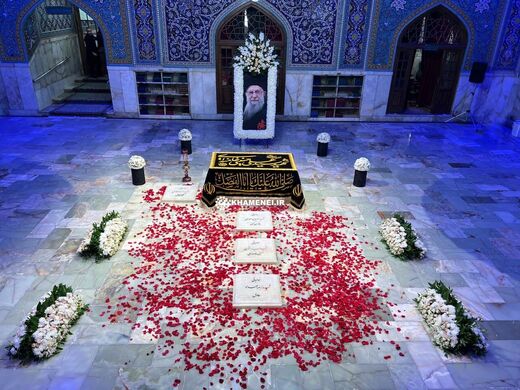
Porter's book is a heavily documented brief showing that Iran never had a policy or took steps to acquire nuclear weapons. It sought a uranium-enrichment capability in order to produce fuel for its civilian nuclear program, but it did not seek weapons. Moreover, Supreme Leader Ali Khamenei had issued a fatwa condemning nuclear weapons as a sin against Islam.
As for Iran's military, the government sought to acquire medium-range missiles, butthis was entirely consistent with its defense needs: Saddam Hussein of Iraq was a standing threat (he had launched an eight-year war complete with chemical attacks and missile strikes on Iran's cities, including Tehran), and Israeli leaders often spoke of the need for a preemptive strike against the Islamic Republic, like the one staged in 1981 against Iraq's nuclear-power reactor at Osirak.
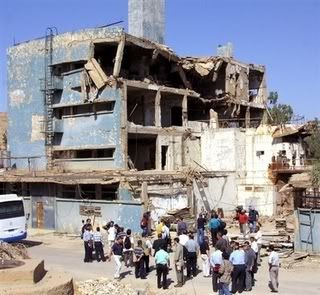
© www.aliraqi.orgThe Osirak nuclear reactor in southern Iraq was bombed and destroyed by Israeli warplanes in 1981 (AFP/File/Ramzi Haidar)
Finally, why were Israel's leadership and American supporters so determined to put Iran at the center of U.S. foreign policy, especially when Israel's government had previously, if covertly, cooperated with the Shiite Islamic Republic on the grounds that both countries had a common enemy in Sunni extremism? Porter's detailed and documented chapter on this aspect of the manufactured crisis concludes, "The history of the origins and early development of Israel's Iran nuclear scare and threat to attack Iran over its nuclear and missile programs highlights a pattern in which both the [Yitzhak] Rabin and [Benjamin] Netanyahu governments deliberately exaggerated the threat from Iran, in sharp contradiction with the Israeli intelligence assessment. The ruse served a variety of policy interests, most of which were related to the manipulation of US policy in the region."



Comment: Puppet Masters of the Puppet Masters. Where will it end?