
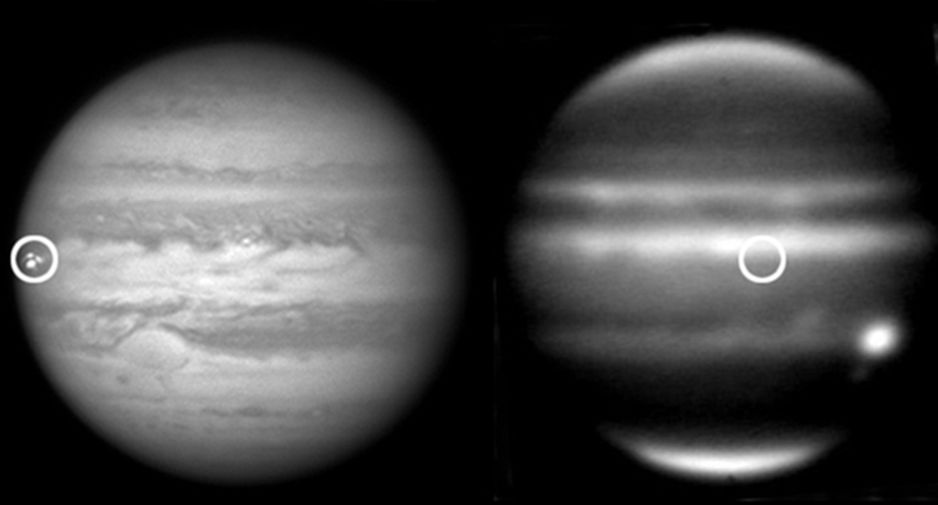
© NASA/IRTF/JPL-Caltech/G. Hall/University of the Basque CountryJupiter has been suffering more impacts over the last four years than ever previously observed, including this meteoroid impact on Sept. 10, 2012. The left-hand image was taken from a red-filtered video by amateur astronomer George Hall of Dallas, Texas, on Sept. 10 and processed by Ricardo Hueso (University of the Basque Country, Bilbao, Spain). The right-hand image is an infrared image from NASA’s Infrared Telescope Facility on Mauna Kea, Hawaii, taken on Sept. 11. Scientists compare the visible-light images to the infrared images to learn about the fireball's disruption of the Jovian atmosphere. In this case, the infrared view reveals no long-term disturbance. The circles in the annotated version indicate where the impact occurred. Scientists think the fireball was caused by an object less than 45 feet (15 meters) in diameter.
"The changes we're seeing in Jupiter are global in scale," Orton said. "We've seen some of these before, but never with modern instrumentation to clue us in on what's going on. Other changes haven't been seen in decades, and some regions have never been in the state they're appearing in now. At the same time, we've never seen so many things striking Jupiter. Right now, we're trying to figure out why this is all happening."
Orton and colleagues Leigh Fletcher of the University of Oxford, England; Padma Yanamandra-Fisher of the Space Science Institute, Boulder, Colo.; Thomas Greathouse of Southwest Research Institute, San Antonio; and Takuyo Fujiyoshi of the Subaru Telescope, National Astronomical Observatory of Japan, Hilo, Hawaii, have been taking images and maps of Jupiter at infrared wavelengths from 2009 to 2012 and comparing them with high-quality visible images from the increasingly active amateur astronomy community. Following the fading and return of a prominent brown-colored belt just south of the equator, called the South Equatorial Belt, from 2009 to 2011, the team studied a similar fading and darkening that occurred at a band just north of the equator, known as the North Equatorial Belt. This belt grew whiter in 2011 to an extent not seen in more than a century. In March of this year, that northern band started to darken again.
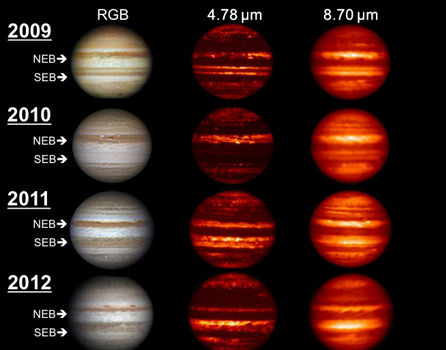
© NASA/IRTF/JPL-Caltech/NAOJ/A. Wesley/A. Kazemoto/C. GoImages in the visible-light and infrared parts of the spectrum highlight the massive changes roiling the atmosphere of Jupiter. In the visible-light images on the left that were obtained by amateur astronomers, Jupiter can be seen "losing" a brown-colored belt south of the equator called the South Equatorial Belt (SEB) from 2009 to 2010. This belt returns in 2011 and is still present in 2012. From 2011 to January 2012, a belt north of the equator known as the North Equatorial Belt (NEB) can be seen to be thinning out. In 2011, it whitened to an extent not seen in over a century. In March of this year, after the last picture in this series was taken, the northern belt began to darken again.
Scientists compared the visible-light data to data obtained in infrared wavelengths of 4.78 and 8.7 microns (middle and right columns), which show progressively deeper levels in the Jovian atmosphere. The infrared images were obtained from NASA's Infrared Telescope Facility on Mauna Kea, Hawaii, except for the 2011 image in the 8.7-micron wavelength (right column, third from the top), which was taken by the Subaru Telescope, also in Mauna Kea, Hawaii. Those data showed a thickening of the deeper cloud decks in the northern belt during that time, and a partial thickening of the upper cloud deck. The South Equatorial Belt saw both levels of clouds thicken and then clear up. The infrared data also resolved brown elongated features in the whitened area of the North Equatorial Belt known as “brown barges” as distinct features and revealed them to be regions clearer of clouds and probably characterized by downwelling, dry air.
Also visible in the infrared observations are a series of blue-gray features that are the clearest and driest regions on the planet and show up as apparent hotspots in the infrared view because they reveal the radiation emerging from a very deep layer of Jupiter's atmosphere. Those hotspots disappeared from 2010 to 2011, but had reestablished themselves by June of this year, coincident with the whitening and re-darkening of the North Equatorial Belt.
The visible-light images were taken by A. Wesley (2009 and 2010), A. Kazemoto (2011) and C. Go (2012). The images in 2009 were all from July. In the set from 2010, the visible-light image and 4.78-micron infrared image were taken in September. The 8.6-micron infrared image was taken in June 2010. The images from 2011 were all taken in August. The images from 2012 were all taken in January.
Scientists compared the visible-light data to data obtained in infrared wavelengths of 4.78 and 8.7 microns (middle and right columns), which show progressively deeper levels in the Jovian atmosphere. The infrared images were obtained from NASA's Infrared Telescope Facility on Mauna Kea, Hawaii, except for the 2011 image in the 8.7-micron wavelength (right column, third from the top), which was taken by the Subaru Telescope, also in Mauna Kea, Hawaii. Those data showed a thickening of the deeper cloud decks in the northern belt during that time, and a partial thickening of the upper cloud deck. The South Equatorial Belt saw both levels of clouds thicken and then clear up. The infrared data also resolved brown elongated features in the whitened area of the North Equatorial Belt known as “brown barges” as distinct features and revealed them to be regions clearer of clouds and probably characterized by downwelling, dry air.
Also visible in the infrared observations are a series of blue-gray features that are the clearest and driest regions on the planet and show up as apparent hotspots in the infrared view because they reveal the radiation emerging from a very deep layer of Jupiter's atmosphere. Those hotspots disappeared from 2010 to 2011, but had reestablished themselves by June of this year, coincident with the whitening and re-darkening of the North Equatorial Belt.
The visible-light images were taken by A. Wesley (2009 and 2010), A. Kazemoto (2011) and C. Go (2012). The images in 2009 were all from July. In the set from 2010, the visible-light image and 4.78-micron infrared image were taken in September. The 8.6-micron infrared image was taken in June 2010. The images from 2011 were all taken in August. The images from 2012 were all taken in January.
The team was also looking out for a series of blue-gray features along the southern edge of the North Equatorial Belt. Those features appear to be the clearest and driest regions on the planet and show up as apparent hotspots in the infrared view, because they reveal the radiation emerging from a very deep layer of Jupiter's atmosphere. (NASA's Galileo spacecraft sent a probe into one of these hotspots in 1995.) Those hotspots disappeared from 2010 to 2011, but had reestablished themselves by June of this year, coincident with the whitening and re-darkening of the North Equatorial Belt.
While Jupiter's own atmosphere has been churning through change, a number of objects have hurtled into Jupiter's atmosphere, creating fireballs visible to amateur Jupiter watchers on Earth. Three of these objects - probably less than 45 feet (15 meters) in diameter - have been observed since 2010. The latest of these hit Jupiter on Sept. 10, 2012, although Orton and colleagues' infrared investigations of these events showed this one did not cause lasting changes in the atmosphere, unlike those in 1994 or 2009.
"It does appear that Jupiter is taking an unusual beating over the last few years, but we expect that this apparent increase has more to do with an increasing cadre of skilled amateur astronomers training their telescopes on Jupiter and helping scientists keep a closer eye on our biggest planet," Orton said. "It is precisely this coordination between the amateur-astronomy community that we want to foster."
Comment: BS, and they know it. The professionals have had a very close eye on Jupiter since 1994, at least, when Comet Shoemaker-Levy broke up and slammed into it. This has absolutely nothing to do with the catch-all equation 'more observers = more impacts recorded'.
The California Institute of Technology, Pasadena, operates the Jet Propulsion Laboratory for NASA.



The video in the blue comment box is great, many main points in about 5 minutes.