
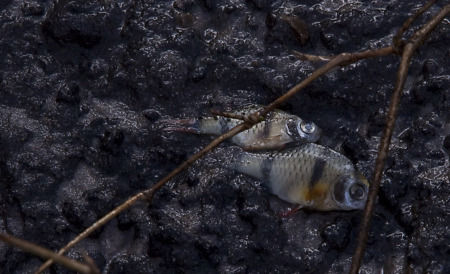
© Willie J. Allen Jr. / TimesDecember freezes killed about 75 percent of the tropical fish, including these tiger barbs found Monday, at Oak Ridge Fish Hatchery in Plant City.
Overall, the average daily temperature, the high and the low divided by two, was about 10 degrees below the norm for the month.
Tampa set a new record low at 53.2 degrees, besting the previous record of 54.5 degrees in 1935. It was even colder than January 2010's record-breaking cold snap.
St. Petersburg's 56.3 degrees beat a record of 56.9, also from 1935.
In Hernando County, Brooksville set a record at 52 degrees. The previous low was 54.1 in 1935.
St. Leo, in Pasco County, also set a record at 51.6 degrees, breaking the previous low of 52.1 in 1935.
Several areas throughout west-central and southwest Florida also set record lows.
Meteorologists say a complex weather system known as the Arctic Oscillation is largely responsible for the cold weather.
The Arctic Oscillation set up a large high-pressure system in the Atlantic Ocean. This high-pressure system blocks cold air from moving east and instead forces it south, meaning much colder weather for much of the Southeast United States.
Although the area is in a La Niña period, typically making for a milder winter, the effects of the Arctic Oscillation are strong enough to drive weather patterns.
Long-range forecasts show temperatures staying below average through January, according to the National Weather Service's Climate Prediction Center.



Comment: Arctic Oscillation? "La Nina"? Or another sign of the weakening Gulf Stream?
Ice Age Now! Damaged Gulf Stream affects Jet Stream - Lord Stirling