
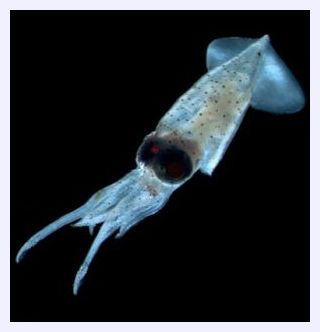
© Woods Hole Oceanographic InstitutionA juvenile squid from the Celebes Sea, between Borneo and The Philippines - one of the strange new forms of life found to be living at up to a depth of 2.8 km.
Put simply: there's an awful lot of places where water could exist - either on the surface of the Earth, or deep within it - yet life is largely concentrated in a small sliver of this.
Eriita Jones and Charley Lineweaver of the Australian National University in Canberra have estimated the volume of the Earth where liquid water can exist, and calculated that life inhabits as little as 12% of it.
Limited range
After compiling observations of life in extreme environments, the researchers found that liquid water in only a limited range of temperatures and pressures can support life.
These observations could help focus the search for life elsewhere in our Solar System. "We suspect that these limits that we find on Earth are the fundamental limits of any water-based life," says Lineweaver.
Hence, they suggest that the search for life on another planet or moon can be narrowed down to those regions with just the right temperatures and pressures.
Lack of nutrient and energy supply
Life on Earth has turned up in environments ranging from deep ocean hydrothermal vents to Arctic ice cores.
Liquid water, however, can exist under a much wider range of conditions, from the high temperatures and pressures of Earth's mantle to the atmosphere, where it exists only transiently as thin films on particulates, according to the study. A lack of nutrient and energy supply in those regions seems to prevent life from developing there.
"Life has tried and tried to inhabit all this water," says Lineweaver, noting that approximately four billion years of evolution has given rise to life in only some conditions. "I think we should listen to what life has to say about its own limits."
Not just any liquid water
Lineweaver and his graduate student Jones, were initially interested in life-supporting environments on Mars, but soon realised they should take advantage of knowledge about life on our own planet.
By looking at Earth first, says Lineweaver, "we can test the [widely held] idea of 'if there is water then there is life'. We're refining that rule," he says. "It's not just any liquid water."
All life on Earth requires water at some point, and H2O is pervasive in the Solar System, says Lineweaver. Therefore he thinks following the water is still a sensible approach.
Limits of life
However, a significant amount of water seems to be too hot, too cold or too salty to be inhabitable, so the pursuit can be more directed.
This study is the first to have provided so much detail into the limits of life in liquid water, according to geologist Jonathan Clarke, vice president of Mars Society Australia.
"'Follow the water' has been and still is a good first approximation," said Clarke. "Like any good approximation, it needs refining, and this is what they've done."
Change in strategy?
Clarke doesn't believe this report will drastically alter the strategy in the search for extraterrestrial life, but agrees that understanding Earth first narrows the target.
"There's not much else we can do, really," he says. "It's like forensic science: you have a general description of the suspect, and it might be the wrong one, but you have to start somewhere."



Reader Comments
to our Newsletter