
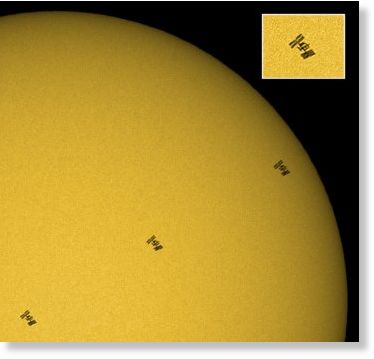
© Levin Dieterle
The station's silhouette traces solar arrays, science labs, living quarters and a docked Russian supply ship. Next year, the outline will expand to include a cosmic ray telescope called the Alpha Magnetic Spectrometer. From its perch atop the station's massive backbone, or "truss," the telescope will scan the heavens for antimatter galaxies, strangelets, dark matter and other exotic phenomena only detectable from Earth orbit.



Worthy of a happy thought.