
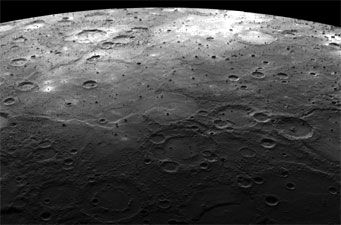
© NASA/Johns Hopkins University Applied Physics Laboratory/Carnegie Institution of WashingtonMercury's Horizon as seen from the Messenger Spacecraft
During the October flyby, Messenger imaged around 30% of Mercury's surface never seen by spacecraft before. Researchers discovered a well-preserved, 430-mile-wide impact basin, recently named Rembrandt, thought to date to the period around 4 billion years ago when large asteroids were pummeling the inner planet
The Rembrandt Basin exhibits a "wheel and spoke" type pattern of ridges and troughs in its floor never seen before in the solar system. According to Messenger lead scientist Sean Solomon (Carnegie Institution in Washington, D.C.), "We don't yet have a good mechanical model for what might have produced such a pattern."
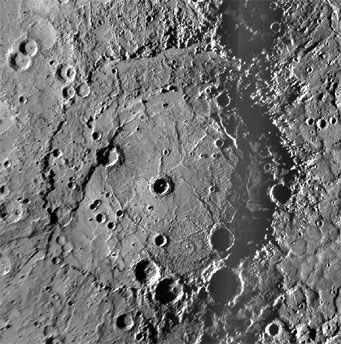
© NASA/Johns Hopkins University Applied Physics Laboratory/Smithsonian Institution/Carnegie Institution of WashingtonThe Rembrandt impact basin, the diameter of which would stretch from New York to Boston, exhibits a wheel-and-spoke pattern, the first of its kind seen in the solar system.
The largest fault on Mercury runs down the middle of the Rembrandt Basin. The fault's size - similar to California's San Andreas Fault - and those of similar features elsewhere on the planet imply that Mercury contracted after it formed, leading to tectonic activity and a history that is unlike that of any other planet in the solar system.
Detailed observations of Mercury's changing magnetosphere reveal that it's strongly coupled to the solar wind. The data also indicate that Mercury has a magnetic north and south pole like Earth, which is expected if an active dynamo in the outer liquid core is producing the field. Mercury's metallic core is a larger fraction of its interior than for any other planet, approximately three-fourths of the planet's radius
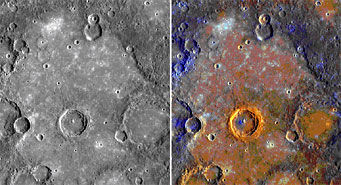
© NASA/Johns Hopkins University Applied Physics Laboratory/Arizona State University/Carnegie Institution of WashingtonPhoto of Mercury before and after color enhancement. Mercury is almost uniformly gray, but color-enhanced images have allowed scientists to map different materials in the crust. This allows researchers to study the planet’s geology and should eventually help them pin down the composition of Mercury’s crust.
Researchers made the first detection of magnesium in Mercury's atmosphere and extended neutral tail, which points away from the Sun. Messenger also measured calcium and sodium, which were previously known to exist. But the calcium and magnesium are not distributed in the same way as sodium atoms, which is surprising given their chemical similarities. The extended sodium tail is much stronger at high northern and southern latitudes, but magnesium shows a more uniform distribution.
Messenger also detected relatively heavy ions in Mercury's ultrathin atmosphere. Because these charged particles are uncommon in the solar wind, scientists think they originate from the planet. This could be a new way to probe the planet's surface composition.
Spectroscopic measurements were correlated with magnetic fluctuations as Messenger flew near the planet, and a stronger northern component to the sodium tail while that hemisphere was more exposed to charged particles from the solar wind is evidence that the Mercury's atmosphere is created at least in part when charged solar ions bombard atoms on the surface and propel them outward.
"Messenger's second flyby has strongly reinforced the inference from the first flyby that Mercury is an extremely dynamic planet and has been so throughout its history," says Solomon. "The science team looks forward to our next flyby and particularly to the mission's orbital phase in anticipation that still more of these dynamical processes will be revealed."
Messenger is scheduled for a third flyby of Mercury on September 29th. It will go into orbit around Mercury in March 2011.


Reader Comments
to our Newsletter