
Under average solar conditions, GPS satellites orbit within the Earth's protective magnetic bubble known as the magnetosphere. However, during extreme solar events which are linked to solar explosions, the magnetosphere is compressed, exposing navigation satellites to higher doses of radiation while the reception of their signals is perturbed.
More generally, the electronic components, onboard memory and cameras on board satellites can be greatly affected by extreme solar events. Developing the ability to accurately forecast the impact and effect of solar explosions (Movie 1) on the near-Earth environment is thus becoming more and more critical to our daily life. This can be done by precisely estimating the key physical parameters of the near-Earth environment and their time evolution, and using this information to constrain models.
A recent paper by Iannis Dandouras and colleagues reports the analysis of two extreme solar events that occurred on 21 January 2005 and 13 December 2006 where the four Cluster (ESA/NASA) and the two Double Star (CNSA/ESA) spacecraft were favourably positioned to provide coordinated measurements of the response of the magnetosphere to these events.
From measurements obtained with both sets of spacecraft, the speed of positively charged particles (or ions) in the solar wind was found to be more than 900 kms-1, more than twice their normal speed. The high speed flow was accompanied with a jump in the ion density by a factor of 5 and a dramatic change of ionic composition (for the 21 January 2005 event). This resulted in an unusual compression of the magnetosphere.
Cluster and Double Star data indicate that the 'nose' of the dayside magnetopause, usually located at an altitude of around 60 000 km, was only 25 000 km from Earth during these extreme solar events.
The second solar event was associated with an X-3 solar flare on 13 December 2006 which was followed by a Coronal Mass Ejection. This event was directly associated with the loss of GPS signal reception on the ground (Figure 1).
In near-Earth space, the typical "nose-like" ion structures were "washed out" by several successive injections of energetic particles (Figure 2). These ion structures were previously formed in an equatorial region of the near-Earth environment called the ring current. This region plays a critical role in satellite safety. The Cluster and Double Star spacecraft simultaneously detected these ion structures on opposite sides of Earth, thus providing information on their large-scale structure and dynamics. These injections resulted in a much harder ring current energy spectrum (see Figure 2).
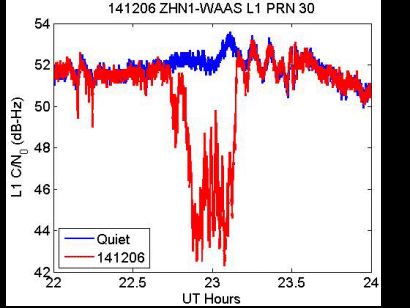
© P. Kintner -- Cornell University, USA.Figure 1. Impact of solar activity on the signal-to-noise ratio of GPS signal measured by a receiver located in Hawaii on 14 December 2006 (red) compared to what is normally received (blue)
"All the detailed information gathered on these extreme solar events helps to constrain computer models of the inner magnetosphere and the near-Earth environment," says Dr. Iannis Dandouras, lead author of the report and Principal Investigator of the Cluster Ion Spectrometer (CIS) instrument on Cluster.
"Looking at such a large scale physical phenomenon with a single spacecraft is something akin to predicting the location of the impact of a tsunami with a single buoy. Cluster and Double Star have once again demonstrated the value in coordinated multipoint plasma measurements in space, this time by monitoring the impact of Coronal Mass Ejections on both sides of Earth," comments Matt Taylor, acting ESA project scientist of the Cluster and the Double Star missions.
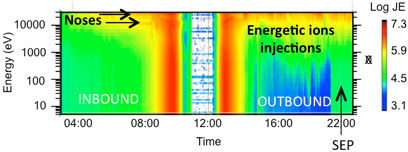
Double Star TC-1 ion data recorded on 14 December 2006 near perigee. Nose shaped ion structures are seen in the inbound pass while energetic ion injections wash out these structures (outbound pass). Impact of solar energetic particles (SEP, see vertical black arrow) are detected around 22:00 when TC-1 was located on the nightside



Reader Comments
to our Newsletter