
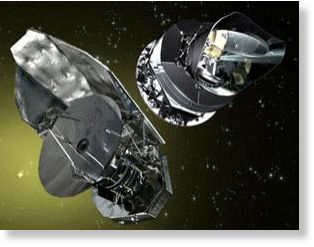
© ESAHerschel (left) and Planck (right) could revolutionise our understanding of the universe.
The Herschel Space Observatory is an infrared telescope almost four times as big as its NASA rival (see New Scientist, 4 April, p 32), Spitzer. Planck will map the aftermath of the big bang with a precision that NASA's scientists can only dream of.
Separately, each is a major mission. Together, they constitute a landmark in astrophysics. The probes could revolutionise our understanding of the cosmos. If everything goes to plan, Herschel and Plank will dominate space science for at least five years. But if the launch goes wrong...
With science budgets shrinking, launching two such important missions on the same rocket smacks of madness, especially given that the launcher, an Ariane 5 rocket, has suffered a couple of high-profile and expensive failures. In 1996, a computer bug caused the loss of ESA's Cluster mission, which was rebuilt at a cost of €315 million. In 2002, a commercial launch exploded, forcing ESA to delay its Rosetta mission and costing it a further €100 million.
With the combined bill for Herschel and Planck coming in at more than €2 billion, it is near-inconceivable that they will be rebuilt if something goes wrong. Their loss would leave ESA reeling.
The agency has other missions in the pipeline, including a mission to Mercury and a star-mapping project called Gaia. These have excellent scientific potential but they somehow seem small in comparison.
In short, if we lose Herschel and Planck, the heart of ESA's - and arguably the world's - space science programme would be ripped out. Let us all wish ESA the very best of luck.
The next truly big launch is not until 2013 at the earliest, when the NASA-led James Webb Space Telescope takes to the skies - on an Ariane 5 rocket.



Reader Comments
to our Newsletter