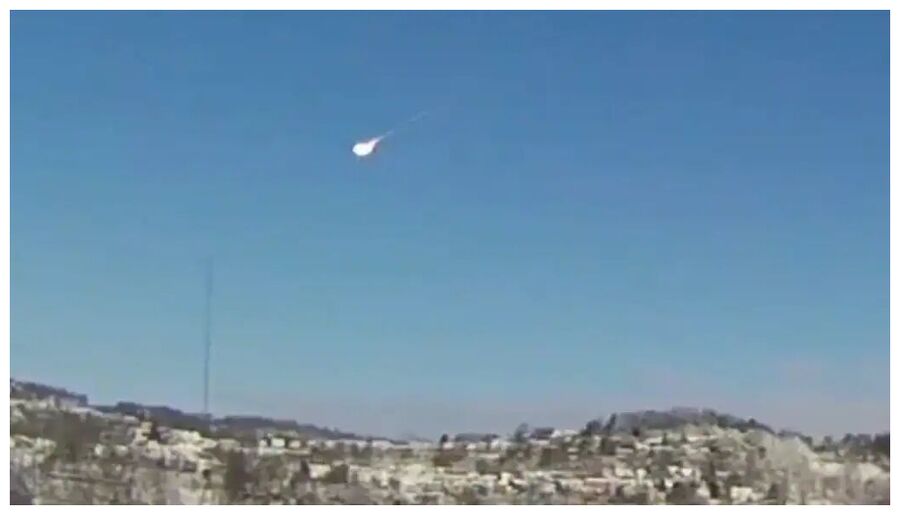
© Jared Rackley via XStill from video captured by NWS Pittsburgh’s Jared Rackley via X.
On a Saturday afternoon this past March, a piece of the solar system plummeted toward a home in north Houston.
The one-ton space rock broke apart nearly 30 miles above the city,
unleashing a violent sonic boom equivalent to 26 tons of TNT. A dark, jagged fragment smashed through a residential roof and
even ricocheted around a bedroom like a cosmic pinball.
This would have been stunning in itself, except
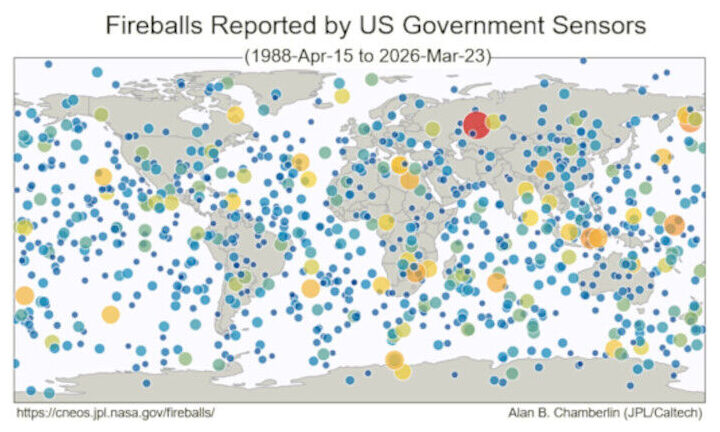
there were more such meteor strikes. During the first three months of 2026, our planet waded through an unusually dense shooting gallery. The American Meteor Society (AMS) has tracked a
staggering wave of large, bright meteors — known as fireballs — lighting up skies from California to Germany.Earth sweeps up tons of space dust every day. Usually, this material is the size of a grain of sand and burns up harmlessly in the upper atmosphere. But right now, we are colliding with much bigger rocks. And scientists are scrambling to figure out why.
Mike Hankey, a researcher who manages fireball reporting tools for the AMS, analyzed data stretching back to 2011. He shared his findings in
a recent AMS report, noting this meteorite season is distinctly visible.
"After years of stable baseline activity, something appears to have shifted," Hankey wrote in the AMS report. "The signal is consistent across multiple metrics."



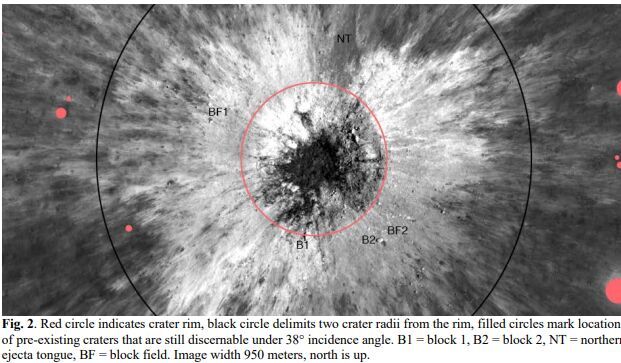




Comment: Careful with the 'once-in-a-century' assumption. In fact, now that this new bar has been set, here's a 'joke' for moon researchers: expect more lunar impacts in the coming years, and maybe months.
See also: The mystery of the Ohio and Texas fireballs