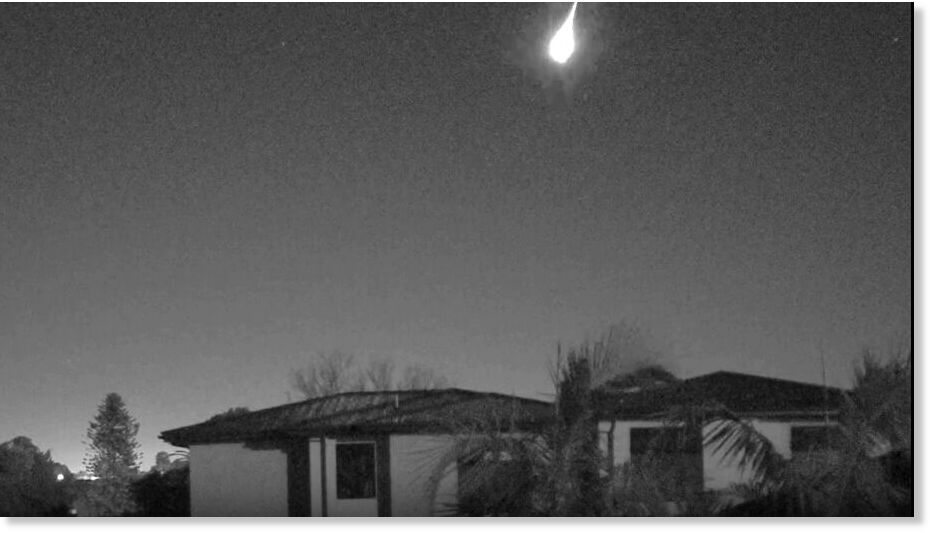
Fireballs
"The meteor illuminated the whole earth and shook the landscape with a loud sound," reports CMMO staff member Zhou Kun. "The flash of light, which peaked at 22:59 pm local time, was widely observed across the Shandong and Jiangsu provinces of China."
A video of the event was shared on YouTube:
The event was recorded in the framework of the SMART project, which is being conducted by the Southwestern Europe Meteor Network (SWEMN). The event was spotted from the meteor-observing stations located at La Hita (Toledo), Sierra Nevada (Granada), and Seville.

Still shot identifying the comet and the fragments and an animation image below.
SOHO is no stranger to discovering new comets - via the NASA-funded Sungrazer Project, the observatory has discovered over 4,000 previously unknown comets since launch in 1995. Most of SOHO's comet discoveries can be categorized into families, or groups, the most famous being the "Kreutz" sungrazer group which accounts for over 85% of the Project discoveries. Only around 4% -some 175 comets- do not appear to belong to any known group or comet family. However, these are often among the most interesting comets and this most recent discovery -SOHO's 4,049th comet- was no exception!
The comet was first spotted on August 5th, 2020, by amateur astronomer Worachate Boonplod. At discovery, it was just a tiny faint smudge near the edge of the C3 coronagraph images recorded SOHO's Large Angle Spectrometric Coronagraph (LASCO) instrument. As it neared the Sun over the next day or so, the smudge became increasingly elongated, ultimately hinting that it may be two comets pretending to be one!
This was confirmed as the comets entered the narrower field of view of the LASCO C2 camera, where the improved resolution confirmed that not only was this more than one comet, it was actually THREE comets! The two main components are easy to spot, with the third a very faint, diffuse fragment following alongside the leading piece.
Prince Edward Island resident Matthew Sentner shared this video showing the bright streak seen from Cavendish on Tuesday evening.
The annual Perseid meteor shower, likely to produce "a few meteors, including the occasional fireball," is best observed after midnight during the pre-dawn hours until August 24, NASA said.
The mysterious blast was heard at about 10:10 a.m. in the Saranac Lake area.
Troopers in Ray Brook said they were still trying to determine what caused the blast but said it appeared to be a sonic boom.
"It's sounding like there were jets flying over the area," Trooper Jennifer Fleishman said.
Fleishman said members of the State Police aviation operation heard the blast and said it sounded like a sonic boom caused when a jet travels faster than the speed of sound.
But so far, no regional air base was claiming responsibility.
We performed follow-up measurements of this object while it was still on the PCCP webpage.
Stacking of 16 unfiltered exposures, 90 seconds each, obtained remotely on 2020, July 27.05 from X02 (Telescope Live, Chile) through a 0.6-m f/6.5 astrograph + CCD, shows that this object is a comet with a diffuse coma about 8" in diameter (Observers E. Guido, M. Rocchetto, E. Bryssinck, M. Fulle, G. Milani, C. Nassef, G. Savini, A. Valvasori).
Our confirmation image (click on it for a bigger version)
David said: "I have seen shooting stars previously but this was much more substantial and nearer to the planet."
Gemma added: "Only guessing it was a shooting star as have never seen anything move so fast or be so bright!"
Terry simply said: "Phenomenal". Asteroids and meteors produce a bright explosion of fire when they hit the atmosphere as it is the first time the space rock has ever met resistance.
David said: "I have seen shooting stars previously but this was much more substantial and nearer to the planet."
Gemma added: "Only guessing it was a shooting star as have never seen anything move so fast or be so bright!"
Terry simply said: "Phenomenal". Asteroids and meteors produce a bright explosion of fire when they hit the atmosphere as it is the first time the space rock has ever met resistance.
The event was recorded in the framework of the SMART project, which is being conducted by the Southwestern Europe Meteor Network (SWEMN). The event was spotted from the meteor-observing stations located at Sevilla, Sierra Nevada (Granada), La Hita (Toledo), and Calar Alto.
According to the American Meteor Society, there were at least 54 reports of a fireball spotted across the US at roughly 3am UT.
Incredible eyewitness video shared on social media captured the moment the apparent meteorite, complete with greenish hue, broke up upon entry in the Earth's atmosphere.
Guys, we just saw one of the craziest things we have ever seen in our lives and I managed to capture some of it. A meteor for the ages! pic.twitter.com/kPIchIPREV
— Amber Coffman (@Amber_Coffman) July 29, 2020
According to the American Meteor Society (AMS), the fireball event happened on Saturday evening. It was spotted over Collinsville, Illinois.
The eyewitness who submitted the report to the AMS provided video footage taken by his home's doorbell security camera. The short clip showed a bright object streaking across the sky. According to the eyewitness, a loud sound similar to a jet flying can be heard as the fireball flew overhead.
The eyewitness, named Michael K., noted that the fireball appeared in the sky for about 20 seconds. It had a light yellowish color and a magnitude of -13, making it brighter than the planet Venus when viewed from Earth.


Comment: Another meteor fireball flashed over southern Spain a week ago.