Fireballs
S


Info

New evidence says an exploding comet wiped out the Clovis culture and triggered the Younger Dryas

comet C/2020 F3 NEOWISE
© By Dbot3000 - Own work, CC BY-SA 4.0,Wikimedia OrgThis photo of comet C/2020 F3 NEOWISE was taken in July 2020. There's no doubt that comets have struck Earth in the past, and some have exploded in the air above the surface. One of these exploding comets could've triggered the Younger Dryas, bringing and end to the Clovis culture and wiping out megafauna.
We don't realize it, but Earth is subjected to a constant cosmic rain of material. The vast majority of it is tiny micrometeors that burn up in the atmosphere, up to 100 tons per day by some estimates. But sometimes, much larger objects strike Earth. The most notable is probably the Chicxulub impactor that wiped out the dinosaurs and left a massive crater, now buried.

There are many other large potential impactors that explode above the surface, called touchdown airbursts, and their effect on Earth is much harder to quantify. New research suggests that a swarm of debris from an exploding comet left its mark by triggering the Younger Dryas, a period of abrupt cooling around 12,000 years ago. The researchers say that the touchdown airburst and the resulting Younger Dryas led to the extinction of megafauna, and the disappearance of the Clovis culture.

Their findings support the Younger Dryas Impact Hypothesis (YDIH) which states that the impact of a disintegrating asteroid or comet is responsible for abruptly cooling the Earth. The YDIH isn't widely accepted in the science community. Critics tout the lack of an impact crater as evidence against the YDIH. They also say that other evidence supporting it can best be explained by other causes.

New research found evidence of comet debris impact at sites of the Clovis culture, a culture that came to an end at the same time as the Younger Dryas. Will this new research lead to wider acceptance of the YDIH?

The research appears in PLOS One. It's titled "Shocked quartz at the Younger Dryas onset (12.8 ka) supports cosmic airbursts/impacts contributing to North American megafaunal extinctions and collapse of the Clovis technocomplex," and the lead author is James Kennett. Kennett is the UC Santa Barbara Emeritus Professor of Earth Science.

Fireball 3

Meteor fireball over Ohio and other states on September 15

mmmmm
© Mike D.
We received 23 reports about a fireball seen over MI, NY, OH, PA and WV on Monday, September 15th 2025 around 02:46 UT.

For this event, we received 2 videos and one photo.


Fireball 2

Meteor fireball over Wisconsin and Illinois on September 15

mmmmmm
© Shutterstock/Triff
We received 6 reports about a fireball seen over IL and WI on Monday, September 15th 2025 around 06:10 UT.

For this event, we received one video.


Fireball 3

Meteor fireball over Arizona and other states on September 14

mmmm
© Justin N.
We received 26 reports about a fireball seen over AZ, CO, ID, MT, NV, PA, UT and WY on Sunday, September 14th 2025 around 10:50 UT.

For this event, we received 5 videos and 2 photos.


Fireball 3

Meteor fireball over Missouri and 2 other states on September 14

mmmmmmm
© Daniel B.
We received 12 reports about a fireball seen over IA, IL and MO on Sunday, September 14th 2025 around 10:55 UT.

For this event, we received one video and one photo.


Fireball 3

Meteor fireball explodes over La Pampa, Argentina on September 13, releasing 0.38 kilotons of energy

Bright fireball over La Pampa, Argentina on September 13, 2025.
© Vanesa WilbergerBright fireball over La Pampa, Argentina on September 13, 2025.
A fireball with an impact energy of 0.38 kilotons (380 tons of TNT equivalent) was detected at 22:26 UTC on September 13, 2025, at an altitude of 22.8 km (14.2 miles) over central Argentina. The event was observed from multiple provinces and produced a persistent trail and visible fragmentation.

A bright fireball was detected at 19:26 local time (22:26 UTC) on September 13, over central Argentina.

The object entered the atmosphere near latitude 38.0°S and longitude 64.8°W, at an altitude of 22.8 km (14.2 miles), releasing an estimated 0.38 kilotons (380 tons of TNT equivalent) of energy, according to NASA's Center for Near Earth Object Studies (CNEOS).

The International Meteor Organization (IMO) received two reports submitted from observers in Bahía Blanca, Buenos Aires Province, and Puerto Madryn, Chubut Province.

Observers described the fireball as extremely bright, with magnitudes between −5 and −6. One report noted a white terminal flash with fragmentation and a persistent incandescent trail lasting about 90 seconds. Another described a large explosion-like flash and a red cloud that remained visible for several minutes.


Fireball 3

Bright meteor fireball streaks across the skies of Ceará, Paraíba, and Pernambuco in Brazil on September 11

mmmmm
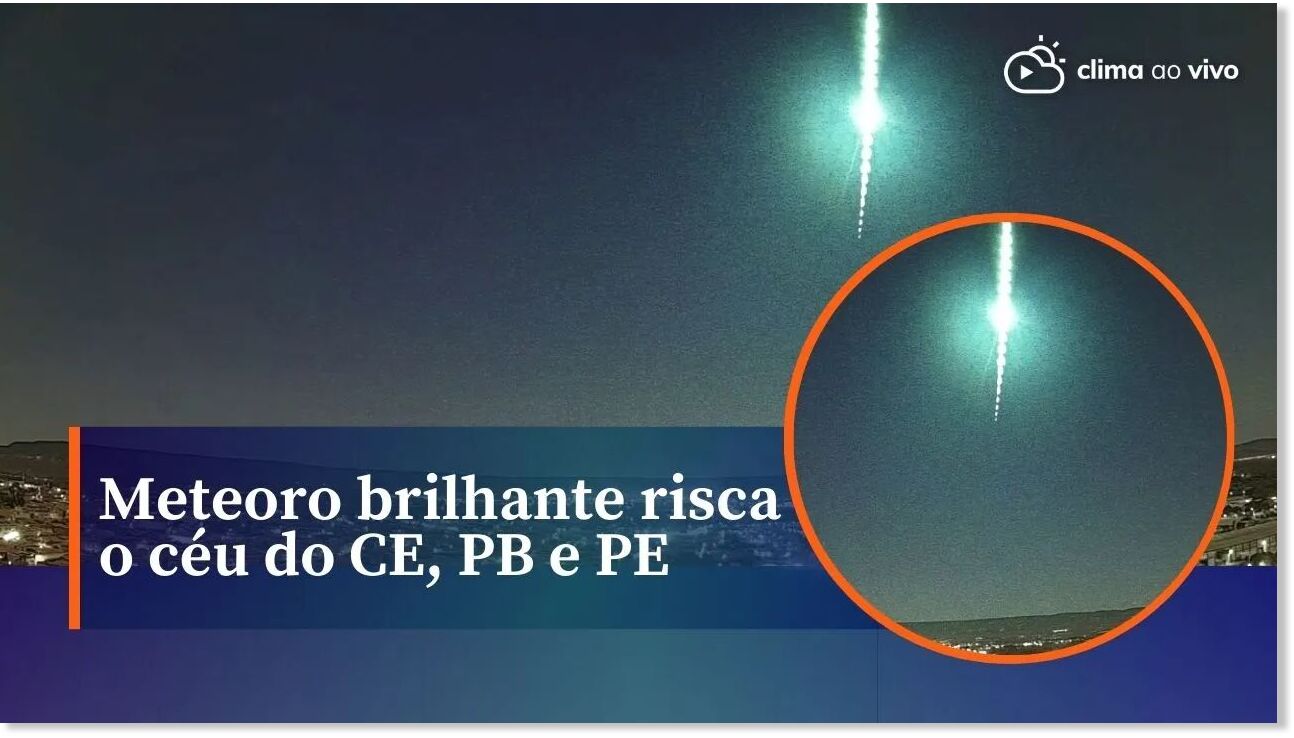
Clima ao Vivo cameras recorded a meteor that occurred during the night of this Thursday (11), which streaked across the sky of some cities in PE, PB and CE.


Fireball 5

Bright daylight meteor fireball over northeastern Brazil on September 9 registered as 0.44-kiloton airburst

Satellite image showing the daylight fireball flash over the Atlantic Ocean off the coast of Ceará, northeastern Brazil, on September 9, 2025.
© NOAASatellite image showing the daylight fireball flash over the Atlantic Ocean off the coast of Ceará, northeastern Brazil, on September 9, 2025.
A bright daylight fireball was recorded at 17:49 UTC (14:49 LT) on September 9, 2025, over the Atlantic Ocean, off the northeastern coast of Brazil. NASA's CNEOS data show the object released 0.44 kilotons of impact energy at an altitude of 24 km (15 miles). IMO and AMS received 10 reports from Ceará, with witnesses describing orange to blue colors, persistent trails, fragmentation, and sounds ranging from faint hissing to thunder-like booms.

The event is confirmed by instrumental detection, satellite imagery, and eyewitness accounts, consistent with a low-altitude bolide airburst visible in broad daylight across Ceará.

A bright daylight fireball was recorded at 17:49 UTC (14:49 local time) on September 9, over the Atlantic Ocean, off the coast of Ceará State, northeastern Brazil. The event was registered at coordinates 2.3°S, 39.5°W.

NASA's Center for Near-Earth Object Studies (CNEOS) measured the object at a peak altitude of 24 km (15 miles). Its velocity was calculated at 20.7 km/s (74 520 km/h or 46 300 mph). The total radiated energy was 1.53 x 10¹¹ J, corresponding to an impact energy of 0.44 kilotons TNT equivalent.

(More here)

Fireball 3

Meteor fireball over Illinois and 2 other states on September 9

mmmmmm
© Shutterstock/Triff
We received 6 reports about a fireball seen over IL, IN, KY and MO on Tuesday, September 9th 2025 around 04:45 UT.

For this event, we received 2 videos.


Fireball 3

Meteor fireball over Oklahoma and 4 other states on September 8

mmmmmm
© Shutterstock/Triff
We received 15 reports about a fireball seen over AR, KS, MO, OK and TX on Monday, September 8th 2025 around 02:01 UT.

For this event, we received 2 videos.